II · THE DISCOVERY · HISTORY OF SCIENCE
Gold
Gold has been worked for more than seven thousand years, yet the reasons it behaves as it does — its resistance to corrosion, its malleability — were understood only after chemistry became a science.
At a glance
- Chemical symbol
- Au, from Latin aurum
- Atomic number
- 79
- Known since
- roughly the 6th millennium BC
- Classification
- Chemical element, metallic material, precious metal
- Pure form
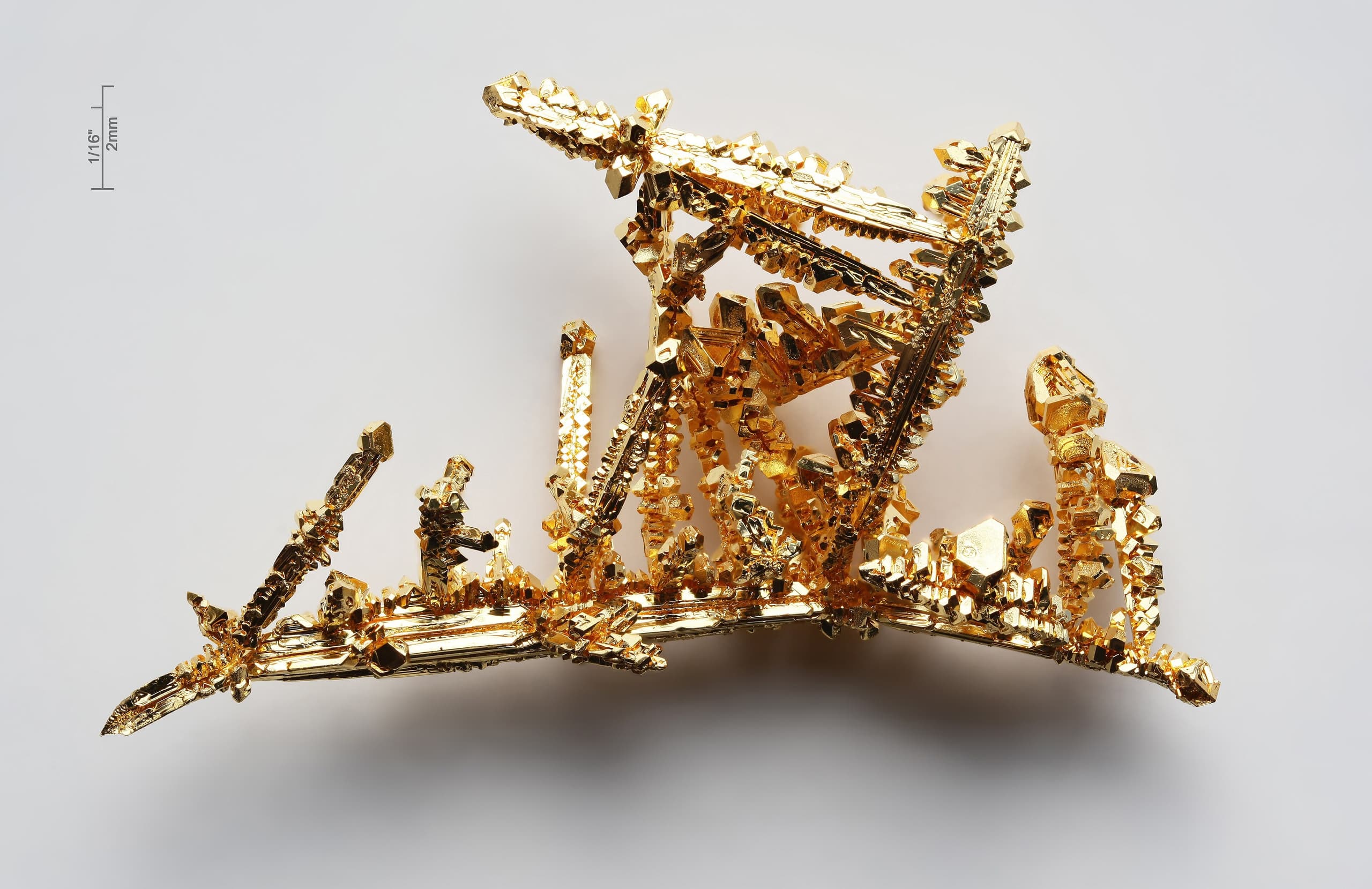
- Bright metallic yellow, dense, soft, malleable, ductile
Look closer
It dissolves in aqua regia but not in either acid alone
Gold resists most acids. It does not dissolve in nitric acid alone, which does dissolve silver and base metals — a property that gave rise to the term 'acid test', because it confirmed the presence of gold in a metallic substance. Gold does dissolve in aqua regia, a mixture of nitric acid and hydrochloric acid, forming a soluble compound called tetrachloroaurate anion. It also dissolves in alkaline solutions of cyanide, which are used in mining and electroplating.
It occurs as the free element, not locked in compounds
Gold often occurs as the free element — called its native state — as nuggets or grains in rocks, veins, and alluvial deposits. It occurs in a solid solution with native silver, as in electrum, and naturally alloyed with other metals such as copper, platinum, and palladium, as well as mineral inclusions such as within pyrite. Less commonly, it occurs in minerals as gold compounds, often with tellurium.
Its malleability and ductility are extreme
Gold is soft, malleable — meaning it can be hammered into thin sheets — and ductile, meaning it can be drawn into wire. These properties are extreme enough that gold can be worked into shapes and thicknesses that would break other metals. Combined with its resistance to corrosion, this made it workable with the tools available in antiquity and kept it bright without tarnishing.
The story
Gold is a chemical element with the symbol Au, from Latin aurum, and atomic number 79. In its pure form it is a bright metallic yellow, dense, soft, malleable, and ductile metal. Chemically it is a transition metal, a group 11 element, and one of the noble metals — a term that refers to its resistance to corrosion and oxidation. It is one of the least reactive chemical elements. Gold is solid under standard conditions.
Gold often occurs as the free element, meaning it is not locked inside a compound with other elements but appears as the metal itself. It is found as nuggets or grains in rocks, veins, and alluvial deposits — sediments carried by water. It also occurs in a solid solution with native silver, as in the alloy called electrum, and naturally alloyed with other metals such as copper, platinum, and palladium. Less commonly, it occurs in minerals as gold compounds, often with tellurium.
Gold resists most acids, though it does dissolve in aqua regia, a mixture of nitric acid and hydrochloric acid, forming a soluble compound called tetrachloroaurate anion. Gold is insoluble in nitric acid alone, which dissolves silver and base metals. This property was long used to refine gold and confirm its presence in metallic substances, giving rise to the term 'acid test'. Gold also dissolves in alkaline solutions of cyanide, which are used in mining and electroplating. Gold dissolves in mercury, forming amalgam alloys, though as the gold acts simply as a solute — a substance dissolved in another — this is not a chemical reaction.
As of 2020, a total of around 201,296 tonnes of gold exist above ground. The world's consumption of new gold produced is about 50 per cent in jewellery, 40 per cent in investments, and 10 per cent in industry. In 2023, the world's largest gold producer was China, followed by Russia and Australia.
Why it mattered then
Gold has been worked since roughly the sixth millennium BC. What made it precious in antiquity was not rarity alone but a set of properties that made it unlike other metals available at the time. It could be hammered into thin sheets and drawn into wire without breaking — its malleability and ductility — and it did not tarnish or corrode, so objects made from it stayed bright. It occurred as the free element, meaning it could be found as the metal itself rather than locked inside an ore that required smelting. This made it workable with the tools available before the development of high-temperature furnaces. Gold was used for coinage, jewellery, and other works of art throughout recorded history. In the past, a gold standard was often implemented as a monetary policy — meaning a currency's value was tied to a fixed quantity of gold. Most gold coins ceased to be minted as a circulating currency in the 1930s, and the world gold standard was abandoned for a fiat currency system — one not backed by a physical commodity — after the Nixon shock measures of 1971.
Why it matters now
Gold's high malleability, ductility, resistance to corrosion and most other chemical reactions, as well as its conductivity of electricity, have led to its continued use in corrosion-resistant electrical connectors in all types of computerised devices. This is its chief industrial use. Gold is also used in infrared shielding, the production of coloured glass, gold leafing, and tooth restoration. A gold-containing drug called auranofin is used to treat rheumatoid arthritis. The world's consumption of new gold produced is about 50 per cent in jewellery, 40 per cent in investments, and 10 per cent in industry. As of 2020, a total of around 201,296 tonnes of gold exist above ground. If all of this gold were put together into a cube shape, each of its sides would measure 21.7 metres.
The surprising detail
Gold dissolves in mercury, forming amalgam alloys. This is not a chemical reaction — the gold acts simply as a solute, a substance dissolved in another, the way salt dissolves in water. The amalgam can be heated to drive off the mercury, leaving the gold behind. This property was used historically to extract gold from ore and to refine it, though the process released mercury vapour, which is toxic.
What is disputed
The date precision given is 'millennium', meaning the discovery date is known only to within roughly a thousand years. The sixth millennium BC spans from approximately 6000 BC to 5001 BC, but no more precise date is recorded.
Remember this
Gold resists corrosion, occurs as the free element, and can be worked without breaking — properties that made it precious before anyone knew why.
Test yourself
Gold does not dissolve in nitric acid alone, but does dissolve in aqua regia, a mixture of nitric acid and hydrochloric acid. Why was this property useful before modern chemistry?
The fact that gold did not dissolve in nitric acid alone, while silver and base metals did, meant you could test whether a metallic substance contained gold by applying nitric acid to it. If it dissolved, it was not gold. If it did not, it might be. This gave rise to the term 'acid test'. The property was used both to refine gold — by dissolving away other metals — and to confirm its presence in an alloy or a suspect object.
Go deeper
Image: Alchemist-hp ( talk ) www.pse-mendelejew.de, CC BY-SA 3.0 de. Licence: CC BY-SA 3.0 de. Source.