IV · THE GAME · MAJOR LEAGUE BASEBALL
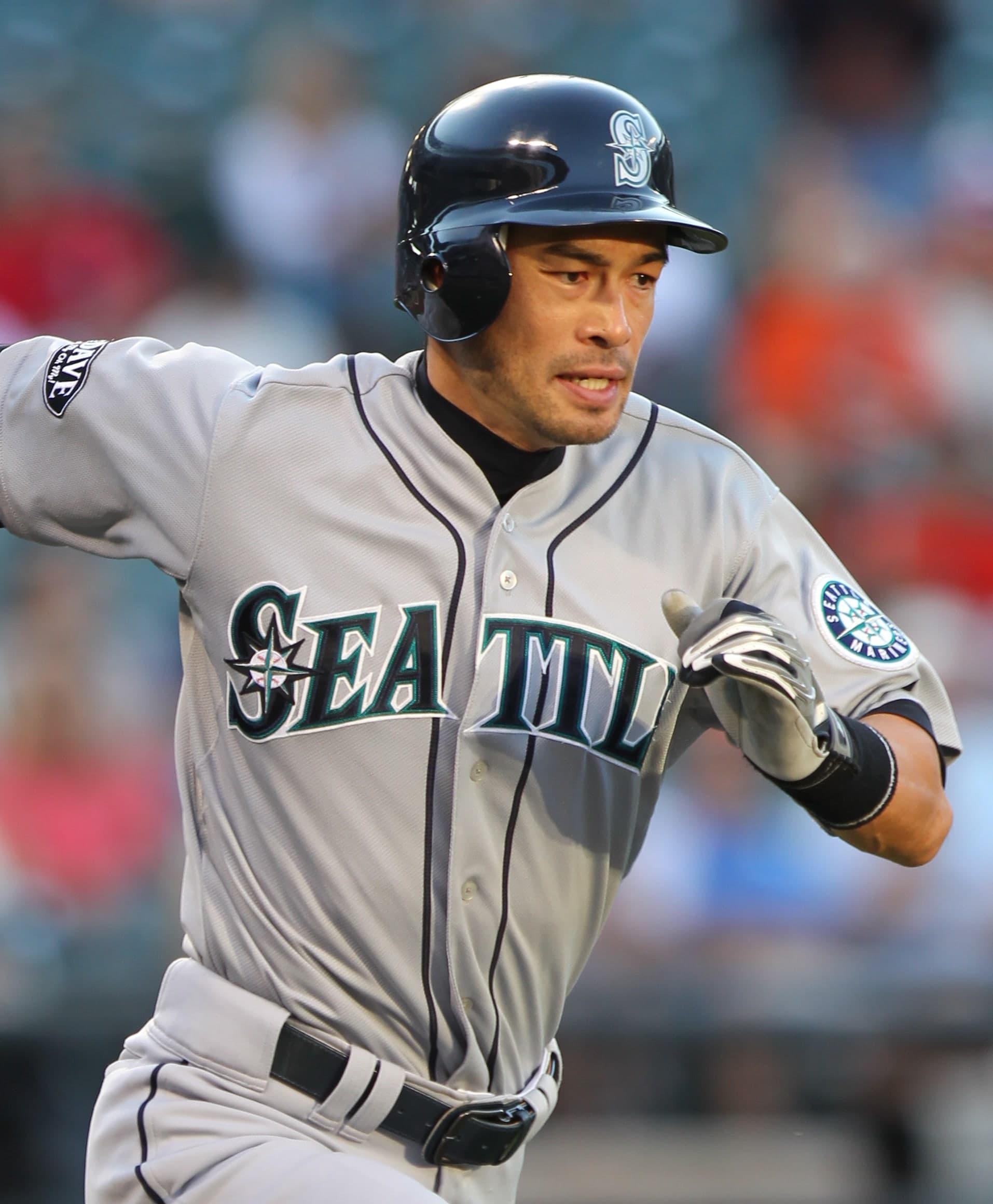
Ichiro Suzuki
Most batting careers have a peak and a decline. This one had a long plateau instead — ten consecutive seasons above 200 hits, and the drop-off didn't arrive until year fifteen.
At a glance
- Career
- 2,653 games · 3,089 hits · 117 home runs · .311 average · .757 OPS
- Debut
- 2 April 2001, aged 27, at Safeco Field, Seattle
- Last game
- 21 March 2019, for the Seattle Mariners
- Build
- 5' 11" · 175 lb · bats left · throws right
Look closer
The debut was a one-run win decided in the seventh
On 2 April 2001 Seattle and Oakland were tied 1–1 after five innings. Oakland scored three in the fourth to lead 4–1, but Seattle answered with one in the fourth, one in the fifth, two in the seventh and one in the eighth. The final was 5–4, Seattle never had to bat in the ninth, and the whole thing took three hours and twenty-three minutes in front of 45,911 people. Seattle made seven hits to Oakland's eight, but Oakland made two errors to Seattle's none, and a one-run margin is exactly the size of that gap.
Ten consecutive seasons above 200 hits
From 2001 through 2010, the hits column never dropped below 206. The highest total was 262 in 2004, the lowest in that span was 206 in 2005. The first time the total fell below 200 was 2011, when it landed at 184 — still more hits than many everyday players manage, but a clear step down from the decade before. That stretch is what the career total is built on: consistency at a high level, not a handful of extraordinary seasons.
The stolen base totals fell in parallel with the batting average
In 2001 he stole 56 bases and hit .350. In 2010 he stole 42 and hit .315. In 2011, when the average dropped to .272, the stolen bases dropped to 40. By 2015, when the average was .229, the stolen bases were down to 11. Speed and contact are not the same skill, but they tend to decline together — a step lost in the sprint to first is often a step lost in the jump toward second as well.
The story
On 2 April 2001, at Safeco Field in Seattle, the Mariners beat the Oakland Athletics 5–4 in a game that took three hours and twenty-three minutes. Oakland led 4–1 after four innings, but Seattle scored once in the fourth, once in the fifth, twice in the seventh and once in the eighth. The home side never had to bat in the ninth, which is why that half-inning shows a dash rather than a nought. Oakland made eight hits to Seattle's seven, but also made two errors to Seattle's none, and a one-run margin is exactly the size of that gap.
The player making his debut that night was twenty-seven years old, which is older than the typical first-year major leaguer. He had spent time playing in Japan before crossing the Pacific, so the debut was not the start of a professional career but the start of its second act.
The second act lasted nineteen seasons and produced 3,089 hits, 509 stolen bases, and a .311 batting average across 2,653 games. The career total is the sum of many ordinary seasons rather than a few extraordinary ones, which is a harder shape to picture but a more reliable one to build.
The first seasons, all with Seattle, look nearly identical in the hits column: 242, 208, 212, 262, 206, 224, 238, 213, 225, 214. The lowest of those totals is 206, the highest is 262, and the gap between them is only 56 hits. That is not a peak and a decline, it is a plateau.
The stolen base totals followed a similar pattern but with a clearer downward slope. He stole 56 bases in 2001, 45 in 2006, 43 in 2008, 42 in 2010. By 2011 the total was 40, by 2015 it was 11, by 2017 it was 1. Speed and contact are not the same skill, but they tend to decline together — a step lost in the sprint to first is often a step lost in the jump toward second as well.
The batting average held steady longer than the stolen bases did. It was .350 in 2001, .351 in 2007, .352 in 2009, .315 in 2010. The first time it dropped below .300 was 2011, when it landed at .272. The following season, split between Seattle and New York, it was .283 overall — .261 in Seattle, .322 in New York. The New York stretch suggests the decline was not yet complete, but the 2013 average was .262, the 2015 average was .229, and the pattern was clear.
He played for three clubs across the nineteen seasons: Seattle for parts of twelve seasons, New York for two and a half, Miami for three and a half. The final two seasons were ceremonial — fifteen games in 2018, two games in 2019, both with Seattle. The last game was on 21 March 2019.
The career total of 3,089 hits divides into 2,533 singles, 362 doubles, 96 triples, and 117 home runs. The singles are 82 per cent of the total. The home run total is low for a nineteen-season career — fewer than seven per season on average — but the contact rate was high and the strikeout total was correspondingly low. He struck out 1,080 times in 9,934 at-bats, which is once every nine trips to the plate.
The OPS — on-base percentage plus slugging percentage, a combined measure of how often a batter reaches base and how much damage he does when he does — was .757 for the career. That is above average but not extraordinary. The batting average of .311 is easier to picture and easier to remember, but it counts a single and a home run as equal events, which they are not. The OPS weights them properly, and the result is a more honest summary: a very good hitter for a very long time, not an extraordinary hitter for any particular stretch of it.
The shape of the career is the opposite of the shape that draws attention. It has no peak year, no season that stands apart from the others, no total that demands to be circled in red. The highest hit total is 262, the highest batting average is .372, and both belong to 2004, but even that season is only slightly higher than the seasons on either side of it. What the career has instead is length and consistency, which are harder to dramatise but easier to sustain.
Why it mattered then
In 2001, when he made his debut, he was not an unknown quantity — he had been playing professionally in Japan and the question of whether that success would transfer to the major leagues was open. The answer arrived quickly. He hit .350 in his first season, made 242 hits, and stole 56 bases. The stretch that followed, from 2001 through 2010, produced at least 206 hits every season. The debut season was not an outlier, it was the start of a pattern, and the pattern held. By the time it began to break down, in 2011, the career total was already above 2,200 hits and the question of whether the success would transfer had long since been answered.
Why it matters now
The career ended in 2019, which is recent enough that the totals are still being compared to active players and recent enough that the footage is still in high resolution. The 3,089 hits are the sum of nineteen seasons, and the consistency across the first seasons — never fewer than 206 hits in any season from 2001 through 2010, never a batting average below .303 in that span — is the rarest part of the total. Peaks are common, plateaus are not. The career is also a reminder that a debut at twenty-seven is not too late, and that time spent in another league is not wasted time. The total is high because the career was long, and the career was long because it started with a foundation that had already been built elsewhere.
The surprising detail
He bats left-handed but throws right-handed, which is the opposite of the usual combination. A left-handed thrower in the outfield has an easier angle to third base and home plate. A right-handed thrower batting left loses that advantage, but gains a shorter sprint to first base — three steps closer than a right-handed batter, which matters when the margin between safe and out is often a single step. The stolen base totals suggest the sprint to first was quick enough to make the trade worth it: 56 steals in the debut season, 509 across the career, and a success rate high enough that he kept running into his late thirties.
What is disputed
Every figure here comes from the MLB Stats API. Statistical categories were not all recorded consistently across the nineteen seasons covered, and the totals are the ones the league publishes today rather than anything independently recomputed here. The debut age is calculated from the birthdate and debut date supplied by Wikidata; no official age at debut is recorded in the API itself.
Remember this
3,089 hits across nineteen seasons, with consecutive seasons above 200 hits from 2001 through 2010: the career is a plateau, not a peak.
Test yourself
The debut game was decided by a single run, and Oakland made more hits than Seattle did. Using only the linescore, what explains Seattle's win?
Errors and timing. Oakland made two errors to Seattle's none, and a one-run margin is exactly the size of that gap. The runs also arrived in different shapes: Oakland scored all four of its runs in a single inning, the fourth, while Seattle spread its five runs across four different innings — one in the fourth, one in the fifth, two in the seventh, one in the eighth. Equal hits do not mean equal innings — clustered hits score, scattered hits can strand runners, but in this case the scattered hits were enough. Note too that Seattle never batted in the ninth, which is why that half-inning shows a dash: the home side does not bat when it is already ahead.
Go deeper
- Ichiro Suzuki — MLB Stats API player record · MLB Advanced Media
- Ichiro Suzuki — career hitting totals (MLB Stats API) · MLB Advanced Media
- Debut game linescore — MLB Stats API game 6818 · MLB Advanced Media
- Ichiro Suzuki — Wikidata · Wikidata
Image: Keith Allison, CC BY-SA 2.0. Licence: CC BY-SA 2.0. Source.