III · THE WORK · ART HISTORY
Woman Holding a Balance
▶ Listen · narrated
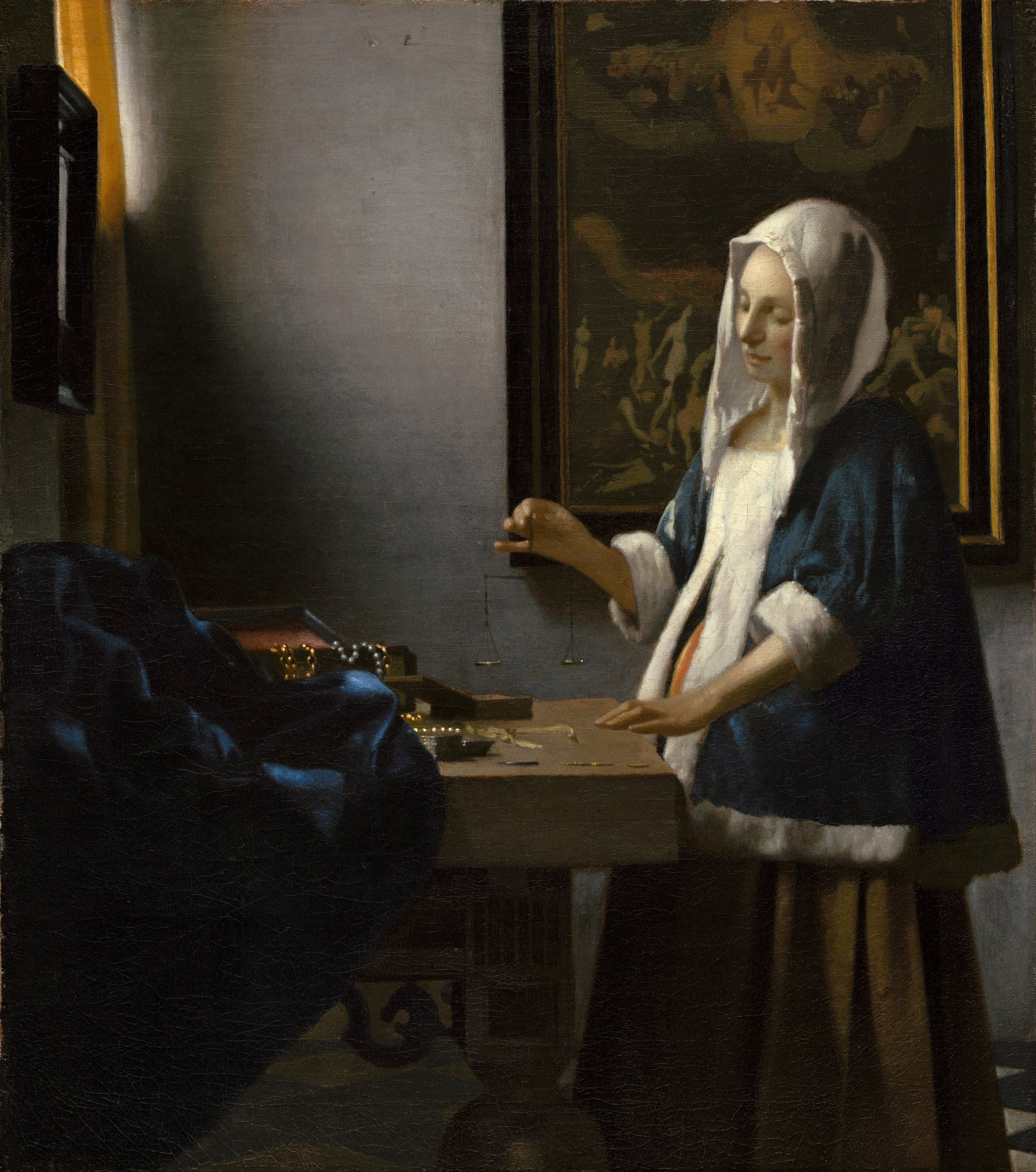
Vermeer’s small canvas of 1665 turns on an instrument that is empty. What the woman measures, and what the scene is for, remains a matter of genuine disagreement.
At a glance
- Artist
- Johannes Vermeer
- Date
- 1665
- Medium
- Oil on canvas
- Dimensions
- 42.5 × 38 cm (1 ft 3 in)
- Genre
- Genre art
- Collection
- Widener Collection
Look closer
The empty balance
The instrument in the woman’s hand is a balance, held level as if a weighing were under way. Closer evaluation has established that the pans are empty. The painting was once known as Woman Weighing Gold; that title no longer fits what can be seen. The action is one of testing or steadying the scales themselves, not of measuring a visible load. Everything the picture invites us to think about value turns on an absence at its centre.
A small field of attention
The canvas is only 42.5 centimetres (1 ft 5 in) high and 38 centimetres (1 ft 3 in) wide. Genre painting of the Dutch Golden Age often worked at this intimate scale, asking the viewer to come close and stay. Vermeer uses that nearness: the figure, the balance and the quiet of the room are given almost no spare space. The modest size is not a limitation so much as a decision about how looking should feel.
Holiness or earthliness
Opinions on the theme and symbolism differ. The woman has been read as a figure of spiritual judgment and, alternatively, as a figure of worldly concern. The empty balance supports both habits of reading and settles neither. The painting does not label its own meaning; it leaves the instrument poised and the interpretation open.
The story
Woman Holding a Balance is an oil painting on canvas by Johannes Vermeer, dated to 1665. It belongs to the current of Dutch Golden Age painting and is classed as genre art: a scene of everyday life rather than a named historical or sacred episode. The work measures 42.5 by 38 centimetres (1 ft 3 in) and is associated with the Widener Collection; its recorded location is Lynnewood Hall. Its inventory number is 1942.9.97.
At the centre of the composition a woman holds a balance. For a long time the picture was known as Woman Weighing Gold, a title that told viewers what they were meant to see before they had quite looked. Closer evaluation changed that. The balance in her hand is empty. She is not caught in the act of weighing coins or jewellery that the eye can verify; she is holding the instrument level, as if testing it, or waiting. The Dutch title Vrouw met weegschaal — woman with a balance — and the alternative English name Woman Testing a Balance both stay closer to what is actually visible.
That correction is small in physical terms and large in effect. An empty balance is not a neutral prop. It is a device associated with measurement, fairness and judgment, yet here it carries no load. The painting therefore withholds the one piece of information that would make the action simple to name. We see the gesture of weighing without seeing the thing weighed.
Vermeer’s handling keeps the drama low. This is not a crowded moral allegory spelled out with many figures. It is a single figure in an interior, given the time and space of a small canvas. Genre painting in this period often used ordinary rooms and quiet tasks as a way to hold attention; Vermeer’s contribution is the particular stillness of the pose and the precision with which the empty instrument is shown. Nothing in the verified account of the work requires us to treat the scene as either purely domestic or purely symbolic. The picture sits between those readings.
Scholars and viewers have not agreed on the theme. The woman has been understood as a symbol of holiness and, with equal seriousness, as a symbol of earthliness. One tradition finds in the poised scales an image of spiritual discernment; another finds a moment of worldly appraisal, even vanity, interrupted or suspended. The empty pans do not decide the question. They are what make the question lasting. Because the balance holds nothing, the painting can be asked to mean more than one kind of value at once.
The work’s materials are straightforward — oil paint on canvas — and its date places it in the middle of Vermeer’s known activity. What is less straightforward is the confidence with which any single meaning can be attached to it. The history of the title is itself a lesson in looking: a name that once seemed obvious had to be retired when the central object was examined more carefully. The painting that remains is quieter than Woman Weighing Gold ever was, and harder to finish explaining.
Why it mattered then
In the Dutch Golden Age, genre painting offered buyers and viewers scenes that looked like private life — a room, a task, a single figure — without always declaring a fixed moral. A woman with a balance fitted that taste: familiar enough to recognise, spare enough to invite thought. Instruments of weighing carried associations with trade, fairness and judgment in a culture deeply engaged with commerce and with religious ideas of reckoning. Whether Vermeer’s first audience saw holiness, worldliness or something suspended between them is not settled by the surviving evidence. What can be said is that a small oil of this kind belonged to a market and a habit of looking in which ordinary gestures were expected to bear scrutiny, and in which an empty scale could be more eloquent than a full one.
Why it matters now
The painting still matters because it shows how little is required to unsettle a meaning. Change one observation — the pans are empty — and the title, the subject and the moral tone all shift. That is a useful pressure on anyone who reads images quickly. The unresolved choice between holiness and earthliness is not a failure of the picture; it is part of how the picture works. In a moment that often wants artworks to deliver a single clear message, Woman Holding a Balance keeps the instrument level and declines to tip it. The small size still asks for close attention, and the empty balance still refuses to tell us exactly what is being measured.
The surprising detail
The painting’s older title, Woman Weighing Gold, did not survive contact with the object it claimed to describe. Once it was established that the balance is empty, the name had to give way. A whole subject — the weighing of gold — turned out to be an assumption read into the gesture rather than something present in the paint. Few corrections in the life of a picture are so simple or so complete.
What is disputed
Opinions on the theme and symbolism differ: the woman is alternatively viewed as a symbol of holiness or of earthliness, and the evidence does not settle which reading, if either, should dominate. The inception is given here as 1665 following the verified record; other accounts have placed the work slightly earlier. The balance’s emptiness is a point established by closer evaluation and should be stated as such, not as a long-obvious fact.
Remember this
The balance is empty: the painting stages the act of weighing without showing what, if anything, is being weighed.
Test yourself
Why does the discovery that the balance is empty change more than the painting’s title?
Because the older title, Woman Weighing Gold, supplied a subject the eye cannot verify. An empty balance removes the load that would make the action plain and leaves the gesture open. That openness is what allows the woman to be read as a figure of holiness or of earthliness; both interpretations depend on a scale that measures something the painting does not depict. The correction is not only factual but structural: it turns a scene of known commerce into a scene of suspended judgment.
Go deeper
Image: Johannes Vermeer, Public domain. Licence: Public domain. Source.