I · THE OBJECT · BRITISH MUSEUM
Yaxchilán Lintel 24
▶ Listen · narrated
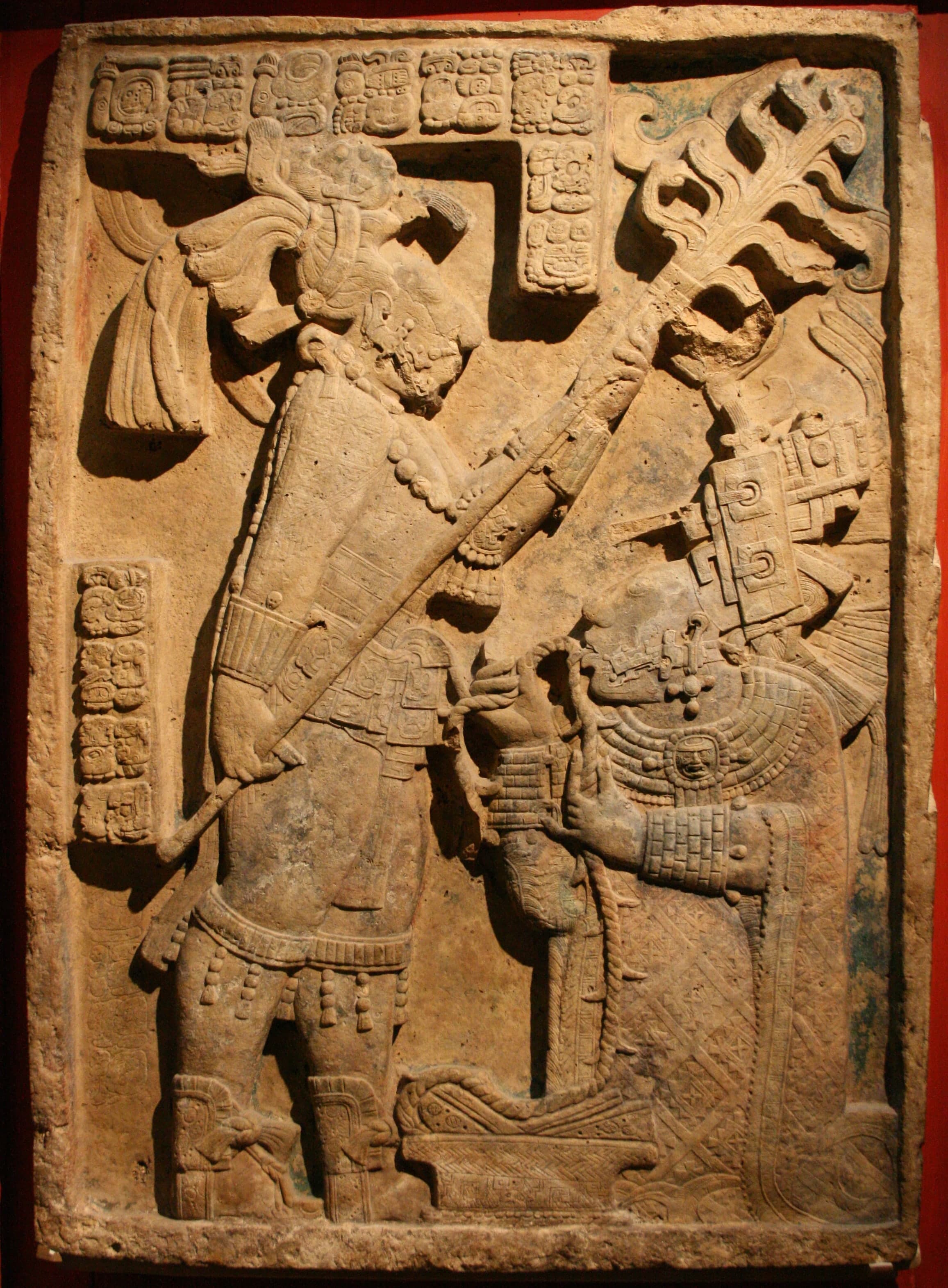
This limestone panel shows a moment of deliberate pain: a Maya queen performing bloodletting in front of witnesses, with the date and the sculptor's name carved beside her.
At a glance
- Date
- About 723–726 AD
- Material
- Limestone
- Site
- Yaxchilan, modern Chiapas, Mexico
- Collection
- British Museum, London
Look closer
The thorned rope
Lady K'abal Xook is shown drawing a rope through her tongue. The rope is studded with thorns. Blood would have run from the wounds, collected in bark paper placed in a bowl below, then burned as an offering. The carving shows her in the act itself, not preparing for it or recovering from it. Her husband, the ruler Itzamnaaj Bahlam III, holds a torch above her. His presence makes the ritual a witnessed, public event, not a private devotion.
Readable text and a signature
The imagery is accompanied by captions in Maya script. These identify the figures by name and record a date. The text also includes something uncommon in Maya monumental carving: a signature. The sculptor gives his name as Mo' Chaak. Most Maya stone inscriptions do not name the person who cut them, so the presence of this signature marks the panel as unusual, though how unusual is hard to say without a full tally of surviving monuments.
A lintel, not a stela
This is Lintel 24, a designation given by archaeologists. A lintel is a horizontal beam placed over a doorway. This limestone relief would have been set above an entrance, so anyone passing through would have walked beneath the scene. The placement was not incidental: the ritual it depicts was tied to the legitimacy and authority of the figures shown, and the doorway would have led into a space where that authority was exercised or displayed.
The story
The carving shows two people. On the right, kneeling, is Lady K'abal Xook. She is drawing a rope through her tongue. The rope is studded with thorns, and the act is deliberate: this is bloodletting, a ritual practice in Maya religion and statecraft. Blood, once drawn, was collected on bark paper and burned. The smoke carried prayers or petitions upward.
Standing to the left is her husband, Itzamnaaj Bahlam III, a ruler of Yaxchilan. He holds a flaming torch above her. His presence turns the act into a public ceremony, not a private rite. Bloodletting was performed by Maya rulers and their families, and it was understood as a way to communicate with ancestors and gods, to mark important dates, or to seek favor before military campaigns or political decisions.
The panel is carved in mid-relief, meaning the figures project partway out from the background stone but are not freestanding. The limestone surface is covered with text in Maya script. The glyphs identify the two figures by name and title, and they record a date. Maya inscriptions often give dates in a calendrical system that counts days from a fixed starting point, allowing events to be placed in a continuous timeline.
What makes this lintel unusual among Maya monuments is the presence of a signature. The sculptor names himself as Mo' Chaak. Most Maya stone carvings do not credit the person who made them, so the inclusion of a name here is notable. Whether this reflects the sculptor's status, the patron's choice, or a local tradition at Yaxchilan is not recorded.
The panel was set above a doorway. Anyone entering the building would have passed beneath it. The placement was meaningful: the ritual shown was tied to royal authority, and the doorway likely led into a space where that authority was enacted — a council room, a throne room, or a ceremonial chamber. The lintel was not decoration. It was a statement about who held power and how that power was maintained.
Why it mattered then
Bloodletting was a political act as much as a religious one. Maya rulers performed it to demonstrate their willingness to endure pain, to show their direct relationship with the divine, and to mark moments of transition or crisis. Lady K'abal Xook's participation was significant. Royal women in Maya society were not passive figures. They performed rituals, commissioned monuments, and appeared in inscriptions as actors in their own right. The carving also served as a record. The date and the names meant that anyone literate in Maya script could read when this ceremony took place and who performed it. That readability mattered. Legitimacy in Maya politics was tied to lineage, to the proper performance of ritual, and to the public display of both. A monument like this was evidence: it showed that the rituals had been carried out, that the ruler and his consort had fulfilled their obligations, and that their authority was grounded in both human action and divine sanction. The lintel was placed over a doorway, so it was seen repeatedly by anyone entering the building. Repetition reinforced the message. The ritual was not a single event but an ongoing claim.
Why it matters now
This panel is one of the clearest surviving depictions of Maya bloodletting, and it is one of the few that names the people involved and records the date. That specificity makes it valuable evidence for understanding how Maya rulers used ritual to assert and maintain power. It is also a demonstration of what Maya script could do. The text is not decorative. It is functional: it names, it dates, it signs. The decipherment of Maya writing, which began in earnest in the second half of the twentieth century, turned monuments like this from images into documents. The glyphs can now be read, and that readability has changed what historians know about Maya politics, religion, and daily life. The panel is in the British Museum. It was removed from Yaxchilan in the nineteenth century, and questions about its removal and ownership are part of ongoing discussions about the repatriation of cultural objects. The Mexican government has requested the return of several Maya monuments held in foreign collections, and Lintel 24 is among them.
The surprising detail
The sculptor signed his work. His name, Mo' Chaak, is carved into the stone alongside the images and the text. Most Maya monumental inscriptions do not include the name of the person who carved them, so this signature is uncommon. What it tells us about Mo' Chaak — whether he was a specialist attached to the royal household, a hired craftsman, or someone with enough status to demand recognition — is not recorded. The signature remains, but the circumstances that led to its inclusion are not explained in the surviving evidence.
How it got here
The lintel was removed from Yaxchilan in the nineteenth century and acquired by the British Museum. The Mexican government has requested the return of several Maya monuments held in foreign collections, including Lintel 24. The British Museum's position is that the objects in its collection are held in trust for the world and that their location in London allows them to be seen in a global context. Discussions about the repatriation of cultural property are ongoing.
Remember this
A queen performing bloodletting in front of her husband, with the date, the names, and the sculptor's signature all carved into the stone.
Test yourself
Why would the placement of this lintel above a doorway have reinforced its message more effectively than placing it on a wall or a stela in a plaza?
Because anyone entering the building had to pass directly beneath it, repeatedly. A stela in a plaza can be avoided or ignored; a doorway cannot, if you need to enter the space beyond it. The repetition mattered. Each passage reinforced the message that the ritual had been performed, that the ruler and his consort had fulfilled their obligations, and that their authority was grounded in both human action and divine sanction. The lintel was not just a record of a single event but an ongoing claim, restated every time someone walked through the door.
Go deeper
Image: CC BY-SA 3.0. Licence: CC BY-SA 3.0. Source.