III · THE WORK · ART HISTORY
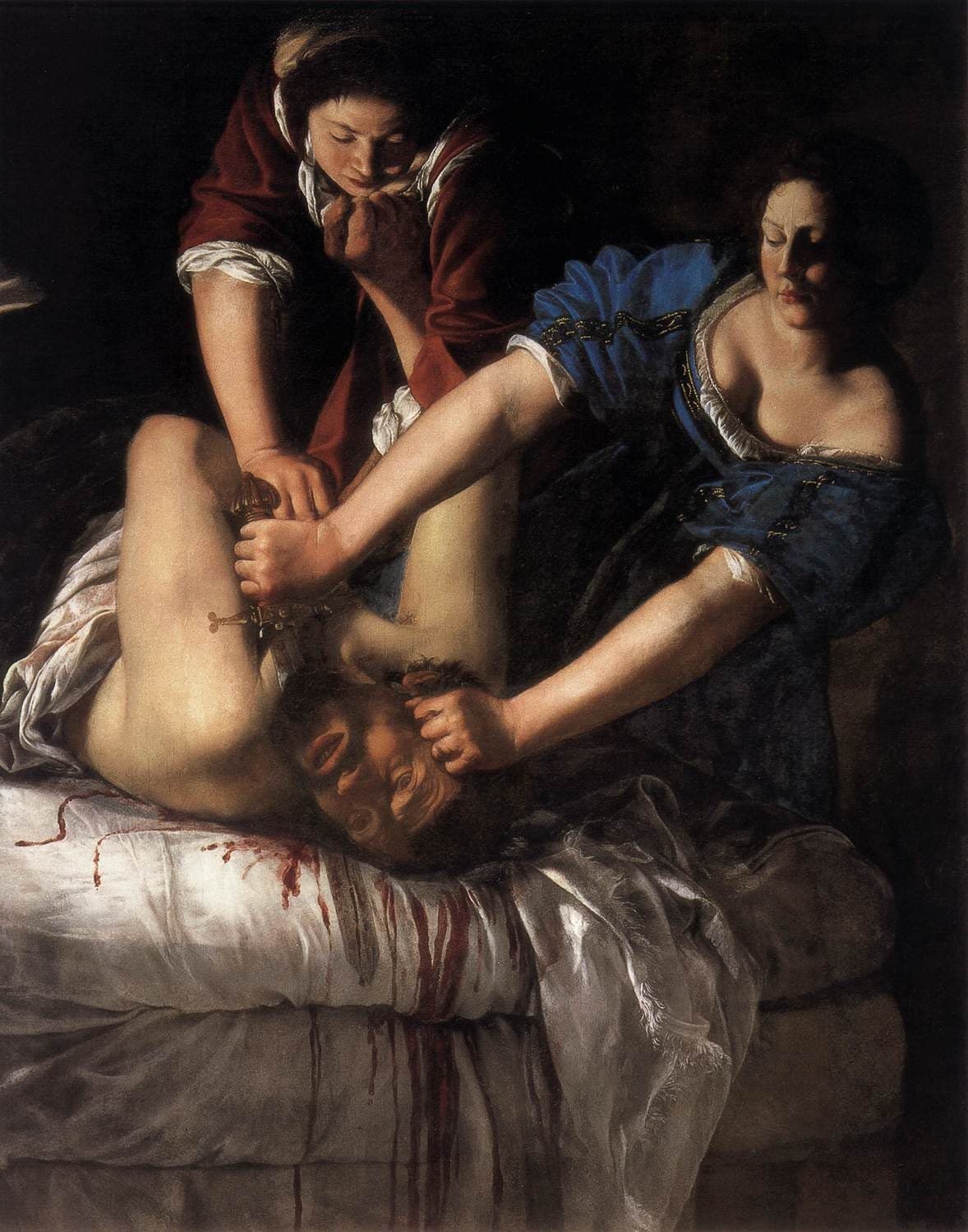
Artemisia Gentileschi's Judith Slaying Holofernes
▶ Listen · narrated
Two women sawing through a neck is not the same composition as two women recoiling from blood. Gentileschi painted the mechanics of the act Caravaggio treated as spectacle.
At a glance
- Artist
- Artemisia Gentileschi
- Subject
- Judith beheading Holofernes, from the Book of Judith
- Medium
- Oil on canvas
Look closer
Both women bracing with their full weight
Judith leans in from the left, arms locked, pressing the sword down and across. Her maidservant Abra does not stand back or avert her eyes: she is bent over Holofernes from the other side, hands pinning his head and shoulders to the bed. Both women are using their body weight. The composition is built around applied force — the diagonal of Judith's arms, the counterpressure of Abra's grip, the resistance of a man trying to rise. This is not a gesture suspended in air. It is work in progress.
Blood arcing in observed trajectories
Blood spurts from the wound in two distinct streams, following the paths that severed arteries would produce. One arc travels upward and to the right, crossing Judith's forearm. The other shoots more horizontally across the bed. The blood is not decorative or symbolic. It moves as liquid under pressure moves, in lines determined by the angle of the cut and the force behind it. Gentileschi has painted blood as a physical consequence of the action, not as a sign that violence has occurred.
The maidservant pinning him down, not fleeing
Abra is not a bystander. She is holding Holofernes by the hair and shoulder, her arms taut, her face concentrated. In Caravaggio's version of the same subject, the maidservant stands to one side, an old woman waiting with a sack. Gentileschi has made her a participant in the mechanics of the act. Without her grip, Holofernes would be able to twist away or throw Judith off balance. The painting makes clear that the beheading requires two people working together.
The story
The subject comes from the deuterocanonical Book of Judith. Judith, a widow from the besieged town of Bethulia, enters the camp of the Assyrian general Holofernes, gains his confidence, waits until he is drunk, and cuts off his head. She and her maidservant Abra carry it back to Bethulia in a sack. The Assyrian army, leaderless, retreats. The story was painted repeatedly in the sixteenth and seventeenth centuries, almost always with Judith as the central figure and the act of beheading as the moment chosen.
Artemisia Gentileschi painted at least two versions of the subject. The evidence for dating and provenance varies between them, and the historical record does not settle which was painted first or where each was made. What the paintings share is a particular reading of the mechanics of the act. Judith is not poised above Holofernes with the sword raised, nor standing back with the severed head. She is midway through the cut, leaning into the blade, her face set in concentration. Abra is not watching from a distance. She is bent over the bed, holding Holofernes down with both hands. He is awake and struggling, his mouth open, one arm reaching upward.
The comparison most often made is with Caravaggio's Judith Beheading Holofernes, painted earlier. Caravaggio placed Judith at arm's length from the body, her face turned away in revulsion, the sword held at an angle that suggests a single stroke. The maidservant is an old woman standing to the side, holding a cloth. Blood runs down the sheet, but the action is frozen at a moment of recoil. Gentileschi's composition is different in almost every particular. Judith is close to Holofernes, her body angled across his, her arms locked in a sawing motion. Abra is young and strong, her hands gripping his head and shoulder. The blood spurts in two trajectories, following the pressure of the cut. The painting describes force applied over time, not a single instant of horror.
The difference is not only in the composition but in what the painting takes as its subject. Caravaggio painted the emotional response to violence. Gentileschi painted the physical work required to sever a neck with a sword. The blade is halfway through. The act is not complete. The viewer is placed at the moment when the outcome is not yet settled, when the success of the attempt depends on sustained effort from both women. That sustained effort is what the painting is about.
Why it mattered then
The Book of Judith was read as a story of political deliverance and female courage. Judith was a widow acting without male authority, using deception and violence to save her city. The story was painted in contexts where those themes had immediate resonance — in cities under siege, in commissions celebrating military victories, in works made for patrons who saw themselves as defenders of the faith. A painting of Judith was not only a biblical subject. It was a claim about the legitimacy of violence in defence of a community, and about the kinds of people who could be trusted to use it. Gentileschi's version makes Judith and Abra collaborators in the act, not a heroine and her servant. The maidservant is not old or passive. She is strong enough to hold a man down and composed enough to do it without hesitation. The painting distributes the agency of the act across both figures. That is a reading of the story, not an illustration of it. It makes the beheading a matter of coordination and physical capability, not of divine intervention or singular heroism.
Why it matters now
The painting is now discussed in relation to Gentileschi's biography, particularly a rape trial that followed her assault by another painter. The trial record survives, and it documents both the assault and the judicial torture Gentileschi was subjected to in order to verify her testimony. The violence of the trial and the violence of the painting are often read together, and the intensity of the Judith images is interpreted as a response to that experience. That reading is not settled. Some scholars argue that linking the paintings too directly to the trial reduces them to autobiography and ignores their place in a wider tradition of Judith images. Others point out that the trial was a public event, that Gentileschi continued to paint violent subjects throughout her career, and that the paintings themselves invite the comparison by their insistence on physical detail. The debate is not about whether the biography is relevant, but about how much explanatory weight it should carry. What is not disputed is that the painting describes the act differently from the versions painted by men. It does not treat the beheading as a spectacle or a moment of recoil. It treats it as work that requires leverage, coordination and sustained effort. That difference is visible in the composition, in the positions of the bodies, in the way the blood moves. Whether or not the painting is autobiographical, it is observant. It describes what the act would require, and it does not look away.
The surprising detail
Caravaggio's Judith Beheading Holofernes shows Judith at arm's length from Holofernes, her face turned away, the sword held delicately. Gentileschi's version shows Judith leaning over him, arms braced, the blade halfway through the neck. The difference is not only compositional. It is a difference in what the painting takes as the subject: Caravaggio painted the horror of the act, Gentileschi painted the mechanics of it. One is about the observer's response. The other is about the work required to accomplish the thing being observed.
What is disputed
Gentileschi painted at least two versions of Judith Slaying Holofernes. The dating and provenance of each version are not fully settled in the historical record, and it is not certain which was painted first or where. The biographical reading that links the intensity of the paintings to Gentileschi's experience of sexual assault and the subsequent trial is widely discussed but remains debated among scholars. Some argue the connection is direct and explanatory; others caution against reducing the work to autobiography. Both positions are represented in the scholarship, and neither has displaced the other.
Remember this
Gentileschi painted Judith and her maidservant as two people applying real force to a difficult task, not as a heroine and a witness.
Test yourself
Why does the position of the maidservant in Gentileschi's painting change the meaning of the act, compared to versions where she stands aside?
Because it makes the beheading a coordinated action rather than a singular heroic gesture. If the maidservant is standing back with a sack, Judith is acting alone and the painting is about her courage or her horror. If the maidservant is holding Holofernes down with both hands, the act requires two people working together, and the painting is about the physical reality of what they are doing. It shifts the subject from individual heroism to collaborative effort, and from the emotional response to violence to the mechanics of accomplishing it. That shift is visible in every part of the composition: the angles of the bodies, the distribution of force, the fact that without Abra's grip Holofernes would be able to resist. The painting describes an act that cannot be done alone, and that changes what the story means.
Go deeper
Image: Artemisia Gentileschi, Public domain. Licence: Public domain. Source.