I · THE OBJECT · BRITISH MUSEUM
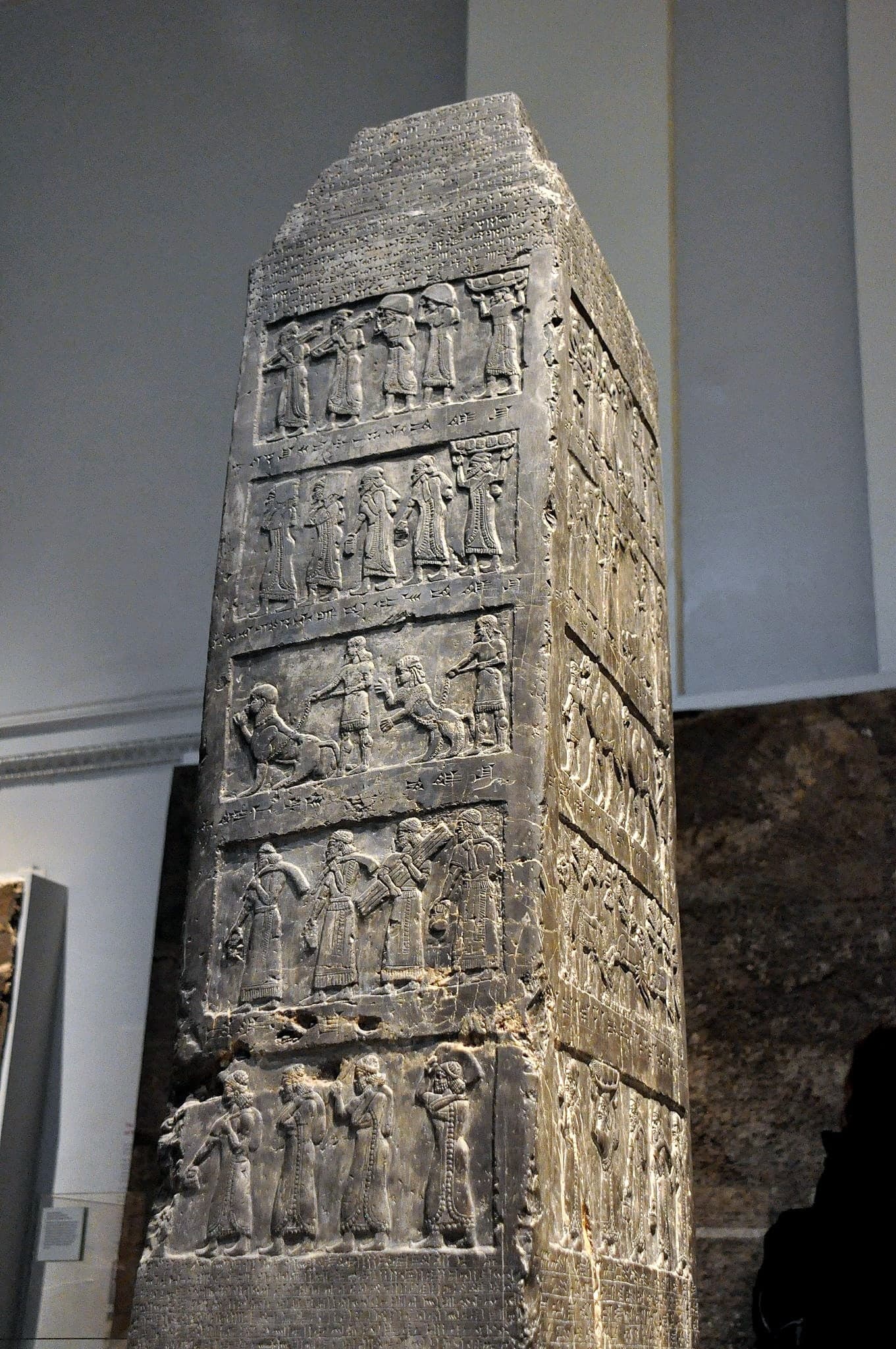
The Black Obelisk of Shalmaneser III
▶ Listen · narrated
This monument was propaganda. It listed enemies, tribute, and submission. Centuries later, historians use it to date events the Assyrians never cared about.
At a glance
- Date erected
- 825 BC
- Material
- Diorite
- Height
- 197.85 cm
- Width
- 45.08 cm
- Discovery
- 1846, Nimrud
Look closer
Four sides, five registers each
The monument is a tapering shaft with relief carvings on all four faces. Each face is divided into five horizontal bands, called registers. Each register shows a different conquered people bringing tribute: animals, vessels, weapons. Above and below the images, cuneiform inscriptions name the regions and list the goods. The structure is repetitive by design — submission after submission, stacked and identical in format.
The second register: a figure bowing
One panel shows a bearded figure prostrate before the Assyrian king. The cuneiform identifies him as 'Yaw' and describes him as a ruler bringing tribute. Scholars have traditionally read this as Jehu, a king mentioned in Hebrew texts. That identification has been questioned — some propose the figure represents a different ruler — but the debate turns on how to read a damaged name in a language where vowels were not always written.
The mention of Parsua
The inscriptions list a place called Parsua among the tribute-giving regions. This is noted in scholarship as a reference to people who would later be known as Persians, but the text itself gives no detail about them beyond the name and the fact of tribute. It is a list entry, not a description.
The story
The obelisk was erected in 825 BC in the central square of Nimrud, the Assyrian capital. Shalmaneser III had reigned for three decades. The monument's purpose was to display his reach: twenty panels of defeated peoples, each bringing goods to the palace.
The inscriptions are extensive. They run in cuneiform bands above and below the images, and they name regions, list tribute, and recount military campaigns. The text is formulaic — conquest, submission, tribute, repeat — but the specificity is what makes it useful. Each entry names a place and a year of the reign.
One panel, on the second register, shows a figure face-down on the ground. The inscription calls him 'Yaw' and describes him as bringing silver, gold, bowls, and other goods. Scholars have traditionally identified this figure as Jehu, a ruler mentioned in Hebrew texts. If that reading is correct, this is an image of an Israelite king made during his lifetime — and such images are rare in the archaeological record. But the identification is not certain. The name in cuneiform is damaged, and vowels in these inscriptions were often omitted or ambiguous. Some scholars have proposed that the text refers to a different ruler instead.
The monument was not made to clarify anyone's history. It was made to impress visitors to Nimrud. The repetition of the panels, the uniformity of the postures, the stacking of the registers — all of this was designed to communicate scale and inevitability. The Assyrians did not need to know which king was which. The point was that they all bowed.
But because the monument names regions and dates them to specific years of Shalmaneser's reign, it has become a tool for historians working on periods the Assyrians themselves did not document in detail. The obelisk gives absolute dates — years that can be tied to other events through cross-reference. For scholars reconstructing the chronology of kingdoms that left thinner records, this monument is an anchor.
The obelisk was discovered in 1846 by Austen Henry Layard during excavations at Nimrud. It was intact, which is unusual for large Assyrian monuments. Many were smashed when the cities fell. This one survived, possibly because it was already buried when the city was destroyed.
Why it mattered then
The obelisk was erected during a civil war. Shalmaneser III was old, and his authority was being challenged. The monument was placed in the central square of Nimrud, where it would have been seen by officials, ambassadors, and anyone entering the city. Its message was not subtle: this king had defeated everyone, repeatedly, across decades. The choice to erect it in 825 BC, late in the reign, suggests it was meant to assert continuity and control at a moment when both were in question. The inscriptions list campaigns year by year, creating a narrative of unbroken success. The images show submission in identical poses, over and over. The repetition is the point. It says: this is normal, this is stable, this is how things are. The monument also had a practical function. It was a public record. The tribute listed in the inscriptions was real wealth flowing into the palace, and the regions named were real places under Assyrian control or pressure. For administrators and military officials, the obelisk was a reference — a carved list of who owed what.
Why it matters now
The obelisk is now used for a purpose its makers never intended. Historians working on the chronology of ancient Israel, Judah, and neighbouring kingdoms use it to establish dates. The Assyrian records are detailed and can be tied to astronomical observations, which makes them reliable for absolute dating. When the obelisk names a ruler and places him in a specific year of Shalmaneser's reign, that date can be used to anchor events recorded in other sources that do not give absolute years. This is why the identification of 'Yaw' matters. If the figure is Jehu, then the tribute scene can be dated to around 841 BC, which helps date other events in the Hebrew texts. If the figure is someone else, the chronology shifts. The debate is not about the obelisk itself — the inscription is clear enough about what it claims — but about how to match that claim to other records. The monument also stands as an example of how propaganda becomes evidence. The Assyrians carved this to project power. Modern scholars read it to reconstruct the calendars of kingdoms the Assyrians barely cared about. The obelisk has been repurposed, and its second life as a chronological tool is longer than its original life as a monument.
The surprising detail
The obelisk was found intact, which is unusual for Assyrian monuments of this size. Many were deliberately smashed when the cities they stood in were destroyed. This one may have survived because it was already buried by the time Nimrud fell. Layard found it in 1846, lying in the ruins of the central square, and it was in good enough condition to be transported whole.
What is disputed
The identification of 'Yaw' as Jehu is traditional but not certain. The cuneiform name is damaged, and vowels in Assyrian inscriptions were often omitted or ambiguous. Some scholars have proposed that the text refers to a different ruler. The debate is ongoing, and the identification affects how historians date events recorded in Hebrew texts.
How it got here
The obelisk was excavated by Austen Henry Layard in 1846 at Nimrud, in what is now Iraq, and was transported to the British Museum. It has remained in the museum's collection since. Iraq has not formally requested its return, but the removal of large monuments from Mesopotamian sites during the nineteenth century is part of broader discussions about archaeological material taken during colonial excavations.
Remember this
A monument built to prove submission became a tool to date events the conquerors never recorded.
Test yourself
Why does the identification of 'Yaw' in the second register matter more to historians of Israel than to historians of Assyria?
Because the Assyrian records are already dated. The obelisk lists campaigns year by year, tied to Shalmaneser's reign, and those years can be anchored to absolute dates through astronomical records and other cross-references. For Assyrian history, the monument is one source among many. But the Hebrew texts do not always give absolute years — they date events relative to reigns, and those reigns have to be tied to outside records to establish when they occurred. If 'Yaw' is Jehu, the obelisk provides a fixed date for his reign, which then anchors other events mentioned in the Hebrew sources. The same piece of evidence does different work depending on what else you have.
Go deeper
Image: Osama Shukir Muhammed Amin FRCP(Glasg), CC BY-SA 4.0. Licence: CC BY-SA 4.0. Source.