I · THE OBJECT · BRITISH MUSEUM
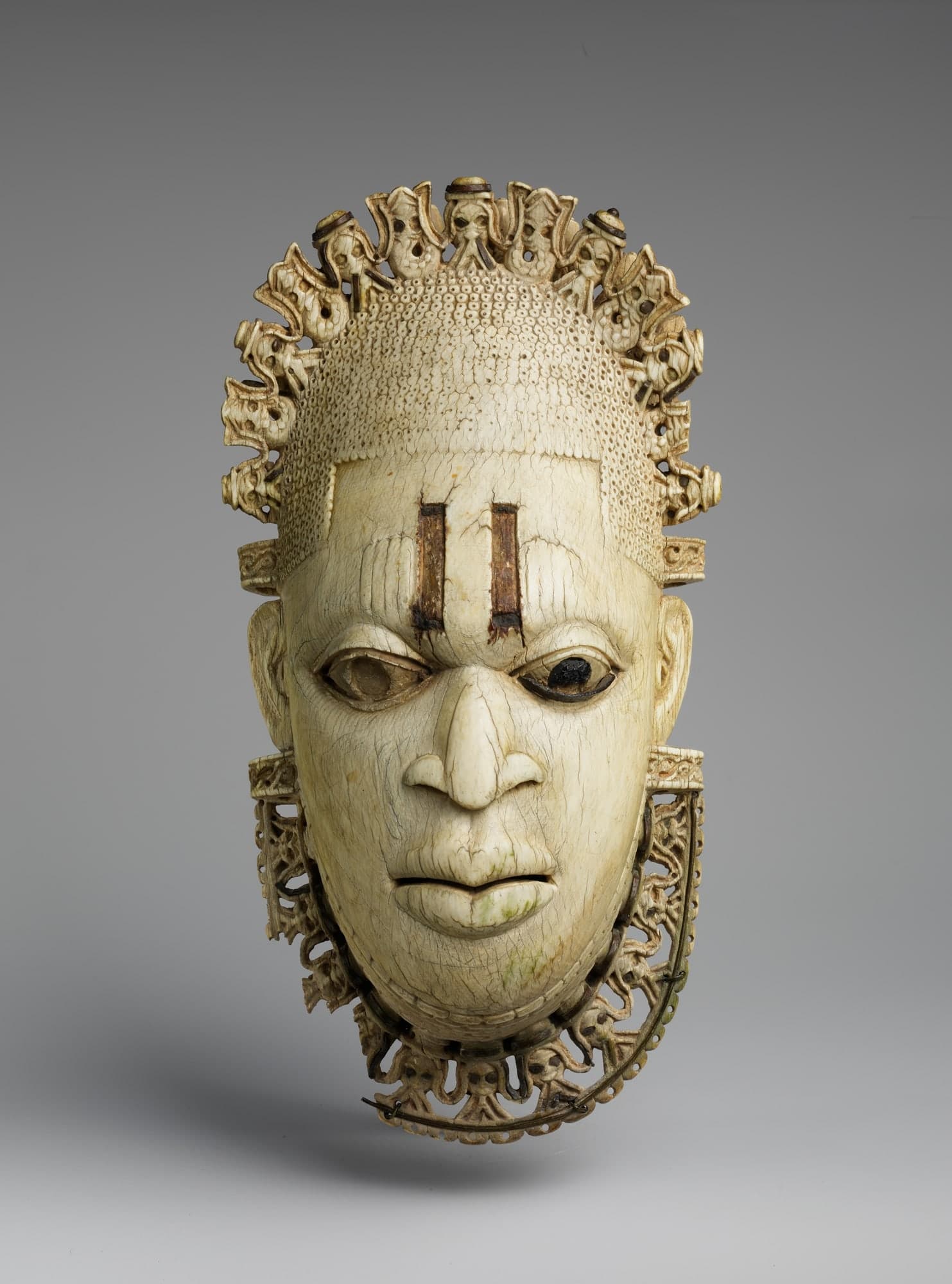
The Queen Idia Pendant Mask
▶ Listen · narrated
A face in ivory, small enough to hang from the hip. It was made for royal ceremony in Benin, taken by force to London, and chosen as the symbol of pan-African culture.
At a glance
- Date
- 16th century
- Material
- Ivory with iron inlay
- Culture
- Edo people, Kingdom of Benin
- Technique
- Ivory carving and inlay
- Form
- Pendant mask, portrait sculpture
Look closer
Iron inlay marking the forehead
Three vertical lines run down the centre of the forehead, emphasised with iron inlay set into the ivory. These marks are scarification — deliberate raised scars cut into the skin as a form of permanent decoration and identification. The iron highlights them, making them legible as a pattern rather than incidental damage. Scarification was widely practised across West Africa, with specific patterns identifying lineage, status, or ethnic group.
Portuguese heads in the crown
The openwork tiara rising above the face includes small bearded heads, understood to represent Portuguese figures. By the sixteenth century, Portuguese traders were active along the coast, and the Oba of Benin controlled access to European goods, including the brass used in royal sculpture. The presence of Portuguese heads in a royal pendant suggests that contact with Europeans was significant enough to be recorded in the iconography of kingship itself.
Mudfish in the headdress
Stylised mudfish appear among the figures in the openwork crown. The mudfish — a creature that lives in both water and air — was a symbol of the Oba's power to move between the human world and the spirit realm. It recurs throughout Benin royal art, on bronze plaques, ivory carvings, and ceremonial regalia, as an emblem of transformation and sacred authority.
The story
This is a miniature portrait in ivory, carved to be worn as a pendant. It depicts a woman's face, serene and frontal, framed by an elaborate openwork crown and collar. The face wears a beaded headdress and a beaded choker at the neck. Three vertical lines of scarification run down the forehead, highlighted with iron inlay. The crown above the head and the collar below are carved with symbolic figures: mudfish, Portuguese heads, and other beings whose identities are less certain. Double loops at each side allowed the mask to be attached and worn.
The subject is understood to be Idia, identified in oral tradition as the Iyoba — the Queen Mother — of the Benin Empire in the sixteenth century. The Iyoba was the mother of the reigning Oba, the king, and held her own court, land, and political authority. The pendant form suggests it was made to be worn by the Oba himself, probably at the hip during ceremonies.
Two nearly identical masks are recorded: this one, now in the Metropolitan Museum of Art in New York, and another in the British Museum in London. A third was held by the Linden Museum in Germany until its restitution to Nigeria in 2022. Two further examples are noted, one in Seattle and one in a private collection. The degree of similarity between them suggests they were made as a set or according to a shared template, though the specific occasion or function that required multiple versions is not recorded.
All were taken from the royal palace during the British military expedition of 1897. The expedition was a punitive action following the killing of a British diplomatic party. British forces occupied the city, removed the Oba, and looted the palace. Thousands of objects — bronze plaques, ivory carvings, ceremonial regalia — were taken and dispersed to museums and private collections across Europe and beyond. The masks were among them.
In 1977, Nigeria hosted FESTAC 77, a major pan-African cultural festival held in Lagos. The festival organisers chose a replica of the British Museum mask as the official emblem. The choice was deliberate: the mask became a symbol not only of Benin's historical artistry but of African cultural heritage more broadly, and of the claim for the return of looted objects. The replica was crafted by Erhabor Emokpae, and the emblem appeared on posters, programmes, and the festival medal. The original mask in London was not lent for the occasion.
Why it mattered then
The mask was made for royal ceremony, to be worn by the Oba as part of the regalia that marked his sacred and political authority. The Oba was not simply a ruler but a figure who mediated between the human and spirit worlds, and the objects he wore during ritual were part of that mediation. The mudfish in the crown signalled his power to cross boundaries. The Portuguese heads recorded contact with Europeans, whose goods — brass, coral, cloth — the Oba controlled and redistributed, reinforcing his position at the centre of trade and diplomacy. The fact that multiple masks were made suggests they were important enough to require duplicates, or that different ceremonies called for separate examples. Ivory itself was a valuable material, sourced from elephants hunted within the kingdom or acquired through trade. Carving it to this level of detail required specialist skill, and the commission of such work was a statement of resources and authority. The masks were not made for display in the way a museum object is displayed. They were made to be worn, seen in motion, and understood as part of a larger ceremonial vocabulary.
Why it matters now
The mask has become one of the most widely recognised objects in discussions of looted cultural heritage. Its selection as the emblem of FESTAC 77 marked a turning point: it was no longer simply an object in a museum vitrine but a symbol of the claim for restitution. The festival was attended by representatives from across Africa and the African diaspora, and the emblem was seen by millions. The mask came to stand for the argument that objects taken by force during colonial rule should be returned to their countries of origin. The British Museum and the Metropolitan Museum have both faced sustained calls for the return of their masks. The restitution of the Linden Museum's example in 2022 set a precedent, though the two major institutions have not followed suit. The masks remain in their collections, and the debate continues. The object itself — small, portable, exquisitely carved — has become larger than its physical form, a focal point for questions about ownership, heritage, and the responsibilities of museums.
The surprising detail
The mask was chosen as the emblem of FESTAC 77 without the original being present. Nigeria requested that the British Museum lend the mask for the festival, and the museum refused. The replica made by Erhabor Emokpae became the emblem instead, and it is that replica — not the sixteenth-century original — that appeared on the festival materials and in the memory of the event. The refusal to lend became part of the story the emblem told: not just a celebration of heritage, but a reminder of its absence.
How it got here
The mask was taken from the royal palace during the British military expedition of 1897, along with thousands of other objects. It entered the collection of the Metropolitan Museum of Art in New York. Nigeria has formally requested the return of looted Benin objects from museums worldwide. The Linden Museum in Germany restituted its mask to Nigeria in 2022. The British Museum and the Metropolitan Museum have not returned their examples, and both remain in their permanent collections. The case is among the most prominent in ongoing debates about the restitution of cultural heritage.
Remember this
Ivory carved for a king, looted by an empire, and chosen as the symbol of a continent's claim for its own past.
Test yourself
Why might the presence of Portuguese heads in the crown be significant for understanding the Oba's authority, rather than simply recording contact with Europeans?
Because the Oba controlled access to European trade goods, and the decision to include Portuguese figures in royal regalia suggests that contact with Europeans was being incorporated into the symbolic language of kingship itself. The crown is not a neutral record but a statement of power: the Oba is shown as the figure who commands the relationship with outsiders, who controls the flow of brass and coral and cloth that came from European trade, and who decides what is worthy of being represented in the sacred objects he wears. The Portuguese heads are not there because Europeans were important in themselves, but because the Oba's ability to manage and monopolise that contact was important to his authority.