IV · THE GAME · MAJOR LEAGUE BASEBALL
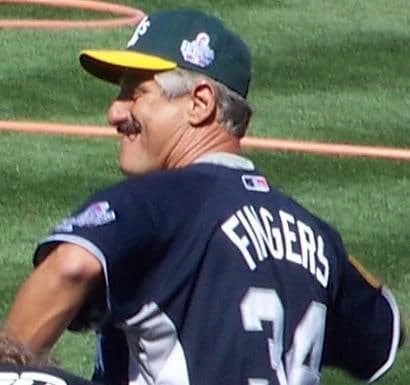
Rollie Fingers
Most pitchers who throw 1,701 innings start most of their games. Fingers started fewer than four in every hundred, and the shape of that career is visible in the numbers.
At a glance
- Career
- 944 games · 37 starts · 114 wins · 341 saves · 2.91 ERA
- Debut
- 15 September 1968, aged 22, at Tiger Stadium
- Last game
- 17 September 1985, for the Milwaukee Brewers
- Innings pitched
- 1,701.1 innings across seventeen seasons
Look closer
The debut was one and a third innings in a rout
On 15 September 1968 the Oakland Athletics made three hits and no runs. Detroit made fifteen hits and thirteen runs, three in the first, two in the third, one in the fourth, three in the fifth, and four in the sixth. Oakland never led, and Detroit never had to bat in the ninth. Fingers entered the game somewhere in that sequence and pitched one and a third innings: he gave up four hits, walked one, struck out none, and allowed four earned runs. His earned-run average for the debut was 27.00, which is what happens when you allow four earned runs in 1.1 innings.
The shift from starting to relieving happened early and stuck
In 1969, his first full season, Fingers started eight games and relieved in fifty-two. In 1970 he started nineteen and relieved in twenty-six. In 1971 he started eight and relieved in forty. From 1972 onwards he started two games total — both in 1973 — and relieved in the other 707. The role settled in his third season and never moved again. Of his 944 career appearances, 907 were in relief.
The save totals rose, peaked, and fell in three distinct phases
From 1971 through 1976 with Oakland, Fingers saved between seventeen and twenty-four games each season. From 1977 through 1982, split between San Diego and Milwaukee, he saved between twenty-three and thirty-seven. In 1981 he saved twenty-eight in forty-seven games and posted a 1.04 earned-run average, the lowest of his career. His last three seasons — 1982, 1984, and 1985 — produced twenty-nine, twenty-three, and seventeen saves respectively. The season table shows no entry for 1984 preceded by any entry for 1983. The final season, 1985, shows the only earned-run average above 5.00 in the table: 5.04 in 55.1 innings.
The story
On 15 September 1968, a Sunday afternoon at Tiger Stadium, the Oakland Athletics and the Detroit Tigers played a game that lasted two hours and thirty-nine minutes in front of 23,260 people. Detroit scored thirteen runs on fifteen hits and made no errors. Oakland scored none on three hits and made no errors. Detroit led after every inning they batted in, which is why the ninth inning shows a dash for the home side: they did not need to bat.
Fingers pitched one and a third innings in that game. He gave up four hits, walked one batter, struck out none, and allowed four earned runs. His earned-run average for the debut was 27.00, which is the number you get when you divide four earned runs by 1.1 innings and multiply by nine. It was not a promising start, and it was also not representative: the next season he pitched 119 innings, posted a 3.71 earned-run average, and saved twelve games.
The shape of the career is visible in two numbers: 944 games played and 37 games started. He relieved in 907 of them. In 1969, his first full season, he started eight times and relieved in fifty-two. In 1970 he started nineteen and relieved in twenty-six. In 1971 the ratio reversed again: eight starts, forty relief appearances. From 1972 onwards he started exactly two games — both in 1973 — and every other appearance was in relief. The role settled in his third season and never moved.
The save totals tell the rest. From 1971 through 1976 with Oakland, he saved between seventeen and twenty-four games each season. The innings pitched in those years ranged from 111.1 to 134.2, and the earned-run averages from 1.92 to 2.99. In 1977 he moved to San Diego and saved thirty-five games in seventy-eight appearances. In 1978 he saved thirty-seven. In 1981, now with Milwaukee, he saved twenty-eight in forty-seven games and posted a 1.04 earned-run average, the lowest of his career. He walked thirteen batters and struck out sixty-one in seventy-eight innings.
The final phase began in 1982. He saved twenty-nine games that season. The season table shows no line for any year between 1982 and 1984. In 1984 he saved twenty-three in thirty-three games, and in 1985 saved seventeen in forty-seven appearances. That last season shows the only earned-run average above 5.00 in the table: 5.04 in 55.1 innings. He walked nineteen, struck out twenty-four, and gave up fifty-nine hits. His last game was on 17 September 1985, eighteen years after the debut, almost to the day.
Why it mattered then
The role Fingers played — entering in the late innings to preserve a lead — was not new in 1968, but the way it was used was changing. Relievers had long been seen as lesser pitchers, the ones who could not start. By the 1970s, managers were beginning to deploy relief pitchers in high-leverage situations late in games, rather than asking starters to finish what they began. Fingers pitched in an era when the specialisation was becoming deliberate rather than incidental. The save, as a statistical category, was introduced in 1969, Fingers's first full season. It gave a name and a count to something that had previously been recorded only as an appearance. The timing matters: the stat and the role it measured were formalised together, and Fingers's career unfolded entirely within that framework. His 341 saves were not retroactively applied to earlier work; they were counted as they happened, in a league that was learning to value the late-inning reliever as a distinct and essential position.
Why it matters now
The shape of Fingers's career — 944 games, 37 starts, 341 saves — is now the template, not the exception. Modern bullpens are built around pitchers who will never start, and many are used in the highest-leverage innings, not the longest stretches. The ninth inning is now a specialist's job, and the role has a name: closer. Fingers did not invent it, but the numbers he posted helped establish that a pitcher could build an entire career in relief and be considered indispensable. The save total, 341, stood as a measure of durability and consistency for decades. It has since been surpassed, but the number still marks a career spent finishing games rather than starting them, and it demonstrates that the work could be done at the highest level for seventeen seasons. The role Fingers played is now so embedded in the structure of the game that it is difficult to imagine a team without it.
The surprising detail
The debut earned-run average of 27.00 and the career earned-run average of 2.91 sit twenty-four runs apart. The debut was 1.1 innings of a blowout loss in September 1968. The career was 1,701.1 innings across seventeen seasons, 944 games, and three clubs. One number is a single bad outing; the other is what happened when the work was repeated, refined, and sustained for nearly two decades. The gap between them is not an anomaly — it is what a career looks like when the first day does not define it.
What is disputed
The career totals come from the MLB Stats API and reflect the league's current records. Statistical categories were not all recorded uniformly across the eighteen years covered, and some figures — particularly saves, which were formalised as a stat in 1969 — were compiled retrospectively for earlier seasons. The totals here are the ones the league publishes, not independently recomputed figures.
Remember this
944 games, 37 starts: a career built on entering late and finishing the work someone else began.
Test yourself
Fingers's 1981 season with Milwaukee shows the lowest earned-run average of his career. Using only the line for that season, what explains it?
He allowed nine earned runs in seventy-eight innings, which produces an ERA of 1.04. But the shape of the line suggests control: he walked only thirteen batters, the fewest in any season where he pitched more than forty-six innings, and struck out sixty-one. The ratio of strikeouts to walks is nearly five to one, and the hits allowed — fifty-five — are fewer than the innings pitched. That combination — limiting walks, limiting hits, and missing bats — is what a 1.04 ERA looks like in numbers. It is not one dominant outing; it is forty-seven games of consistent work.
Go deeper
- Rollie Fingers — MLB Stats API player record · MLB Advanced Media
- Rollie Fingers — career pitching totals (MLB Stats API) · MLB Advanced Media
- Debut game linescore — MLB Stats API game 156523 · MLB Advanced Media
- Rollie Fingers — Wikidata · Wikidata
Image: Bbsrock, CC BY-SA 3.0. Licence: CC BY-SA 3.0. Source.