IV · THE GAME · MAJOR LEAGUE BASEBALL
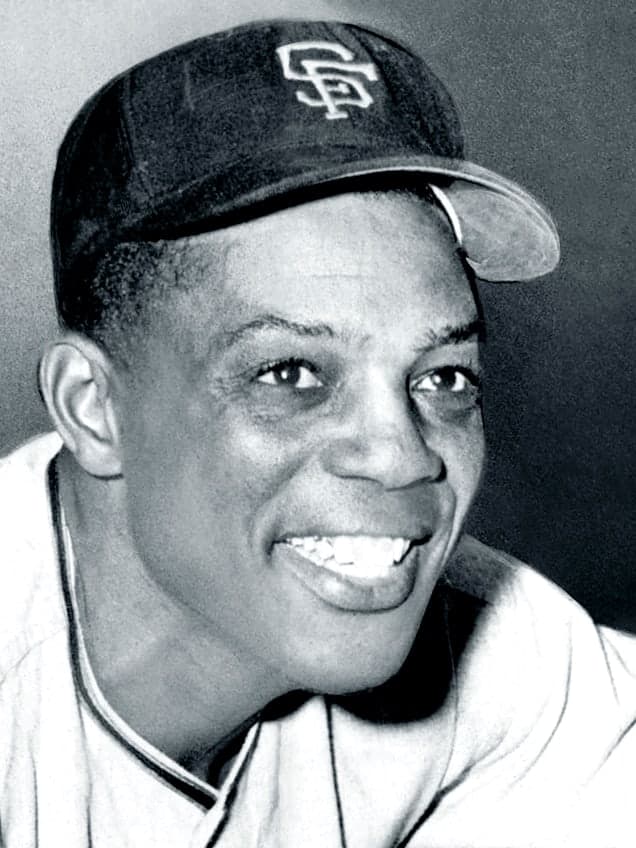
Willie Mays
A record built across two decades looks different from one built in a single brilliant year. Mays never hit sixty home runs in a season. He hit six hundred and sixty of them.
At a glance
- Career
- 3,005 games · 3,293 hits · 660 home runs · 1,909 runs batted in · .301 average
- Debut
- 25 May 1951, aged 20, at Shibe Park, Philadelphia
- Last game
- 9 September 1973, for the New York Mets
- Height and weight
- 5 feet 11 inches · 180 pounds
Look closer
The debut was won in the eighth, not the ninth
On 25 May 1951 the Giants led 3–2 after seven innings, then scored five runs in the top of the eighth to make it 8–2. Philadelphia did not score in the bottom half, so the Giants never batted in the ninth — the game was already decided. That is why the away side shows a nought for the ninth inning rather than a dash: they had their turn and made nothing of it. The home side's ninth is a dash because they never came to bat at all.
The fifty-two came in 1965, not at the start or the end
The highest single-season home run total — fifty-two — arrived in 1965, the fifteenth season in the major leagues. The first full season, 1951, produced twenty. The last, 1973, produced six. The peak was neither early brilliance nor late surge but something closer to the middle of a long span, and the decline from it was gradual rather than sudden: forty-seven in 1964, fifty-two in 1965, thirty-seven in 1966.
Thirteen games for Birmingham in 1948
The season-by-season table begins with thirteen games for the Birmingham Black Barons in 1948, three years before the major-league debut. Those thirteen games produced ten hits in forty-three at-bats, a .233 average, and no home runs. The 1951 line — one hundred and twenty-one games, twenty home runs, a .274 average — marks a different level of play, not a different player.
The story
On 25 May 1951 the New York Giants came to Shibe Park in Philadelphia and beat the Phillies 8–5 in two hours and fifty-two minutes. The Giants made twelve hits to Philadelphia's eight, but also made four errors to Philadelphia's two, so the margin was tighter than the hit total suggests. The game was level at 2–2 after three innings, Philadelphia led 4–3 after six, and then the Giants scored five runs in the top of the eighth to settle it. Philadelphia never batted in the ninth because they were already behind, which is why that half-inning shows a dash rather than a nought. The attendance was 21,082.
That was the debut. The career that followed lasted twenty-three seasons and 3,005 games, all of them as an outfielder. The club changed twice: the Giants moved from New York to San Francisco after the 1957 season, and Mays moved to the New York Mets partway through 1972. The position did not change, and neither did the batting hand — right — or the throwing hand, also right.
The home run totals rose quickly and stayed high for a long time. The first full season, 1951, produced twenty. The second, 1952, produced four in only thirty-four games. The 1954 season produced forty-one, the 1955 season fifty-one, and the 1965 season fifty-two — the highest single-season mark in the career. That peak arrived in the fifteenth major-league season, not at the beginning or the end. The decline from it was not sudden: thirty-seven home runs in 1966, twenty-two in 1967, twenty-three in 1968. The final season, 1973, produced six home runs in sixty-six games for the Mets.
The career total was 660 home runs. The single-season high was 52. The difference between those two numbers is twenty-three years of play, most of it at a level well above ordinary but well below the single-season peak. The .301 batting average across the career is higher than the average in any season after 1965, which suggests that the power numbers — home runs, runs batted in — were what declined first and fastest. The last season with more than thirty home runs was 1966. The last season with more than a hundred games played was 1971.
The stolen base totals tell a different story. The 1951 season produced seven. The 1956 season produced forty, the highest single-season mark in the career. The 1971 season produced twenty-three — more than any season between 1962 and 1970. Speed lasted longer than power, or perhaps the role changed and stealing bases became more important as home runs became less frequent.
Why it mattered then
The debut in 1951 came after the major leagues had begun admitting Black players — the exclusion that had lasted since the 1880s had ended, though when exactly is not recorded in the figures here. The thirteen games Mays played for Birmingham in 1948 were in the Negro leagues, a separate structure that existed because the major leagues were closed. By 1951 that closure had ended, but only just, and the number of Black players in the major leagues was still small. The move from New York to San Francisco after the 1957 season was part of a wider shift: major-league baseball had been concentrated in the north-east and midwest since the 1800s, and the westward expansion of the 1950s and 1960s — the Giants and Dodgers both moved to California in 1958 — changed the geography of the sport. A player who began in New York and played most of his career in San Francisco lived through that change rather than reading about it later.
Why it matters now
The 660 career home runs is a large total by any measure, but this lesson has no leaderboard, so the number must stand on its own: 660 home runs across twenty-three seasons is an average of just under twenty-nine per season, sustained for more than two decades. That is the shape of the achievement — not a single brilliant year but a long span of very good ones. The career also marks a moment when the major leagues were still integrating, still expanding westward, and still playing a different kind of game from the one that would emerge later. The stolen base totals — 339 across the career, with a late-career peak in 1971 — suggest a player who could do more than hit home runs, and a game in which that versatility mattered. The figures do not say whether the game was better then or now, but they do say it was different.
The surprising detail
The two totals that sit oddest together are 660 home runs across the career and 52 in a single season. The peak year, 1965, came in the fifteenth season, not the fifth or the twentieth. The decline from that peak was gradual rather than sudden: 47 home runs in 1964, 52 in 1965, 37 in 1966, 22 in 1967. Nothing about the career total was concentrated in a few extraordinary years. It was earned at a high but not extreme rate for a very long time, which is the least dramatic way a large total can be built.
What is disputed
Every figure here comes from the MLB Stats API. The 1948 line for Birmingham is included in the season-by-season table the API returns, but Birmingham was not a major-league club — it played in the Negro leagues, a separate structure that existed before major-league integration. Whether to count those thirteen games as part of the professional career depends on how 'professional career' is defined; the major-league career began in 1951. Statistical categories were not all recorded consistently across the twenty-three major-league seasons covered, and records for the 1950s were compiled retrospectively from contemporary scoring; the totals are the ones the league publishes today.
Remember this
660 home runs, never more than 52 in a season: the total is a length of time as much as it is a rate.
Test yourself
The Giants made twelve hits to Philadelphia's eight in the debut game, but the final margin was only three runs. Using only the linescore, what explains why twelve hits did not produce a larger lead?
Errors and timing. The Giants made four errors to Philadelphia's two, so some of Philadelphia's five runs may have been unearned — scored because of mistakes rather than hits. The timing of the hits also matters: the Giants scored five runs in a single inning, the eighth, which means their twelve hits were not evenly spread. Hits that arrive in the same inning score more runs than hits that arrive one per inning, because runners are already on base. Equal hit totals do not mean equal run production — clustered hits score, scattered ones strand runners. The Giants also left runners on base, which is why twelve hits produced only eight runs rather than twelve.
Go deeper
- Willie Mays — MLB Stats API player record · MLB Advanced Media
- Willie Mays — career hitting totals (MLB Stats API) · MLB Advanced Media
- Debut game linescore — MLB Stats API game 131752 · MLB Advanced Media
- Willie Mays — Wikidata · Wikidata
Image: New York World-Telegram and the Sun staff photographer, William C. Greene, Public domain. Licence: Public domain. Source.