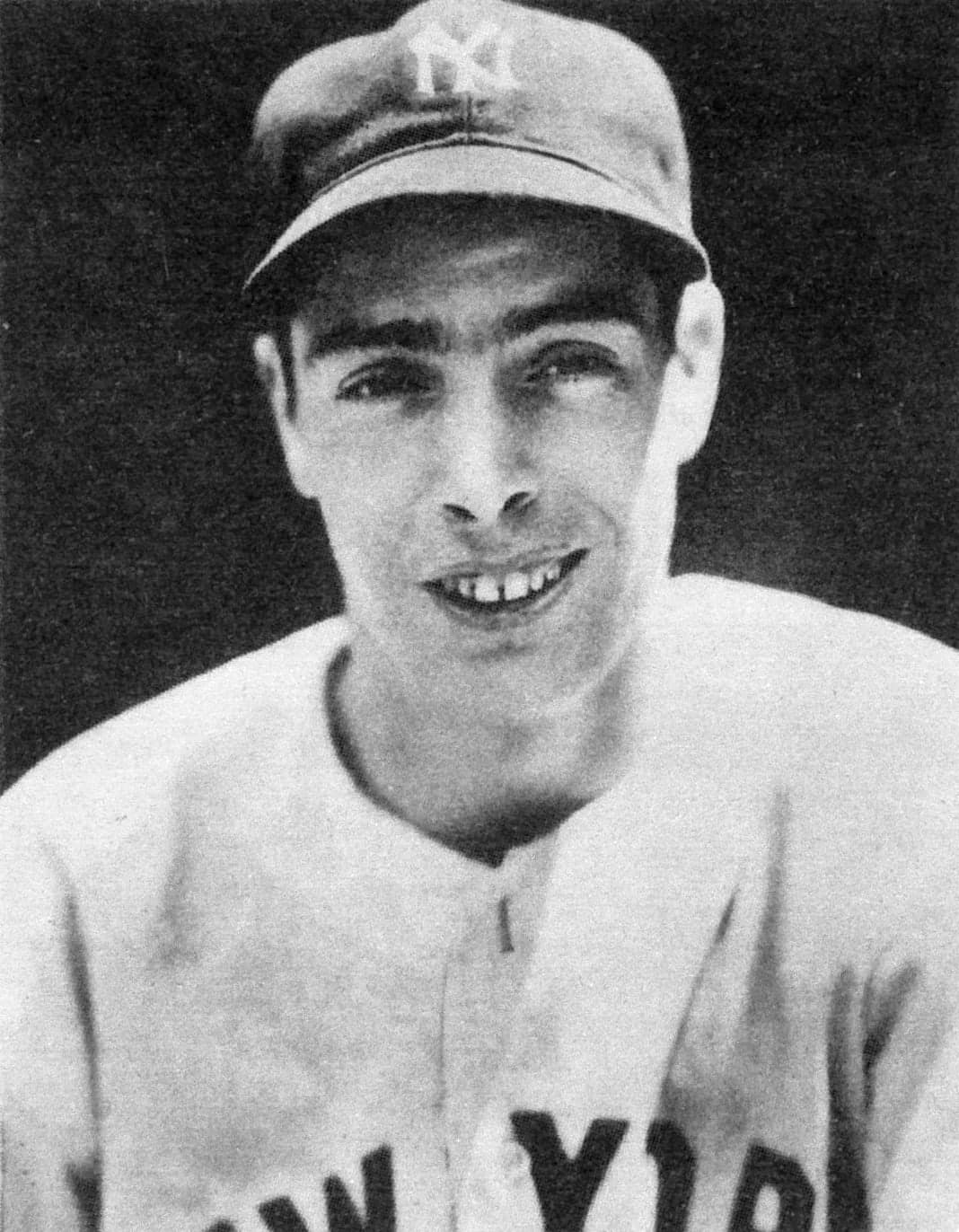
IV · THE GAME · MAJOR LEAGUE BASEBALL
Joe DiMaggio
Between 1942 and 1946 there are no lines in the table. The seasons either side of that gap show what time away cost, and what remained afterwards.
At a glance
- Career
- 1,736 games · 2,214 hits · 361 home runs · 1,537 runs batted in · .325 average
- Debut
- 3 May 1936, aged 21, at Yankee Stadium
- Last game
- 30 September 1951
- Height and weight
- 6' 2" · 193 lb
Look closer
The debut was a rout, and the Yankees scored in five different innings
On 3 May 1936 the Yankees made seventeen hits to St. Louis's thirteen, and won 14–5 in front of 25,430 people. New York scored four runs in the first inning, three in the second, two in the fourth, four in the sixth, and one in the seventh. St. Louis scored three in the first, one in the third, and one in the fifth. Each side made one error. The ninth inning shows a dash for the home side because the Yankees did not need to bat — they were already ahead.
Forty-six home runs in 1937, then never that many again
In his second season DiMaggio hit forty-six home runs in 151 games, drove in 167 runs, and finished with a .346 average. It is the highest home-run total in the table. The next-highest is thirty-nine, in 1948. Between 1936 and 1942 he hit between twenty-one and forty-six each year. After the gap — 1946 onwards — he hit between twelve and thirty-nine. The 1937 line also shows the highest runs-batted-in total: 167. After 1942 the highest is 155, in 1948.
Thirteen seasons across sixteen years, with three missing in the middle
The table runs from 1936 to 1942, then jumps to 1946 and continues to 1951. There are no lines for the years between 1942 and 1946. Thirteen seasons are recorded across sixteen calendar years. The gap sits in the middle of the career, not at the beginning or the end, which means the numbers either side of it can be compared. In 1942 DiMaggio played 154 games and hit .305. In 1946 he played 132 and hit .290. The 1946 total of twenty-five home runs is lower than any year from 1936 to 1942 except 1942 itself, when he hit twenty-one.
The story
On 3 May 1936 the New York Yankees beat the St. Louis Browns 14–5 at Yankee Stadium. The Yankees scored in five separate innings — four runs in the first, three in the second, two in the fourth, four in the sixth, one in the seventh — and made seventeen hits to St. Louis's thirteen. Each side made one error. The game was a day game in front of 25,430 people. DiMaggio was twenty-one years old.
The season table shows thirteen lines, all for the same club. It begins in 1936 and ends in 1951. Between 1936 and 1942 there are lines for each year. Then the table jumps to 1946 and runs without interruption to 1951. The missing years sit in the middle of the career, not at the edges. Thirteen seasons are recorded across sixteen calendar years.
The highest home-run total is forty-six, in 1937. That season he played 151 games, made 215 hits, drove in 167 runs, and finished with a .346 average. It is the only season in which he hit more than forty home runs. The next-highest total is thirty-nine, in 1948. Between 1936 and 1942 the home-run totals range from twenty-one to forty-six. After the gap — 1946 onwards — they range from twelve to thirty-nine.
The runs-batted-in totals follow a similar shape. In 1937 he drove in 167 runs, the highest figure in the table. In 1948 he drove in 155, the second-highest. Before the gap the totals are 125, 167, 140, 126, 133, 125, 114. After it they are 95, 97, 155, 67, 122, 71. The 1949 season shows only seventy-six games played, the fewest in any year except 1951, when he played 116.
The batting average — hits divided by at-bats — was .323 in his first season, rose to .381 in 1939, and stayed above .300 in every year from 1936 to 1942 except 1942 itself, when it was .305. After the gap it was .290 in 1946, .315 in 1947, .320 in 1948, .346 in 1949, .301 in 1950, and .263 in 1951. Five of the six post-gap seasons are below .320. Five of the seasons from 1936 to 1942 are at or above .323.
Strikeouts show different patterns before and after the gap. Between 1936 and 1942 the totals are thirty-nine, thirty-seven, twenty-one, twenty, thirty, thirteen, thirty-six. After 1946 the strikeout totals are twenty-four, thirty-two, thirty, eighteen, thirty-three, thirty-six. In 1941 he struck out thirteen times in 541 at-bats. In 1939 he struck out twenty times in 462 at-bats.
The career totals are 1,736 games played, 6,821 at-bats, 1,390 runs, 2,214 hits, 389 doubles, 131 triples, 361 home runs, 1,537 runs batted in, thirty stolen bases, 790 walks, 369 strikeouts, and a .325 batting average. His on-base percentage — the rate at which he reached base safely — was .398. His slugging percentage — total bases divided by at-bats — was .579. He batted right-handed and threw right-handed.
Why it mattered then
The gap in the table corresponds to a period when many players were not available. The missing seasons sit in what would otherwise have been the middle of DiMaggio's career, between the ages of twenty-eight and thirty-one. The 1942 season ended in late September. The 1946 season was the first in the table after 1942. The numbers either side of the gap show what time away cost. In 1942 DiMaggio played 154 games, hit twenty-one home runs, and finished with a .305 average. In 1946 he played 132 games, hit twenty-five home runs, and finished with a .290 average. The 1946 total of twenty-five home runs is lower than every season from 1936 to 1941. The 1946 batting average is lower than any season in the table except 1951, his final season, when it was .263. The post-gap seasons include two strong years — 1948 and 1949 — but also two shortened ones. In 1949 he played only seventy-six games. In 1951 he played 116. The 1951 line is the last in the table: 116 games, twelve home runs, a .263 average. He was thirty-six years old.
Why it matters now
The shape of the career — seasons from 1936 to 1942, a gap, then seasons from 1946 to 1951 — is visible in the table but not always in the totals that summarise it. The career lasted thirteen seasons across sixteen years. Counting only the seasons played gives one number; counting the calendar years from debut to retirement gives another. Both are correct, but they describe different things. The gap also makes it possible to compare the same player at two different stages, with the comparison forced by circumstances rather than age alone. In 1942 DiMaggio was twenty-seven. In 1946 he was thirty-one. The difference is four years, but only one of them was spent playing baseball. The 1946 numbers are lower than the 1942 ones, and the 1947 numbers are lower still in some categories. The 1948 season — thirty-nine home runs, 155 runs batted in, a .320 average — looks more like the pre-gap years, but it is surrounded by seasons that do not. The table also shows that a career can have more than one peak. The highest home-run total is in 1937, the second year. The highest batting average is in 1939, the fourth year. The second-highest home-run total is in 1948, the tenth season played but the thirteenth calendar year. A career is not always a single arc.
The surprising detail
DiMaggio struck out only 369 times in 6,821 at-bats, which works out to once every 18.5 at-bats. In 1941 he struck out thirteen times in 541 at-bats, or once every 41.6 at-bats. In 1941 he also hit thirty home runs and finished with a .357 average. The combination — high batting average, substantial power, very few strikeouts — is unusual. Most players who hit for power strike out more often, because the swing required to drive the ball a long distance is harder to control. DiMaggio's strikeout rate stayed low even in the seasons after the gap, when other figures declined. In 1950 he struck out thirty-three times in 525 at-bats, or once every 15.9 at-bats. In 1951, his final season, he struck out thirty-six times in 415 at-bats, or once every 11.5 at-bats.
What is disputed
The season-by-season figures come from the MLB Stats API, which compiles data recorded at the time but standardises it to categories defined later. Walks, strikeouts and some other totals were not tracked as systematically in the 1930s and 1940s as they are now, and early records have been reconstructed from contemporary box scores. The totals given here are the ones the league publishes today.
Remember this
Thirteen seasons across sixteen years, with the gap in the middle rather than at the edges, and the numbers never quite the same afterwards.
Test yourself
The 1937 season shows DiMaggio's highest home-run total — forty-six — and his highest runs-batted-in total — 167. But it does not show his highest batting average. Which season does, and what might explain why a season with fewer home runs produced a higher average?
The highest batting average is .381, in 1939. That season he hit thirty home runs in 462 at-bats across 120 games — fewer games and fewer at-bats than in 1937, when he played 151 games and had 621 at-bats. A home run counts as one hit, just like a single, so hitting more home runs does not automatically raise the batting average unless the overall hit total rises in proportion. In 1939 DiMaggio made 176 hits in 462 at-bats, which is 38.1 hits per hundred at-bats. In 1937 he made 215 hits in 621 at-bats, which is 34.6 hits per hundred. The 1939 rate is higher even though the home-run total is lower. Batting average measures how often a batter gets a hit, not how far the ball travels when he does.
Go deeper
- Joe DiMaggio — MLB Stats API player record · MLB Advanced Media
- Joe DiMaggio — career hitting totals (MLB Stats API) · MLB Advanced Media
- Debut game linescore — MLB Stats API game 113078 · MLB Advanced Media
- Joe DiMaggio — Wikidata · Wikidata
Image: Play Ball cards, published by Bowman Gum, Public domain. Licence: Public domain. Source.