III · THE WORK · ART HISTORY
The Fayum Mummy Portraits
▶ Listen · narrated
These are the faces of people who died under Roman rule in Egypt, painted in hot pigmented wax and bound over their mummified heads for burial.
At a glance
- Period
- Late 1st century BC or early 1st century AD onwards
- Technique
- Encaustic (hot wax) or tempera on wooden boards
- Function
- Funerary portraits attached to wrapped mummies
- Known examples
- About 900 portraits
Look closer
Highlights built up in hot pigmented wax
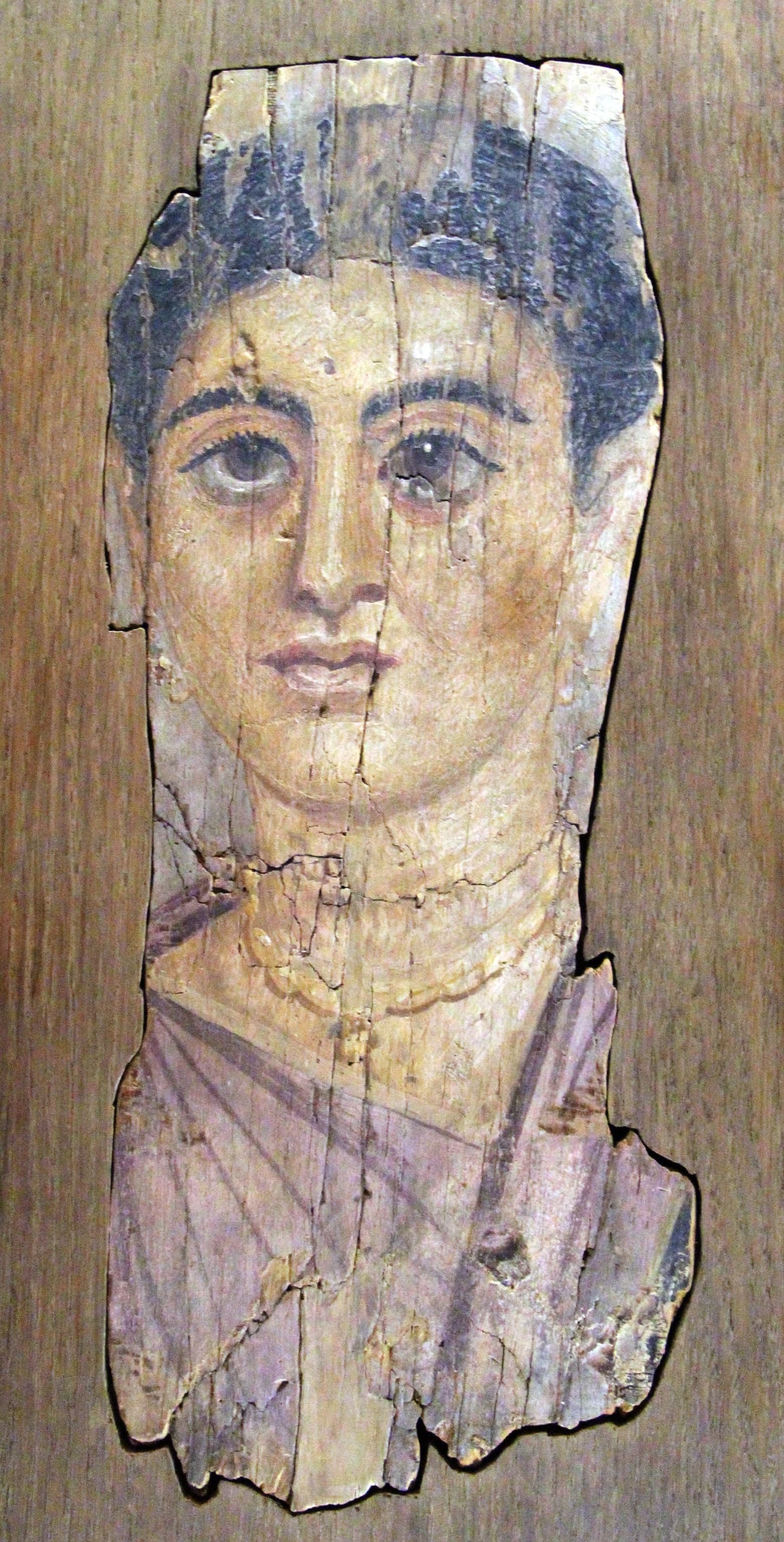
The higher-quality portraits are encaustic — painted in pigmented wax applied hot. The technique allows thick, luminous highlights: a catch of light on a cheekbone, the fold of an eyelid, the curve of a lip. The wax cools fast, so each stroke is committed. The paint has body. You can see where it was laid on and where the artist left it thin. The dry Egyptian climate preserved the wax, and the colours — ochres, reds, lead white — remain vivid.
Direct, unflinching gaze at the viewer
Almost all the portraits show the head frontally, eyes meeting yours. This is not the profile convention of pharaonic Egyptian art, nor the three-quarter turn common in later European portraiture. The sitter looks straight out. The effect is immediate and uncomfortable: these are faces painted to be seen, and they see back. The directness is part of the Greco-Roman portrait tradition, but here it is intensified by the funerary context — a person looking at you from inside the wrappings of their own burial.
Jewellery and hairstyle used to date the portrait
The portraits show earrings, necklaces, hairstyles. Scholars use these details to date the paintings, matching them to fashions recorded in Roman imperial coinage and sculpture. A woman's hair pinned in tight curls suggests one decade; loose waves another. The clothing and ornament are Roman in style, not pharaonic. The people buried with these portraits lived under Roman rule and dressed accordingly, but chose mummification — an Egyptian funerary practice — for their bodies.
The story
The Fayum mummy portraits are panel paintings of individual people, bound over the faces of their mummified bodies. They were made during the Roman period in Egypt, beginning in the late 1st century BC or early 1st century AD. It is not clear when the practice ended, though some research suggests the middle of the 3rd century. The portraits have been found across Egypt, but are concentrated in the Faiyum region, particularly at sites including Hawara and the Roman city Antinoopolis. The term "Fayum portraits" is now used as a stylistic description rather than a strictly geographic one.
The people buried with these portraits were mummified — a practice rooted in Egyptian tradition — but the portraits themselves derive from Greco-Roman artistic conventions. The images are naturalistic, frontal, and painted in the manner of Classical panel painting. This combination is distinctive: Roman naturalism serving Egyptian funerary practice. While painted cartonnage mummy cases — shaped coverings made of plastered linen or papyrus — date back to pharaonic times, the panel portraits were an innovation of the Roman era.
Two techniques can be distinguished. One group is painted in encaustic: pigment mixed with hot wax. The other uses tempera: pigment bound with a water-soluble medium, likely egg. The encaustic portraits are usually of higher quality. The wax allows thick, luminous paint and precise modelling of light. The tempera portraits are thinner in handling and less vivid in colour.
The portraits were mounted into the linen wrappings that bound the mummified body. Almost all surviving examples have since been detached. They typically show a single person, head or head and upper chest, viewed frontally. The sitters are men, women and children. Some wear gold jewellery; others are more plainly dressed. The faces are individuated — different bone structure, different expressions, different ages. Whether they are true likenesses painted from life, or idealised images made after death, is not recorded. Both practices are known from other Roman funerary contexts, and the portraits themselves do not resolve the question.
About 900 mummy portraits are known. The hot, dry Egyptian climate preserved them. The wood has not rotted, the paint has not flaked, and the colours — ochres, reds, lead white, Egyptian blue — remain brilliant. They are vivid in a way that is startling for ancient panel painting, because the conditions of burial kept them intact.
Why it mattered then
For the people who commissioned them, these portraits were part of a funerary process that joined two traditions. Mummification was Egyptian, ancient, and concerned with the preservation of the body for the afterlife. Panel portraiture was Greco-Roman, current, and concerned with individual likeness and social display. The portraits were not made to hang on a wall. They were made to be seen briefly — during the funeral procession, perhaps, or in the period between death and burial — and then to be bound into the wrappings and placed in the tomb. The people buried with these portraits were living in Egypt under Roman rule. Many were ethnically Greek or Roman; others were Egyptian. The choice to be mummified was a choice to adopt or continue an Egyptian practice, but the style of the portrait and the clothing depicted are Roman. The portraits suggest a culture in which people participated in multiple traditions at once, selecting elements of each for different purposes. The naturalism of the image and the preservation of the body were both, in different ways, concerned with permanence.
Why it matters now
These portraits are a direct surviving record of what individual people looked like in Roman-period Egypt. Not idealised emperors or mythological figures, but men, women and children whose names, in most cases, are not recorded. The paint is thick enough to see the brushwork. The faces are specific enough to recognise. They are closer to photographs than to the stylised imagery of most ancient art. They also survive in unusual numbers. Panel painting was highly regarded in the Classical world, but wood and fabric rot. The Fayum portraits exist because they were buried in a desert. They are not exceptional as objects — they are provincial work, made for private clients, not for temples or imperial patrons — but they are exceptional as evidence. They show what routine, accomplished painting looked like in the Roman period, and they show it in colour, at full scale, on the original surface. The directness of the gaze is harder to account for. These are faces painted to be looked at, and they look back. The effect is not softened by time. The people are dead, the portraits are two thousand years old, and the eye contact is still uncomfortable.
The surprising detail
The portraits are frequently very well preserved, and the reason is burial. They were painted to be seen briefly and then wrapped into linen bandages and placed in a tomb, in a desert, where almost nothing decays. The same climate that preserved the mummies preserved the paint. The wood has not warped, the wax has not cracked, and the colours have not faded. They look recent. In museums, under gallery lighting, they are more vivid than many paintings made a century ago. The preservation is so complete that it is easy to forget how old they are, and how unlikely it is that they survived at all.
What is disputed
Whether the portraits were painted from life or after death is not recorded. Both practices are attested in Roman funerary contexts, and the portraits themselves do not settle the question. The end date of production is also uncertain: some research suggests the middle of the 3rd century, but the evidence is not definitive.
Remember this
Roman naturalism in the service of Egyptian burial: panel portraits painted to be bound over mummified faces, and then buried in a desert that did not let them rot.
Test yourself
The portraits combine Roman artistic conventions with Egyptian funerary practice. Why does this combination tell us something important about cultural identity under Roman rule in Egypt?
Because it shows that people living in Roman Egypt did not simply adopt one tradition or preserve another in isolation. They selected elements from both: mummification, which was Egyptian and ancient, and naturalistic panel portraiture, which was Greco-Roman and current. The portraits were not made to resolve a conflict between identities but to serve a practical need — a funeral — in a way that drew on multiple sources. This suggests that cultural identity in the Roman provinces was not a matter of choosing sides, but of navigating overlapping practices and making them work together. The portraits are evidence of that navigation, preserved because they were buried in a climate that kept them intact.
Go deeper
Image: Francesco Bini, CC BY-SA 4.0. Licence: CC BY-SA 4.0. Source.