III · THE WORK · ART HISTORY
Lapita Pottery
▶ Listen · narrated
A design language travelled from Island Melanesia to Samoa and Tonga, carried by potters who crossed open ocean. The sherds they left behind map the journey.
At a glance
- Culture
- Lapita
- Period
- c. 1600–500 BCE
- Locations
- Island Melanesia, Samoa, Tonga
- Technique
- Dentate stamping on earthenware
Look closer
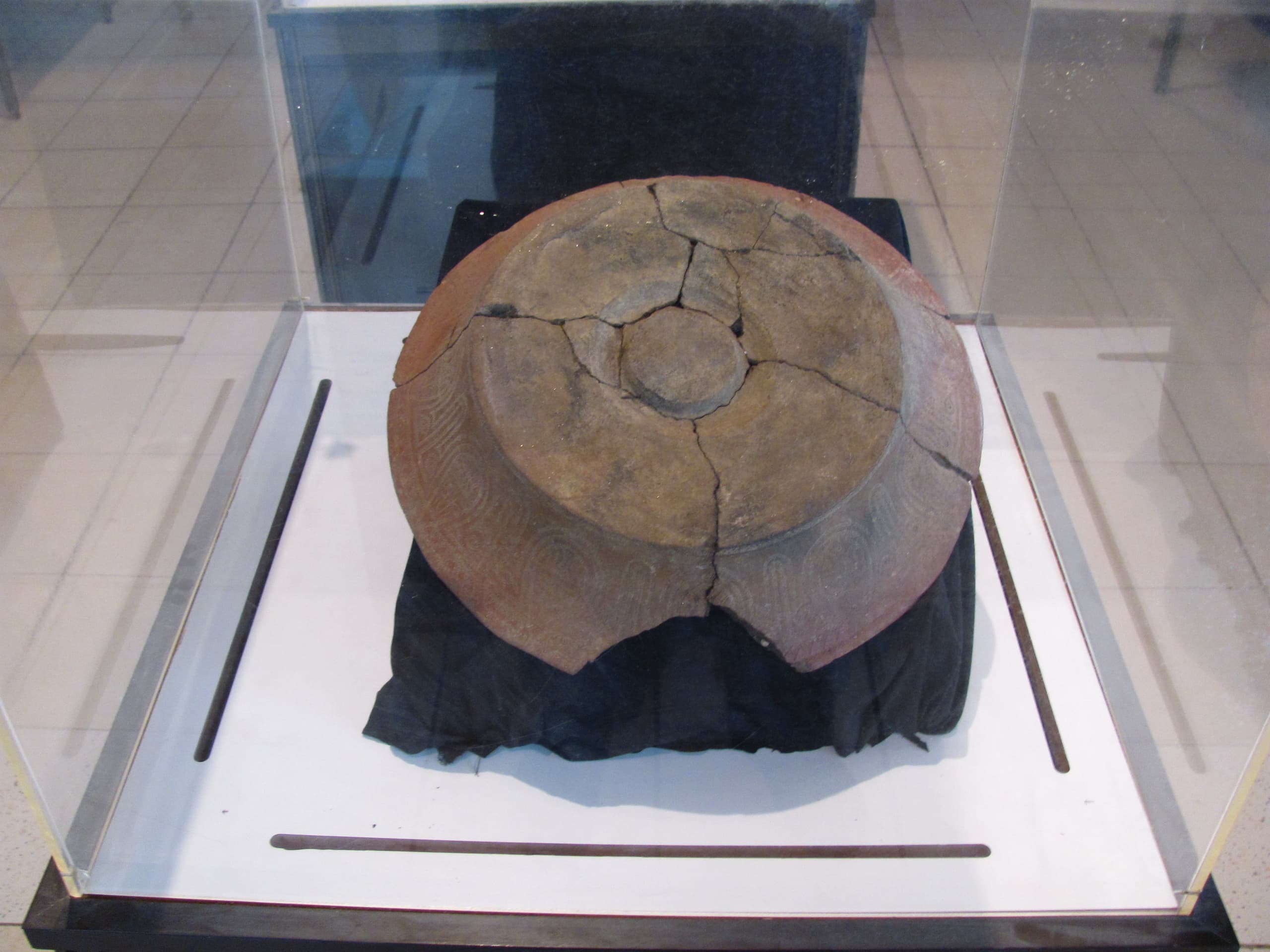
Comb-stamped dentate bands
The geometric patterns were made by pressing a toothed implement — dentate means toothed — into the surface of the clay before firing. The tool left a row of small rectangular impressions, which could be arranged into bands, zigzags, triangles and more complex interlocking shapes. The potter worked on wet clay, building up the design by repeating the stamp in different orientations. The technique produces a visual texture that is both regular and varied: each tooth-mark is crisp, but the cumulative pattern can be intricate.
The stylised face motif in the design field
Some Lapita pottery carries what appear to be highly abstracted faces, built from the same dentate impressions that form the geometric bands. Eyes, noses and mouths are suggested by arrangements of stamped marks rather than modelled or incised. The effect is that a face emerges from the pattern rather than sitting on top of it. Whether these represent ancestors, spirits or something else is not recorded in the archaeological evidence, and interpretations vary.
Lime infill making the pattern legible
The stamped impressions were sometimes filled with a white lime paste after firing, which made the design stand out sharply against the reddish-brown clay body. Without the infill, the pattern would be visible as texture but harder to read at a distance. The lime was a deliberate finishing step, not a side effect of use or burial. On sherds where it survives, the contrast is immediate: the design becomes graphic rather than tactile.
The story
Lapita pottery is named after an archaeological site, and it refers to a material culture associated with Austronesian-speaking people who settled Island Melanesia, Samoa and Tonga by seaborne migration between around 1600 and 500 BCE. The pottery is the most distinctive part of that culture, and it is distinctive because of its decoration: geometric patterns stamped into wet clay with a toothed tool before firing, often filled with lime paste to make the design legible.
The term dentate-stamped describes the technique. The potter used an implement with a toothed edge — possibly a carved piece of shell, wood or bone — and pressed it repeatedly into the clay surface. Each impression left a row of small rectangular marks. By varying the angle, spacing and arrangement of these impressions, potters built up bands, triangles, chevrons, lozenges and interlocking shapes. Some designs are purely geometric. Others incorporate what appear to be stylised faces, formed from the same stamped marks.
What makes this pottery archaeologically significant is its distribution. Sherds with the same design vocabulary — the same repertoire of motifs and the same stamping technique — have been found across a span of three thousand kilometres, from Island Melanesia through to Samoa and Tonga. The designs are not identical everywhere, but they share enough formal elements that archaeologists treat them as variations within a single tradition. That distribution maps a migration: people carried the pottery, and the knowledge of how to make it, across open ocean.
The Lapita people are understood to have originated from the northern Philippines, though whether they travelled directly or via the Mariana Islands, or both, is not settled. They intermarried with Papuan populations to varying degrees. They are considered the direct ancestors of the Austronesian peoples of Polynesia, eastern Micronesia and Island Melanesia. The pottery is the clearest material trace of that movement, because it is durable and because its decoration is specific enough to track.
The sherds that survive are fragments. Whole vessels are rare. What we have are broken pieces from cooking pots, storage jars and bowls, found in middens, burials and settlement sites. The designs are preserved on those fragments because they were pressed into the clay before firing, which made them permanent. The lime infill, where it was used, has sometimes survived as well, though on many sherds it has been lost and only the impressed pattern remains.
The meaning of the designs is not recorded. We do not know whether the geometric motifs had symbolic significance, whether the face-like forms represented ancestors or spirits, or whether the decoration was primarily aesthetic. Interpretations have been proposed, but they are interpretations, not evidence. What is clear is that the potters worked within a shared visual language, and that the language travelled with them.
Why it mattered then
The pottery marks a moment when people with a particular set of technologies and cultural practices moved into and across a vast region of the Pacific. The migration was seaborne, which means it required knowledge of navigation, boat-building and provisioning for long voyages. The fact that the same design vocabulary appears across three thousand kilometres suggests that the movement was not a single event but a sustained expansion, with communities maintaining contact or memory across distances. The pottery itself was functional. These were cooking pots, storage vessels and serving bowls, used in daily life. The decision to decorate them with complex stamped designs, and to fill those designs with lime paste, suggests that the objects carried social or symbolic weight beyond their practical function. Whether the decoration marked identity, status, lineage or something else is not known, but the effort involved in making the patterns indicates that they mattered. The intermarriage with Papuan populations that is recorded in the archaeological and genetic evidence shows that the Lapita people did not move into an empty landscape. They encountered existing communities and, in some places, merged with them. The pottery tradition appears to have been maintained through that process, which suggests it was part of how the Lapita people understood themselves.
Why it matters now
Lapita pottery is the clearest material evidence we have for the settlement of the remote Pacific. The migration it maps is one of the great movements of prehistory: people travelling by canoe across open ocean, carrying with them the plants, animals, tools and knowledge needed to establish new communities on islands that had not been inhabited before. The pottery connects Island Melanesia to Polynesia, and it does so with a physical object that can be dated, analysed and compared across sites. The designs themselves are still studied for what they might reveal about how the Lapita people organised their world. The geometric patterns are not random, and the recurrence of certain motifs across widely separated sites suggests that they were meaningful. Whether that meaning was religious, social, decorative or all three is debated, but the consistency of the tradition is not. The fact that the same design vocabulary appears over such a large area, and over a period of more than a thousand years, also raises questions about how knowledge and identity were transmitted. The potters who made these vessels in Samoa were working within a tradition that had begun in Island Melanesia, but they were separated from the origin of that tradition by both distance and time. How was the design language maintained? Was it taught deliberately, or did it persist through use? These are questions that the pottery poses but does not answer.
The surprising detail
The dentate-stamped designs on Lapita pottery closely resemble pottery recovered from the Nagsabaran archaeological site in northern Luzon, in the northern Philippines. The similarity is not casual: the same toothed-stamping technique, and some of the same geometric motifs, appear on pottery from both regions. This resemblance is one of the pieces of evidence that supports the understanding that the Lapita people originated in the northern Philippines. It suggests that the design tradition travelled with them, and that the pottery found thousands of kilometres away in the Pacific is part of a continuum that stretches back to a point of origin in the Philippines.
What is disputed
The route by which the Lapita people travelled from the northern Philippines is not settled. Some evidence supports a direct migration; other evidence suggests movement via the Mariana Islands; both routes may have been used. The meaning of the dentate-stamped designs is also not recorded in the archaeological evidence, and interpretations of the motifs — including whether the face-like forms represent ancestors or spirits — remain speculative.
Remember this
Lapita pottery maps a seaborne migration across three thousand kilometres of the Pacific, using a design language stamped into clay before firing.
Test yourself
Why does the fact that the same design vocabulary appears across such a wide area matter more than if each island had developed its own unrelated pottery tradition?
Because it demonstrates that the people who made the pottery were connected — either by recent migration, by sustained contact, or by a shared cultural memory strong enough to preserve specific design elements over great distances and long spans of time. If each island had developed its own unrelated tradition, we would have evidence of separate communities making pottery independently. The shared vocabulary tells us instead that the settlement of the region was a linked process, not a series of isolated events. It allows archaeologists to trace the route of the migration and to understand that the communities scattered across Island Melanesia, Samoa and Tonga were part of a single, extended movement. The pottery becomes a map.
Go deeper
Image: Torbenbrinker, CC BY-SA 3.0. Licence: CC BY-SA 3.0. Source.