I · THE OBJECT · BRITISH MUSEUM
The Lycurgus Cup
▶ Listen · narrated
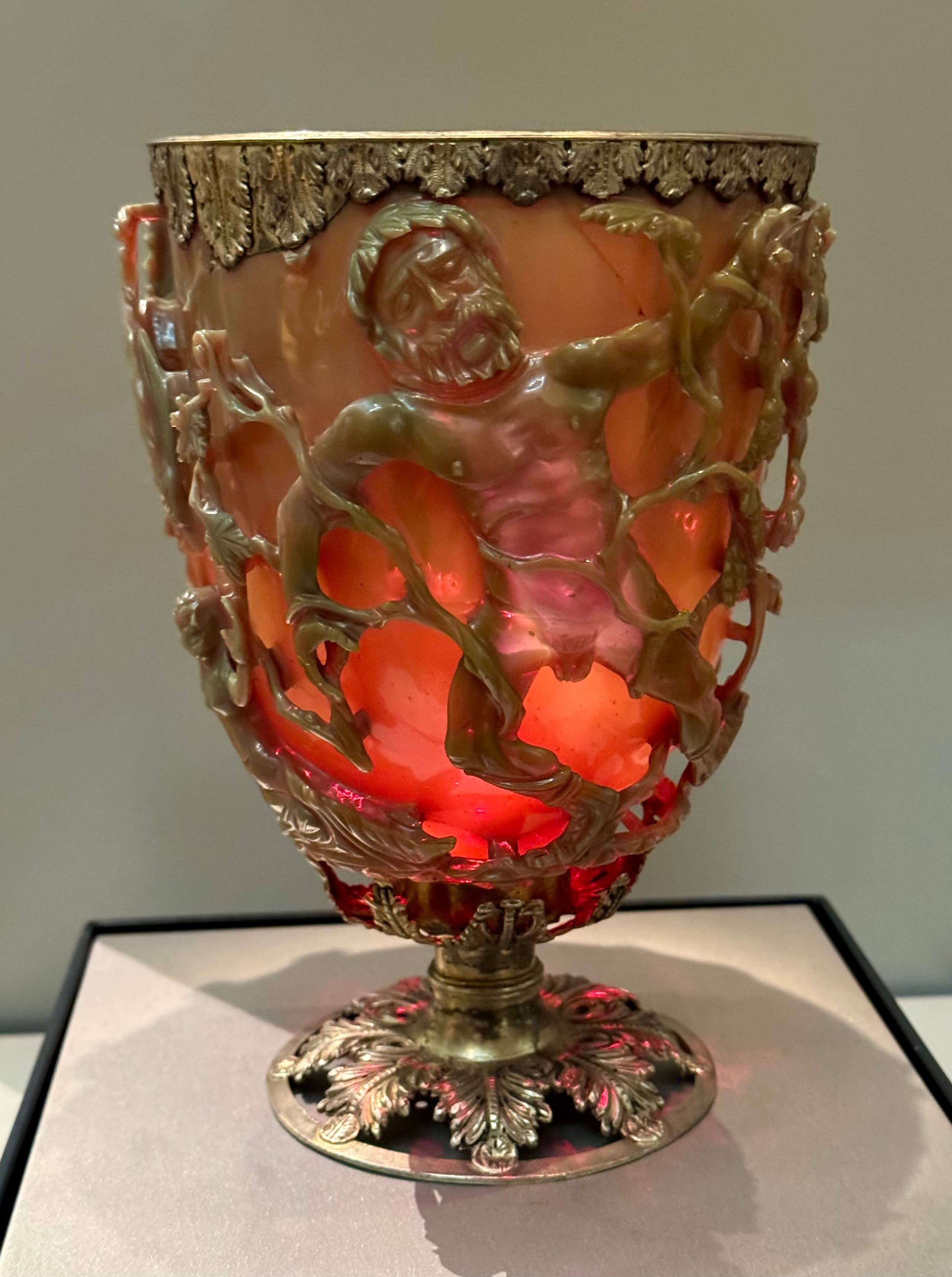
The colour of glass usually stays put. This cup shifts from green to red depending on where you stand, because of metal particles far too small to see.
At a glance
- Date
- 4th century
- Material
- Dichroic glass, silver
- Museum number
- 1958,1202.1
- Type
- Cage cup (diatretum)
Look closer
The cage floats free of the inner wall
The outer layer of carved figures and vines does not rest against the cup beneath. It has been cut and ground away until parts of it hang in the air, attached only at specific points. This technique — called a cage cup or diatretum — means the glassmaker started with a thick-walled vessel and carved it down, removing material until what remained was a decorative shell separated from the inner surface by empty space. Many sections are completely undercut.
Dichroic means two colours, not two shades
When lit from behind, the cup glows red. When lit from the front, it appears green. This is not a trick of shadow or angle — the glass itself transmits and reflects different wavelengths depending on the direction of the light. The effect comes from nanoparticles of gold and silver dispersed throughout the glass in colloidal form — particles so small that they interact with light at the scale of its wavelength, scattering some colours and letting others pass through.
The scene shows a king trapped by a vine
The carved figures show King Lycurgus entangled in a vine. According to myth, he tried to kill Ambrosia, a follower of the god Dionysus. She was transformed into a vine that coiled around him, restraining and eventually killing him. Dionysus and two followers appear in the scene, taunting the trapped king. Most Roman cage cups carry geometric patterns; this one carries a narrative.
The story
The cup is made of dichroic glass — glass that shows one colour when light passes through it and another when light reflects off it. Here, transmitted light makes it glow red, while reflected light renders it green. The effect depends on tiny particles of gold and silver, dispersed in the glass at a scale far below what the eye can resolve. These nanoparticles are small enough to scatter light according to its wavelength, which means different colours behave differently: some pass through, others bounce back.
How Roman glassmakers achieved this remains unclear. The quantities of metal involved are minute, and the process was probably not well understood by those who made the cup. It may have been discovered by accident — contamination from gold or silver dust in the workshop, residue on tools, or trace amounts of gold present in silver alloy. Most Roman silver contains small proportions of gold, and the glassmakers may not have known gold was involved at all, given how little was needed. The handful of other surviving fragments of Roman dichroic glass vary considerably in their colours, which suggests the technique was neither controlled nor reliably reproduced.
The cup is also a cage cup, or diatretum. The outer surface has been cut and ground back until the decorative layer floats free of the vessel wall, attached only at specific points. This required starting with a thick blank of glass and removing material until what remained was a fragile openwork shell. The labour involved was considerable, and the risk of breaking the piece during manufacture was high.
The carved scene depicts a moment from myth: King Lycurgus, who tried to kill Ambrosia, a follower of Dionysus. She was transformed into a vine, which coiled around the king and restrained him. The cup shows him trapped, with Dionysus and two companions looking on. The narrative is legible in three dimensions as the figures wrap around the vessel.
Why it mattered then
Cage cups were luxury objects, expensive and fragile, made for display rather than daily use. The labour required to carve one — and the risk of ruining it in the final stages of grinding — meant they signalled wealth and access to specialist craft. Adding the dichroic effect, whether by intention or happy accident, would have made this cup still more remarkable, as it behaved in a way that other glass did not. The myth of Lycurgus carried a warning about hubris and the consequences of offending the gods. Dionysus was a god of wine, transformation and boundary-crossing, and the story of a king trapped and killed by a vine would have been legible to anyone familiar with Greek and Roman mythology. Displaying such an object at a gathering, where wine was served and the cup's colour could shift under different lighting, would have made the mythological reference part of the social performance.
Why it matters now
The cup matters now because modern analysis has explained what Roman glassmakers could not. Researchers examining fragments under an electron microscope identified the gold and silver nanoparticles responsible for the colour shift. The particles measure around 70 nanometres across — small enough to interact with light at the wavelength scale, which is what produces the dichroic effect. This means Roman craftsmen were working with nanotechnology over a millennium and a half before the term existed, even if they did not understand the mechanism. The discovery has implications beyond archaeology. The principle behind the cup — using nanoparticles to manipulate light — is the same principle used in modern sensors, optical devices and even pregnancy tests. A technique stumbled upon in a Roman workshop, probably by accident, turns out to describe a physical phenomenon that underpins contemporary technology. The cup is evidence that sophisticated material effects do not require sophisticated material theory; they require trial, error and the willingness to reproduce something that works without knowing why.
The surprising detail
The process used to make the dichroic glass remains unclear, and it is likely that the glassmakers themselves did not understand or control it. The effect may have come from accidental contamination — gold or silver dust left in the workshop, residue on tools, or trace gold in the silver alloy. The few other surviving fragments of Roman dichroic glass vary considerably in their colours, which suggests the technique was neither stable nor reliably repeated. What this means is that one of the most technically complex objects to survive from Roman glassmaking may have been the result of a mistake that someone noticed and tried to reproduce, without ever knowing exactly what had caused it.
What is disputed
The process by which the dichroic effect was achieved is not known. It may have resulted from deliberate addition of metal to the glass mix, or from accidental contamination in the workshop. The glassmakers may not have understood what caused the colour shift, and the variation in other surviving fragments suggests the technique was neither controlled nor reliably reproduced.
Remember this
Roman glassmakers created a colour-shifting effect using nanoparticles of gold and silver, probably without understanding the mechanism — or even knowing gold was involved.
Test yourself
The dichroic effect depends on nanoparticles of gold and silver in the glass. Why might the Roman glassmakers not have known gold was involved, even if they were trying to reproduce the effect?
Because the quantities of gold required are so small that they could have been present as trace contaminants rather than deliberate additions. Most Roman silver contained small proportions of gold, so adding silver to the glass mix might have introduced gold without the maker's knowledge. Alternatively, gold dust or residue from other work in the workshop — left on tools or in the air — could have been enough. The glassmakers may have believed they were working only with silver, or with an impurity they could not identify, and the fact that other surviving fragments of dichroic glass vary in colour suggests they never controlled the process reliably. A technique can be reproduced without being understood, especially when the active ingredient is invisible and present in minute amounts.