I · THE OBJECT · BRITISH MUSEUM
Ram in a Thicket
▶ Listen · narrated
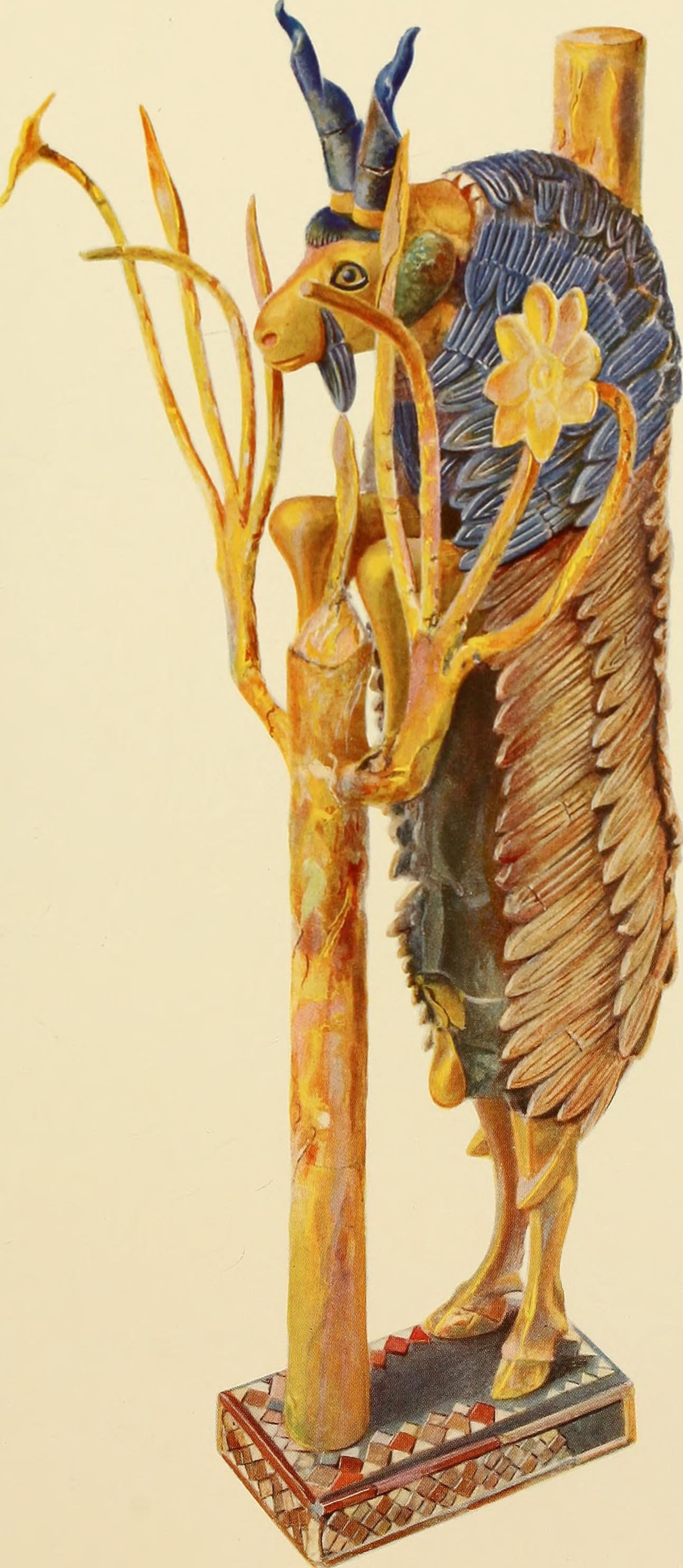
This figure reached the museum as a pile of gold foil, shell and stone. The animal you see standing upright was assembled from those pieces, held together by guesswork and wax.
At a glance
- Date
- 27th century BC
- Culture
- Sumerian
- Discovery
- 1928, Ur
- Collection
- British Museum
Look closer
Gold over wood, now gold over wax
The figure was built around a wooden core, covered with sheet gold hammered over bitumen. The wood decayed in the ground over four and a half thousand years, leaving the gold as a collapsed shell. What holds the figure upright now is modern material: wax poured into the space where wood once was, shaped to match what the excavator thought the original form had been.
The name is a guess
"Ram in a Thicket" borrows from the Book of Genesis, where Abraham finds a ram caught in a thicket and sacrifices it in place of his son. The figure is a goat, not a ram — the horns curl back rather than spiral — and it is not caught in anything. It stands upright on its hind legs, forelegs resting against a flowering plant. The name stuck because the excavator used it, but it describes a biblical scene, not a Sumerian one.
A pair, not a single object
Two of these figures were found at Ur. One is in the British Museum; the other is in the University of Pennsylvania Museum. They were discovered together and are similar in form and material, though not identical. Whether they flanked an entrance, supported a piece of furniture, or stood as offerings is not recorded in the surviving evidence.
The story
In 1928, excavators working at a cemetery at Ur, in what is now southern Iraq, uncovered two figures, each about half a metre tall, buried in a context dated to the 27th century BC. They had been made by hammering gold foil over a wooden core coated with bitumen, with details added in lapis lazuli and shell. The wood had rotted away entirely, and the gold had collapsed into the space it left.
The excavator lifted the fragments carefully and shipped them to the museum, where conservators faced a problem: the object as found was a pile of materials, not a standing figure. To display it, they had to decide what shape it had held. Field notes and photographs recorded the position of the pieces as they lay in the ground, and from that evidence the conservators inferred a structure. They poured wax into the hollow where the wood had been, shaping it to support the gold in what they believed was its original form. The figure you see standing upright, forelegs raised, is that reconstruction.
This is not a scandal. It is how archaeological objects are made visible. When organic materials decay — wood, leather, textile, bone — what survives is often the more durable substances that were attached to them: metal, stone, glaze. The original structure is gone, and the archaeologist or conservator must decide whether to leave the fragments as they were found, flat and unintelligible, or to rebuild a three-dimensional form from the evidence. Both choices are honest, but they answer different questions. Leaving the pieces flat preserves the state of survival; rebuilding them preserves the state of use.
The risk in rebuilding is that the reconstruction may be wrong. The conservator works from the position of the fragments, from knowledge of other objects, and from what seems structurally plausible — but those inferences are not certainties. A different reading of the evidence might produce a different form. The wax inside this figure holds one interpretation of what the wood had been. It is a defensible interpretation the conservators could make from the evidence they had, but it is still an interpretation.
What matters is that the reconstruction is visible as such. The gold is ancient; the wax is modern. A label that states this plainly is not admitting a failure — it is describing the object accurately. Most of what a visitor sees in a museum case has been cleaned, stabilised, reassembled, or filled. That is not a degradation of the evidence. It is the work that makes the evidence legible.
Why it mattered then
The figures were found in a cemetery context at Ur, dated to the 27th century BC, a period when the city was a centre of Sumerian culture. Their materials — gold, lapis lazuli, shell — and their workmanship suggest they were valuable objects, though their function is not recorded. They may have been offerings, or they may have had a structural role, supporting or flanking something else. The motif of an animal standing upright against a plant appears elsewhere in Sumerian art, but the specific meaning of the motif is not preserved in texts from the period. What is clear is that someone chose to bury these figures, and that the burial was careful enough that they survived in a condition that allowed reconstruction.
Why it matters now
This figure is a lesson in how much of what we see in museums is the product of decisions made after the object was found. It is a reminder that archaeological display is not passive — it is an active interpretation of fragmentary evidence. That does not make the display dishonest, but it does make it provisional. A different conservator, or a different reading of the field notes, might have produced a different form. The figure as it stands is a reconstruction the evidence allowed, but it is not the only one that could have been made. Understanding that is part of understanding what a museum object is: not the past itself, but a bridge built from surviving materials and informed inference, crossing the gap between what was buried and what we can see.
The surprising detail
The excavator called them "rams" and linked them to the Genesis story, but the animals are goats. The horns curve backward in the manner of a goat, not forward and spiralling like a ram's. The biblical reference caught on because it was vivid, but it describes a scene from a text written more than a thousand years after these figures were made, in a different culture and language. The name is now too embedded to dislodge, but it is a reminder that even the words we use to describe an object can be reconstructions, shaped by what the finder thought he recognised rather than by what the evidence records.
What is disputed
The original structure is not known with certainty. The figure as displayed is a reconstruction based on the position of fragments as they were found and on the conservators' understanding of how the materials would have been assembled. A different interpretation of the evidence might have produced a different form. The wooden core is entirely modern, and the arrangement of the gold, lapis and shell reflects one plausible reading of the archaeological record, not a recorded blueprint.
Remember this
The figure is ancient; the form is modern. Most museum objects are assemblies of both, and that is how archaeology makes the past visible.
Test yourself
Why is it more honest to rebuild a collapsed object with modern materials like wax than to leave the fragments as they were found?
Neither choice is more honest — they are honest about different things. Leaving the fragments flat is honest about the state of survival: it shows what the ground gave back. Rebuilding the form is honest about the state of use: it shows what the object was when it functioned. The dishonesty would be to rebuild it and not say so, or to present the reconstruction as certain when the evidence allows more than one reading. As long as the label states what is ancient and what is modern, both choices are legitimate. The question is which question you are answering: what survived, or what was made.
Go deeper
Image: Joint Expedition of the British Museum and of the Museum of the University of Pennsylvania to Mesopotamia; Hall, H. R. (Harry Reginald), 1873-1930, ed; Woolley, Leonard, Sir, 1880-1960; Legrain, Leon, 1878- ed, No restrictions. Licence: No restrictions. Source.