I · THE OBJECT · BRITISH MUSEUM
The Battersea Shield
▶ Listen · narrated
This shield could not have protected anyone. The bronze is too thin, the decoration too delicate. It went into the river as an offering, not as wreckage.
At a glance
- Date
- 5th century BC, or possibly 350 BC
- Material
- Bronze sheet over wood (wood lost)
- Height
- 77.7 cm
- Found
- 1857, near Chelsea Bridge
Look closer
Bronze over wood, not bronze alone
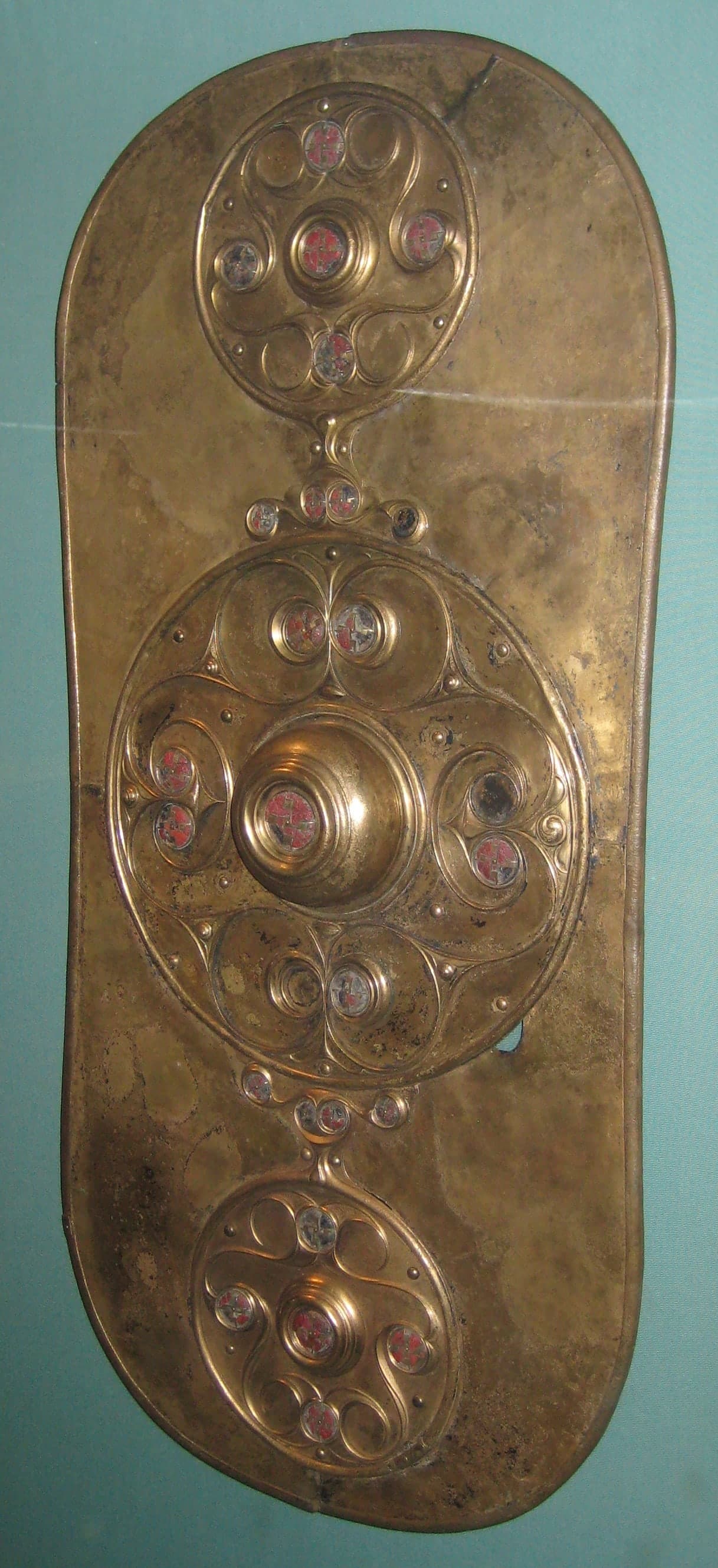
What survives is a thin sheet of bronze that once covered a wooden core. The wood is gone — it rotted in the riverbed — so the shield you see is the decorative skin, not the structural body. The bronze would have been fixed to the wood with small rivets or adhesive. Without the wood behind it, the sheet metal is fragile. This was never a combat shield in the sense of something you would raise against a sword edge or a spear point.
Circles within circles
The decoration is built from circular motifs arranged symmetrically down the length of the shield. Each roundel is made by hammering the bronze from behind so that raised bosses and curves stand proud of the surface. The technique is called repoussé — the metal is worked from the reverse side, not carved or cast. The curves and spirals follow a style found across Celtic Europe in this period, a visual language of flowing lines and rotational symmetry with no straight edges.
Placed in the river, not dropped
The shield was found in the Thames near Chelsea Bridge in 1857. The location and condition suggest it was deposited deliberately, not lost. Rivers in ancient Britain were places where people put valuable objects — weapons, tools, ornaments — in acts that may have been votive, marking a boundary, a treaty, or a death. The Thames has yielded hundreds of such objects. The shield went into the water intact, not as battlefield debris, and stayed there until the riverbed was dredged.
The story
The object is a bronze covering for a shield, not a shield that could have been used in fighting. The bronze sheet is thin, the decoration delicate, and the whole construction too light to stop a weapon. It was found in the Thames near Chelsea Bridge in 1857, and the circumstances of its deposition — intact, in a river — suggest it was placed there on purpose.
The date is uncertain. It has been assigned to the fifth century BC and also to around 350 BC, both based on the style of the decoration. The curves and circles belong to a tradition of Celtic metalwork that spread across Europe during those centuries, but stylistic dating is not precise and the range reflects that uncertainty.
The bronze was hammered into shape from behind, a technique called repoussé. The craftsman worked on the reverse side of the sheet, pushing the metal outward to create raised bosses and flowing curves on the front. The design is symmetrical, with three large circular panels arranged down the length of the shield, each filled with spirals and smaller roundels. The effect is one of controlled repetition and rotational balance.
The wooden core is lost. Wood does not survive long immersion in riverbeds, and what remains is the bronze skin alone. The shield would have been assembled by fixing the metal sheet to a wooden backing, probably with rivets or an adhesive, and fitting a grip on the reverse. Without the wood, the bronze is fragile and would buckle under impact.
The Thames has produced many objects like this — weapons, tools, personal ornaments — deposited in the water in the centuries around the shield's date. The pattern is widespread in Britain and in parts of Europe: rivers and bogs were places where people put valuable things, and the deposits seem to have been deliberate. Whether they were offerings to gods, markers of political agreements, or acts tied to funerals and succession is not recorded. What is clear is that the river was not just a boundary or a transport route. It was a place where things were given up.
The shield was dredged from the riverbed in 1857 and passed into the collection of the British Museum. A replica is held by the Museum of London.
Why it mattered then
The shield was made to be seen, not to be used in combat. Its thinness and its decoration mark it as a parade object or a votive piece — something carried in ceremony or given as an offering. The river deposit suggests the latter. Placing valuable objects in water was a recurring practice in ancient Britain, and the Thames was a site where this happened repeatedly over centuries. The act of deposition may have been tied to religious belief, to political ritual, or to both. Rivers were boundary places, and gifts to them may have marked agreements, transitions, or dedications. The choice of a decorated shield rather than a plain one suggests the act was public or that the object's appearance mattered to whoever placed it there. The shield was not hidden or discarded. It was given.
Why it matters now
The shield is evidence that rivers in ancient Britain were more than routes or resources. They were places where people performed acts that required witnesses and cost them wealth. The pattern of river deposits — weapons, tools, ornaments — is consistent enough to suggest shared practices across regions and across time, even where no written record survives. The object also shows the reach of a decorative tradition. The curves and spirals on the shield are part of a visual language that appears on metalwork from Ireland to the Balkans during these centuries. The style is recognisable, but the meanings it carried are not recorded. The shield is a fragment of a culture that left objects but no texts, and it raises questions that cannot be answered from the material alone.
The surprising detail
The shield was found during dredging work near Chelsea Bridge in 1857. The discovery location is now part of central London, but in the ancient period it was a tidal stretch of the Thames, away from any known settlement. The river was not just a place people crossed or fished in. It was a place they went to in order to deposit things, and the deposits were not casual losses. The Thames has yielded swords, spearheads, axes, cauldrons, and human skulls, all from the centuries around the shield's date, and almost all from the river itself rather than from settlements on the banks.
What is disputed
The date is disputed. The shield has been assigned to the fifth century BC and also to around 350 BC, both based on the style of the decoration. Stylistic dating for Celtic metalwork is not precise, and the range reflects genuine uncertainty. The original function — whether parade armour, votive object, or both — is also inferred from the thinness of the bronze and the context of the find, not from any recorded account.
Remember this
Too thin to block a blow, too decorated to be expendable — and thrown into the river anyway.
Test yourself
If the shield was too fragile for combat, why make it in the form of a shield at all? Why not a plaque or a disc?
Because the form carried meaning. A shield shape, even a non-functional one, signalled protection, status, or martial identity in a way that an abstract decorated disc would not. The object was made to be recognised as a shield, and that recognition mattered to whatever act it was made for — whether that was a parade, a dedication, or a river offering. The form was part of the message. A lesson that applies beyond this object: ritual and display often require objects to look like the things they represent, even when they do not need to function as those things.