I · THE OBJECT · BRITISH MUSEUM
Gebelein Man
▶ Listen · narrated
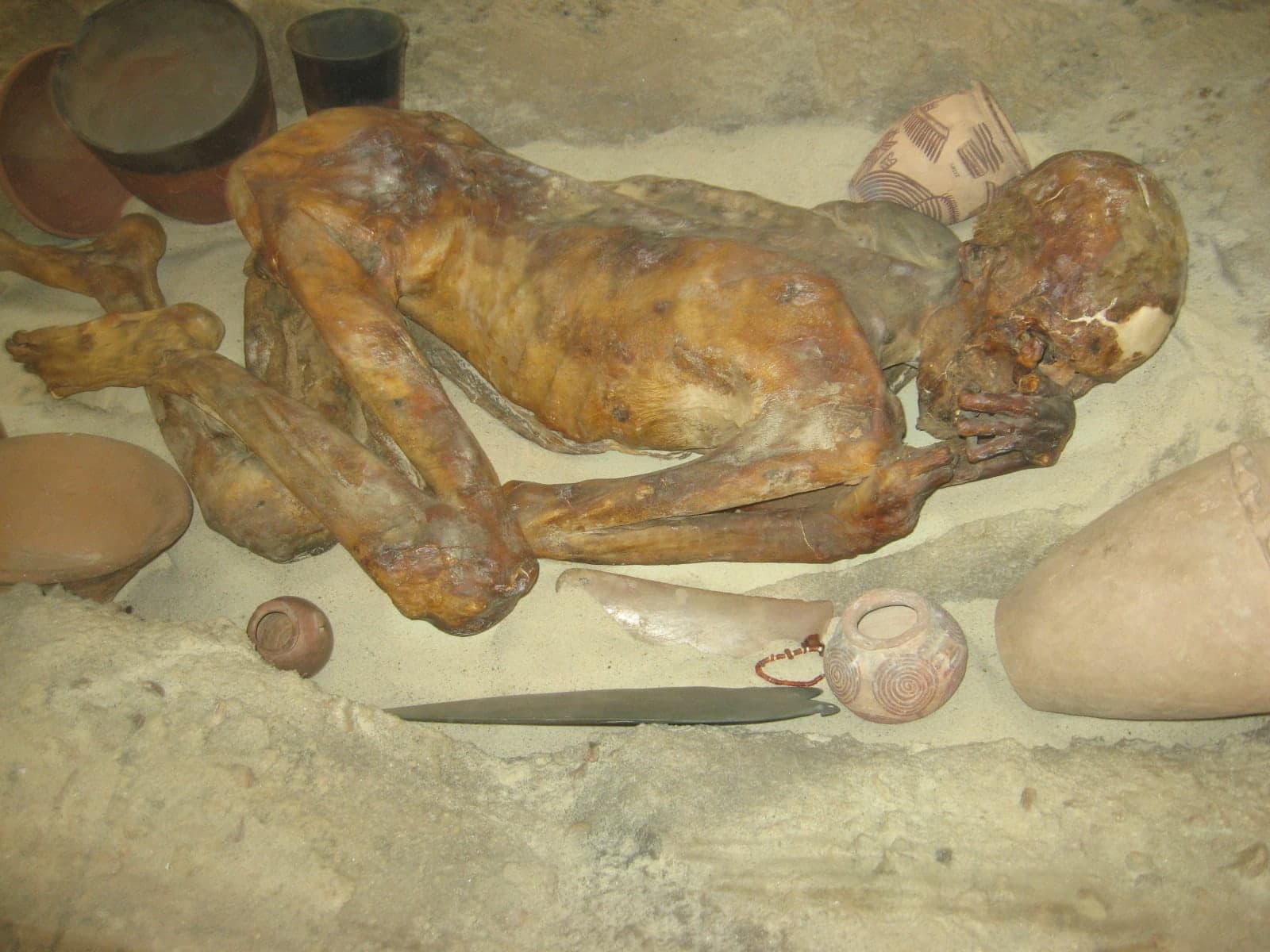
Egypt is famous for embalming, but this man was never embalmed. The sand did the work, and kept him intact for five thousand years.
At a glance
- Date
- c. 3400 BC, Late Predynastic period
- Radiocarbon range
- 3341–3017 BC at 95.4% probability
- Findspot
- Gebelein, Upper Egypt
- Excavated
- 1896 by Wallis Budge
- Acquired
- British Museum, 1900
Look closer
The hair and skin are real
The ginger-coloured hair visible on the scalp is the person's own, preserved by contact with dry sand. The skin, though darkened and leathery, is also original tissue, not wrapping or coating. Mummification in pharaonic Egypt involved removing internal organs, treating the body with natron salt, and wrapping it in linen. None of that happened here. This body was placed directly into sand, in a shallow grave, and the heat and aridity of the desert drew moisture out faster than bacteria could cause decay. The process is called natural desiccation.
The wound in the back
The museum's object record describes a penetrating wound to the upper left back. CT scanning has made that wound visible in detail: a blade entered from behind, between the ribs, and the injury would have been fatal. Whether the death was murder, execution, or something else is not recorded. The body was buried in a flexed position, lying on the left side, which was the usual arrangement in these graves. No written account survives from this period — writing in Egypt begins more than five hundred years later — so the circumstances are silent.
Tattoos, visible only under infrared
Infrared imaging published in 2018 identified figural tattoos on the skin of this body and on another from the same site, a female burial. The tattoos are not visible to the naked eye under ordinary light, but infrared reveals the pigment. The images are figurative — they depict recognisable shapes, not just geometric patterns. The publication does not specify what the figures represent. Tattooing this early is rare in the archaeological record, though that may reflect preservation rather than practice.
The story
The body now called Gebelein Man was buried in a shallow sand grave on the eastern slopes of a hill at Gebelein in Upper Egypt, sometime around 3400 BC. The grave was not elaborate. The person was placed in a flexed position, lying on the left side, and covered with sand. Pots and flints were recorded at the time of excavation as grave goods, but they were not acquired by the museum and their location now is unknown.
The sand preserved the body by accident, not by design. In the hot, dry conditions of the Egyptian desert, moisture left the tissues faster than decay could take hold. Bacteria need water to break down organic material, and in a sand grave they do not get it. The result is natural desiccation: the body dries out and remains intact, skin and hair included, without any intervention. Egyptians in later periods would develop elaborate embalming techniques — removing organs, treating the body with natron salt, wrapping it in linen — but none of that had been invented yet. This burial precedes the pyramids by three and a half thousand years, and it precedes the invention of writing in Egypt by more than five centuries.
The body was excavated in 1896 by Wallis Budge, who was Keeper of Egyptian and Assyrian Antiquities at the British Museum at the time. The museum acquired it in 1900, and it has been on public display since 1901. The current display places it in a reconstructed sand grave in Room 64.
CT scanning, carried out in recent decades, revealed a penetrating wound to the upper left back. A blade entered between the ribs, and the injury would have been fatal. Whether this was murder, execution, or death in some other violent encounter is not known. The body was buried in the usual way for the period, which does not settle the question.
Infrared imaging published in 2018 identified figural tattoos on the skin, not visible under ordinary light. Another body from the same site, a female burial, also bears tattoos. The images are figurative, but what they depict is not specified in the publication. Tattooing this early is rarely preserved, so it is unclear whether the practice was common or exceptional.
Why it mattered then
This burial belongs to a period when Egyptian society was becoming more stratified and more centralised, but had not yet developed the institutions we associate with pharaonic Egypt. There were no pyramids, no writing, no state-sponsored temples. Burial practice in this period was relatively uniform: shallow graves in sand, bodies in flexed positions, a few grave goods. The preservation was unintentional, a side effect of the environment rather than a goal. The tattoos, if they were common, suggest a visual culture that has largely disappeared. Figural images on skin are fragile evidence, dependent on exceptional preservation, so the archaeological record is thin. The grave goods — pots and flints — were typical of the period, but they were not kept with the body and so cannot be studied now.
Why it matters now
This body is evidence of what happens when a burial practice stops. Later Egyptian mummification was deliberate, expensive, and effective, but it was also a departure. The sand graves that preserved bodies like this one were abandoned once embalming was developed, and later burials in coffins and tombs, away from direct contact with sand, often decayed completely. The irony is that the older, simpler method worked better by accident than many later techniques worked by design. The CT scanning and infrared imaging are examples of how museum collections can be re-examined with new tools. The wound in the back was not visible to Budge in 1896, and the tattoos were not visible to anyone until infrared imaging was applied more than a century later. The body has been on display since 1901, but what we can learn from it has changed. The ethical questions around displaying human remains are live ones. The British Museum's current policy treats human remains with particular care, and the display of this body is accompanied by explanation of its context and significance. Some argue that remains this old, from a culture with no living representatives to speak for them, occupy a different category from more recent burials. Others argue that all human remains deserve the same consideration. The museum's position is that display is justified where it serves educational purposes and is done respectfully, but the conversation continues.
The surprising detail
The body has been on public display in the British Museum since 1901, longer than almost any other object in the Egyptian collection. For much of that time it was simply called 'Ginger', a nickname derived from the colour of the hair. That name is no longer used in museum labelling, on the grounds that it is disrespectful to refer to human remains by a casual nickname. The current label identifies it by its museum number and the site name.
How it got here
The body was excavated by Wallis Budge in 1896 from a site at Gebelein in Upper Egypt, and acquired by the British Museum in 1900. Budge's excavation methods, typical of the period, did not meet modern archaeological standards, and the grave goods recorded at the time were not acquired by the museum. Egypt has made requests for the return of objects in foreign collections, though this body has not been the subject of a specific repatriation claim that the museum has made public. The British Museum's position is that its collection is held in trust for the world, and that objects are preserved and made accessible to a global audience. Critics argue that human remains and objects taken during colonial periods belong in their countries of origin.
Remember this
The sand preserved this body better than embalming preserved many later ones — accident sometimes works better than technique.
Test yourself
Why did sand graves preserve bodies in predynastic Egypt, but later burials in coffins and tombs often did not?
Sand graves worked by natural desiccation: hot, dry sand drew moisture out of the body faster than bacteria could cause decay. Later Egyptian burials moved away from direct sand contact — bodies were placed in coffins, in constructed tombs, sometimes in stone sarcophagi. These environments were less arid, and unless the body was thoroughly embalmed, decay could proceed. Embalming was an attempt to replicate artificially what the sand had done by accident, but it required skill, expense, and the right materials. When any of those were lacking, the body decayed despite the elaborate burial. The lesson is that preservation depends on environment as much as intention, and that a simple method in the right conditions can outperform a complex one in the wrong conditions.
Go deeper
Image: Jack1956. Licence: CC BY-SA 3.0. Source.