III · THE WORK · ART HISTORY
The Windows of Chartres Cathedral
▶ Listen · narrated
Most cathedrals have windows. Chartres is a stone frame built to hold glass — and the blue in that glass remains a chemical puzzle.
At a glance
- Construction
- 1194–1220
- Height
- 113 metres
- Width
- 16.4 metres
- Medium
- Pot-metal stained glass
- Type
- Catholic cathedral
Look closer
The cobalt 'Chartres blue'
The blue glass at Chartres has a depth and intensity that sets it apart from other medieval windows. The colour comes from cobalt oxide added to molten glass, but the exact proportions and the other trace elements present have not been replicated. Modern attempts produce blues that are either too pale or too purple. The original recipe was not written down, and the glass itself does not surrender the formula to analysis — the concentrations are too small and the interactions between ingredients too complex. What remains is the colour itself, still glowing after eight centuries, and no certain account of how it was made.
Lead cames drawn as part of the composition
Stained glass is held together by strips of lead called cames, which run between each piece of coloured glass. At Chartres, these dark lines are not merely structural — they are drawn into the composition as outlines, folds, features and borders. A saint's robe is shaped by the lead that divides one piece of blue glass from another. A face is defined by the came that separates the flesh-coloured glass of the cheek from the red of the lips. The glassmakers worked within the constraint that every edge would be visible, and turned that constraint into a graphic system, so that the window reads as both mosaic and drawing at once.
Donor guilds shown at the window's base
Many of the windows at Chartres were paid for by trade guilds, and the donors are depicted at the bottom of the panels they funded. Bakers, butchers, masons, furriers and water-carriers appear in small scenes showing their work — a man kneading dough, another splitting a carcass, a third carrying a barrel on his back. These images sit directly below the biblical or hagiographic scenes above them, so that the guild's labour is literally the foundation of the sacred story. It is a visual contract: the tradespeople paid for the window, and in return their work was recorded in glass and placed inside the liturgical programme of the cathedral.
The story
Chartres Cathedral was built between 1194 and 1220, on the site of earlier churches that had stood there since the fourth century. What survives today is not the original structure — at least five cathedrals occupied the site before this one — but it is the building that has lasted, and the reason it has lasted is in part because it was finished quickly. Most of the structure went up in less than thirty years, which means it has a coherence many cathedrals lack. It was conceived as a single project, and it was completed before the ambitions or the money ran out.
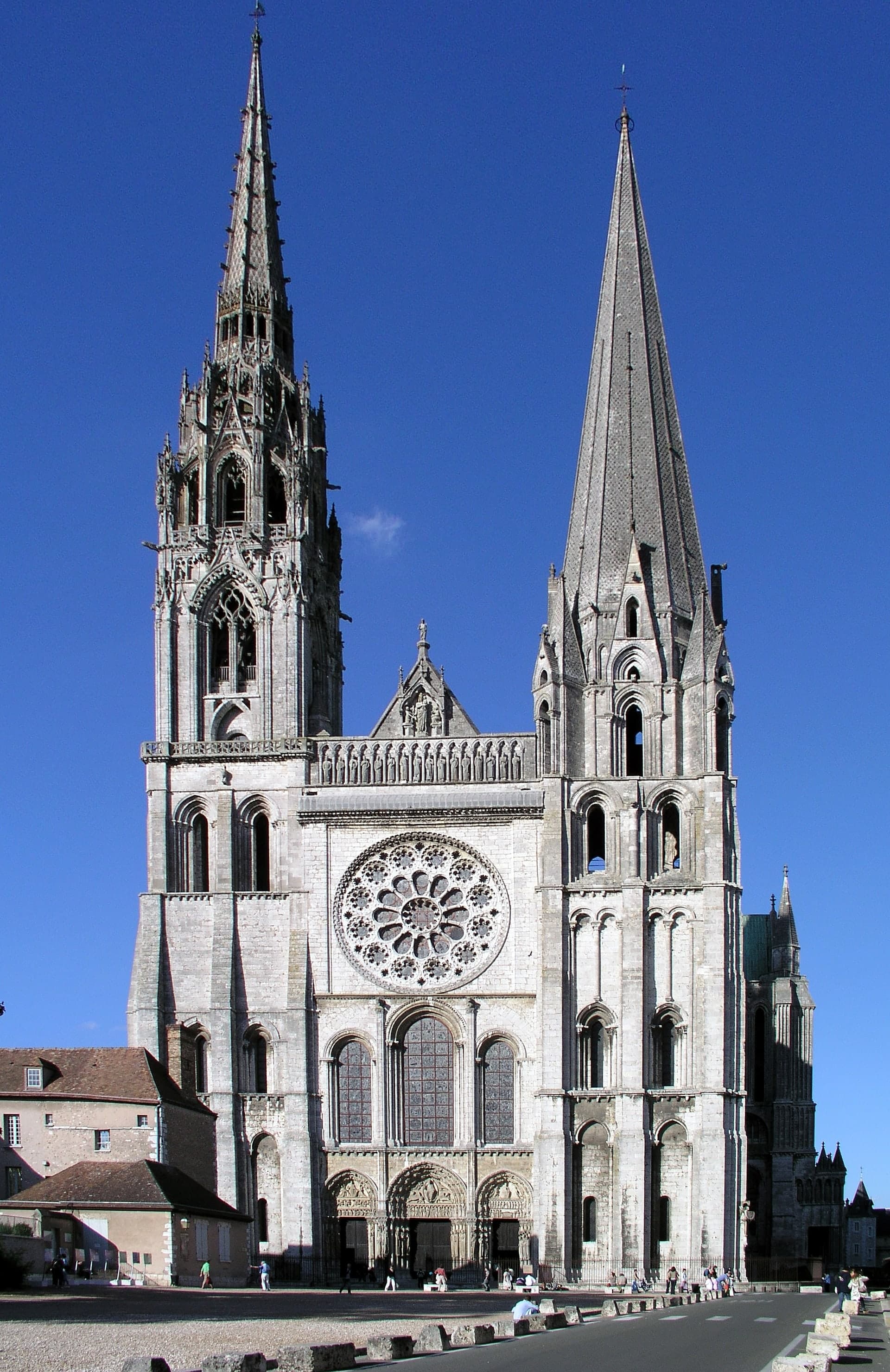
The most striking thing about the building is the amount of glass. The walls are held up by flying buttresses — stone arches that brace the walls from outside — which allowed the masons to open up the interior and fill it with windows. The result is a building where the structure is doing everything it can to get out of the way of the light. The stone is there to hold the glass, not the other way round.
The glass itself is pot-metal stained glass, which means the colour runs all the way through. The glassmakers added metallic oxides to molten glass while it was still in the pot, so the colour is not painted on but baked in. Copper makes green, manganese makes purple, cobalt makes blue. The blue at Chartres is the colour people remember. It has a particular intensity, a saturation that seems to hold its own light, and it has never been successfully reproduced. The cobalt oxide that produces it is present in tiny amounts, along with other trace elements whose exact proportions are not recorded. Modern glassmakers have tried to match it and come close, but not close enough that the difference disappears.
The windows are read from the bottom up. A rose window — a large circular window divided into segments radiating from a central point — is not a picture to be taken in all at once. It is a sequence. You begin at the bottom, where the donor guilds are often shown, and you move upward through the narrative panels, following the story as it ascends toward the centre. The structure of the window mirrors the structure of the liturgy and the hierarchy of heaven: earth at the base, the divine at the apex. The light comes through the glass in the same direction the eye is meant to move.
Most of the original glass survives. The windows have been removed at various points for safekeeping and then reinstalled. The fact that they are still there, still in place, still doing what they were made to do, is unusual. Many medieval cathedrals have lost their glass to war, fire, iconoclasm or later remodelling. Chartres kept its windows, and kept them intact, which means the building still works as it was designed to work: as a structure whose purpose is to frame coloured light.
Why it mattered then
The windows at Chartres were made for a building that had just survived a fire. In 1194, much of the earlier cathedral burned, and the decision to rebuild was not automatic. Chartres was not a wealthy town, and a project on this scale required donations from across the region. The windows were part of the fundraising strategy. Trade guilds, nobles and the royal family paid for individual panels, and their contributions were recorded in the glass itself. A window was both a devotional object and a receipt. The glass also served a liturgical function. Most of the people who entered the cathedral could not read, and the windows were a visual scripture. The life of Christ, the martyrdoms of saints, the parables and prophecies — all of it was laid out in coloured light, readable by anyone who knew the stories. The windows were not decoration. They were instruction, and they were designed to be legible from the floor of the nave, where the congregation stood. The intensity of the blue mattered because colour had theological meaning. Blue was associated with the Virgin Mary, to whom the cathedral is dedicated, and the abundance of blue glass reinforced that dedication every time the sun came through. The building was not neutral space. It was a constructed argument about heaven, and the glass was the medium of that argument.
Why it matters now
Chartres Cathedral remains a functioning cathedral, which means it is still used for the purpose it was built for, and it is also a destination for tourists and scholars who come to see the glass. The windows have been studied, photographed, measured and copied, but the blue has not been replicated. That failure is itself significant. It suggests that medieval craft knowledge was more specific and less transferable than we sometimes assume, and that techniques can be lost even when the objects themselves survive. The building also matters as evidence of what was possible in the early thirteenth century. The engineering required to support that much glass, the logistics of coordinating the work of masons, glaziers, carpenters and sculptors, the money required to pay for it all — Chartres is a record of what a medieval town could do when it organised itself around a single project. The fact that the work was finished in less than thirty years is itself remarkable, and it explains why the building has the unity it does. The windows are still there, still in place, and they still glow. That continuity is rare. Most medieval glass has been replaced or restored so heavily that what survives is as much modern as medieval. Chartres kept its windows, and kept them whole, which means the light inside the building today is the light the builders intended. That is not a small thing.
The surprising detail
The north spire of Chartres Cathedral was built more than three centuries after the rest of the building. The main structure was completed around 1220, but the north spire was not added until 1507–1513. It is built in the Flamboyant style, which is a later and more ornate phase of Gothic architecture, and it contrasts sharply with the plain pyramid of the south spire, which was finished around 1160. The result is a building with two spires that do not match, one medieval and one early Renaissance, standing side by side on the same façade. The asymmetry was not planned, but it has become part of what the building is.
What is disputed
The exact recipe for the cobalt blue glass at Chartres is not recorded, and modern attempts to reproduce it have not succeeded in matching the colour precisely. The reasons for this are not fully understood — the concentrations of cobalt oxide and other trace elements are too small to be measured with certainty, and the interactions between ingredients in the original pot-metal process are complex. What is certain is that the colour has not been replicated, and that the glass itself does not surrender the formula to analysis.
Remember this
Chartres was designed as a frame for glass, and the blue in that glass has never been reproduced.
Test yourself
A rose window at Chartres is read from the bottom up, not taken in all at once. What does this upward movement mirror, and why does the structure of the window reinforce it?
The upward movement mirrors both the liturgical progression from earth to heaven and the hierarchy of the divine. The donor guilds and earthly trades are shown at the base, and the narrative ascends through biblical scenes toward the centre, where the divine or the Virgin is typically placed. The structure of the window — radiating segments that draw the eye inward and upward — reinforces this movement by making it the natural way to look. The light also comes through in the same direction the eye is meant to move, so the physical experience of reading the window aligns with its theological meaning. This is not decoration. It is a designed sequence, and the glass is doing the work of instruction.
Go deeper
Image: BT, Public domain. Licence: Public domain. Source.