III · THE WORK · ART HISTORY
Cueva de las Manos
▶ Listen · narrated
The hands were made by blowing pigment around a living palm pressed flat against stone. The pattern of which hands appear tells us which hand did the blowing.
At a glance
- Location
- Santa Cruz province, Argentina
- Culture
- Tehuelche
- Date range
- 7300 BC to AD 700
- Rock type
- Ignimbrite
- Technique
- Stencilled by spraying pigment
Look closer
Overlapping stencils from different generations
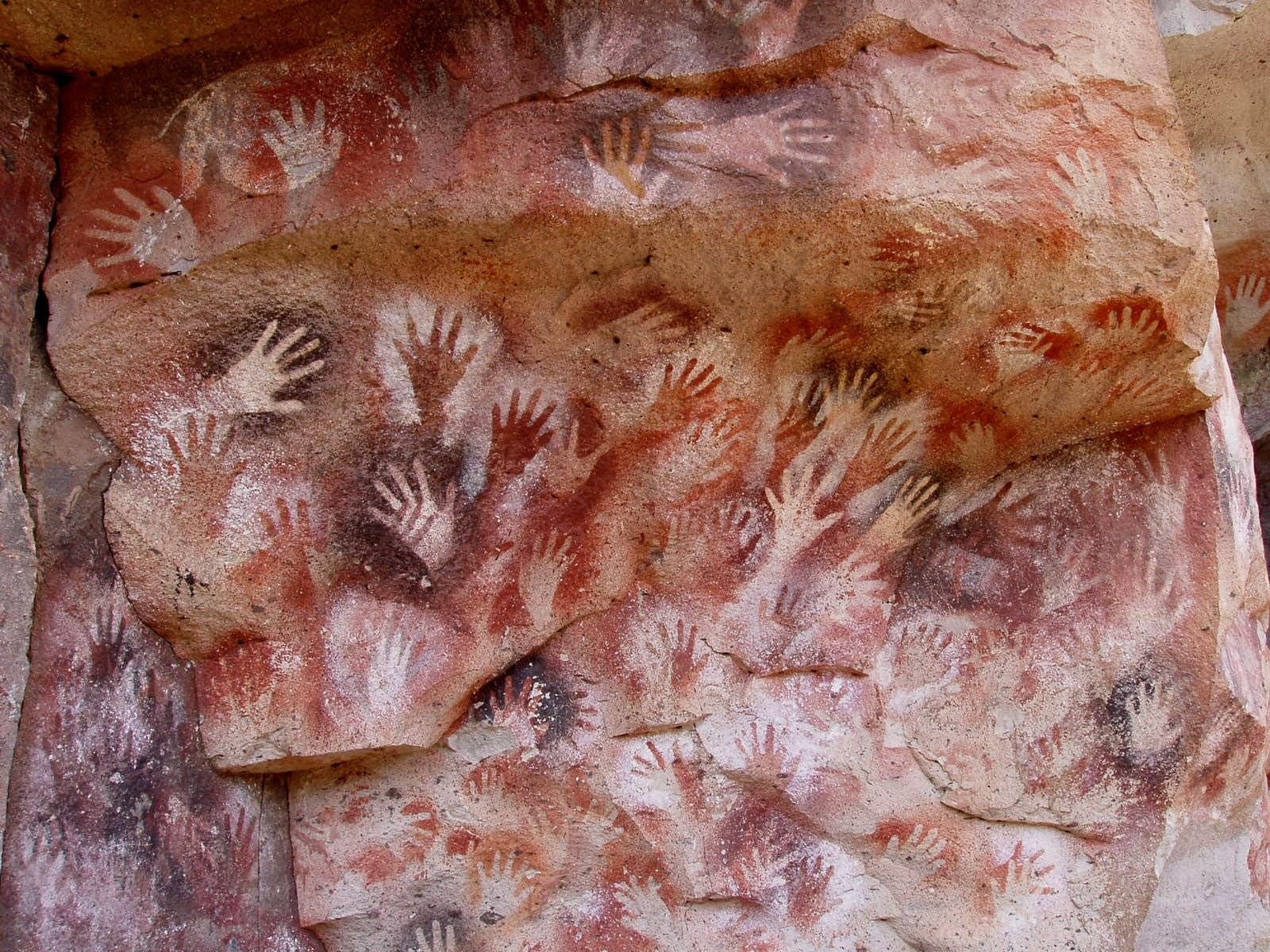
The hands are not arranged in neat rows. They overlap, crowd, layer on top of one another in collages that built up over centuries. Some are sharp-edged and vivid, others faded to shadows. The layering means that what you see is not a single event but a surface returned to again and again, each generation adding its marks to those already there. Where one hand crosses another, you can sometimes read the sequence: which came first, which was laid on top.
The guanaco hunting scene
Alongside the hands are images of guanacos — wild relatives of the llama, native to the region and hunted by the groups who made the paintings. The animals are shown in profile, often in groups, some with lines or marks that may represent weapons or hunting tools. The guanaco scenes belong to the same tradition as the hands, made with the same mineral pigments, part of the same long span of use. They record what the people who left their handprints were doing in the landscape around the cave.
Negative-space technique: the hand is unpainted
The hand you see is not painted. It is the rock surface, left untouched while pigment was blown around it. The artist placed a palm flat against the stone, then sprayed mineral pigment — likely through a bone pipe — over and around the fingers. When the hand was lifted, its silhouette remained as bare rock surrounded by colour. The technique is called stencilling, and it produces a reversed image: the hand is the absence, not the mark.
The story
Cueva de las Manos is a cave in the province of Santa Cruz, Argentina, named for the hundreds of hand stencils that cover its rock walls. The hands were made by pressing a palm against the stone and blowing mineral pigment around it, leaving the hand's outline in negative space — bare rock surrounded by colour. Almost all of the hands are left hands, not because the artists were left-handed but because they held the tool for spraying the pigment in their right.
The pigment was mineral-based, ground from rock and mixed to a consistency that could be blown. The remains of bone pipes have been found at the site, and these are understood to be the tools used for spraying. The artist would have filled the pipe with pigment, placed one end in the mouth, and blown a fine mist over the hand pressed to the wall. The result is a stencil: the hand itself is unpainted, defined only by the cloud of colour around it.
The hands were made over a span of eight thousand years, from 7300 BC to AD 700. This long chronology comes from three sources: radiocarbon dating of the bone pipes, radiocarbon dating of organic material in the paint itself, and stratigraphic dating — reading the layers of deposit in the cave to establish which marks are older and which are newer. The hands overlap in places, layered on top of one another, evidence that the site was returned to across many generations.
The cave also contains images of animals, particularly guanacos, which are wild relatives of the llama and were hunted by the people who made the paintings. The guanacos are shown in profile, often in groups, and some have lines or marks that may represent hunting implements. These scenes are part of the same artistic tradition as the hands, made with the same pigments and techniques.
The site is in a remote location, south of the town of Perito Moreno. The rock is ignimbrite, a volcanic stone formed from compressed ash. The cave and its surrounding area were studied extensively by Argentine surveyor and archaeologist Carlos J. Gradin and his team, beginning in 1964. Their work, which continued for thirty years, documented the rock art in and around Cueva de las Manos and established much of what is now known about the site's chronology and the groups who created it. The site is a National Historic Monument in Argentina and a UNESCO World Heritage Site.
Why it mattered then
For the people who made them, the hands may have been marks of presence — a way of saying, I was here, my hand touched this stone. The repetition across so many generations suggests that the act mattered, that placing your hand on the rock and leaving its outline was something worth doing more than once, worth returning to do again. The guanaco scenes suggest that the cave was connected to hunting, either as a place where hunters gathered or as a site where the act of hunting was recorded or prepared for. The images are not random: they show animals that were central to survival, and they were made in a place that was returned to over and over. Whether the paintings had a ritual function, or were teaching tools, or simply records, is not settled. What is clear is that the cave was a significant place over a very long time, and that marking it — with hands, with animals — was part of how the people who used it understood their relationship to it.
Why it matters now
Cueva de las Manos is evidence of continuity. Eight thousand years is a span that reaches from 7300 BC to AD 700 — a duration difficult to hold in the mind, covering periods in which agriculture developed, cities were founded, and writing systems emerged elsewhere in the world. The hands are a reminder that people were here, making marks, returning to the same place, across that entire span. The fact that the hands are mostly left hands is also evidence of something specific: it tells us not just that hands were stencilled, but how. The asymmetry is not symbolic; it is mechanical. The people who made the hands were right-handed in the same proportions that people are right-handed now, and so the hands they stencilled were mostly left hands. The pattern is not about meaning; it is about the body holding the tool. The site has been studied, protected, and designated as heritage, which means it is now understood as something to be preserved rather than added to. The last hands were made more than a thousand years ago. What remains is a record of a practice that was repeated, generation after generation, in a place that mattered enough to return to.
The surprising detail
The age of the paintings was established in part by dating the bone pipes used to spray the pigment. The pipes themselves — tools made from animal bone, hollow and narrow enough to blow through — survived in the cave's deposits and could be radiocarbon dated. This means that what we know about when the hands were made comes not just from dating the paint, but from dating the breath: the tools that held the pigment in the mouth and sent it as a mist onto the stone.
Remember this
The hands are left hands because the right hand held the tool. The pattern is evidence of technique, not preference.
Test yourself
Why does the fact that almost all the hands are left hands tell us something about how they were made, rather than about the people who made them?
Because the asymmetry is a consequence of the method, not a choice. To make a stencil, you press one hand to the wall and spray pigment with the other. If the population was right-handed in roughly the proportions that humans generally are — about nine in ten — then most people would have held the spraying tool in their right hand, which means the hand pressed to the wall would have been the left. The pattern of left hands is not evidence that the artists were left-handed; it is evidence that they were right-handed, and that they used their dominant hand for the more controlled task: holding and blowing through the pipe. The hands record the mechanics of the process, not the identity of the individuals.
Go deeper
Image: Mariano, Public domain. Licence: Public domain. Source.