III · THE WORK · ART HISTORY
The Vairocana Buddha at Longmen
▶ Listen · narrated
Seventeen metres of carved stone, funded partly by an empress, with features that Tang viewers may have recognised as hers. The attribution remains unsettled.
At a glance
- Location
- Longmen Grottoes, 12 kilometres south of Luoyang
- Period
- Tang dynasty
- Material
- Limestone cliff, carved in relief
- Height
- 17 metres (57 feet)
- Patron
- Empress Wu Zetian, among others
Look closer
The serene, slightly smiling face
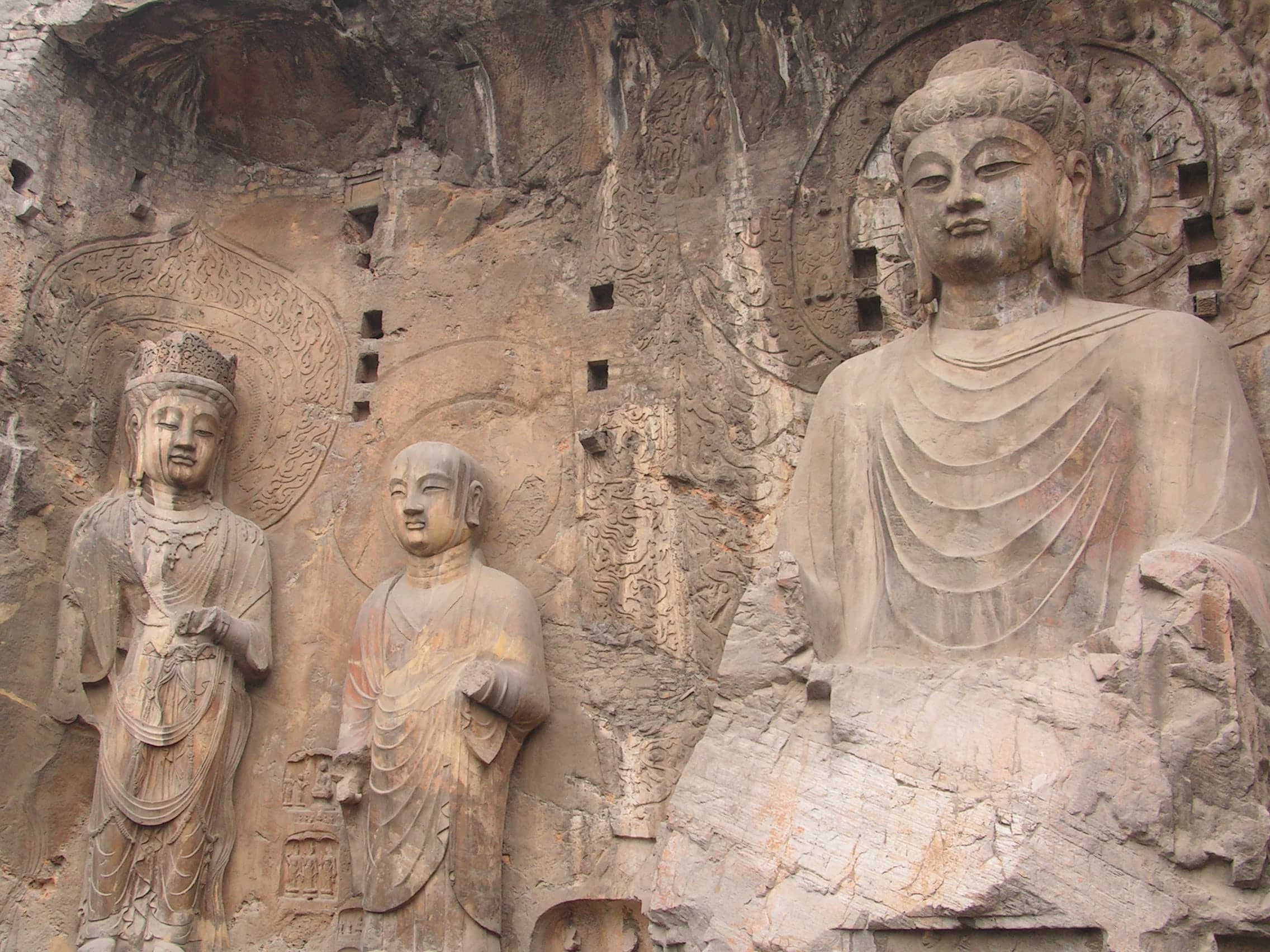
The face is broad and round, with lowered eyelids and a faint upward curve at the lips. The expression reads as calm rather than remote — a composure that does not exclude the viewer. The features are simplified: no individual locks of hair, no texture in the stone skin, no sharp transitions. Everything has been shaped for legibility at distance. The face measures several metres from crown to chin, carved to be read from the ground far below.
Drapery folds simplified for viewing at distance
The robes fall in broad, shallow curves across the chest and arms. The folds are carved as long, parallel grooves, each one wide enough to cast a shadow that remains visible from across the river. There is no attempt at the fine pleating or gathered fabric seen in smaller sculptures. The drapery has been reduced to its essential rhythm: enough information to suggest cloth, not enough to distract from the figure's stillness.
Attendant figures dwarfed by the central Buddha
Smaller figures stand to either side of the Buddha, each carved into the same cliff face. They are perhaps a tenth of the central figure's height, and their scale makes the Buddha's size legible in a way that measurements alone do not. The attendants are detailed — their postures, their gestures, their individual faces are all present — but the composition subordinates them entirely. The hierarchy is spatial and theological at once.
The story
The Longmen Grottoes are cut into limestone cliffs that face each other across the Yi River, south of the city of Luoyang in Henan province. The site contains tens of thousands of carved figures, ranging from an inch to seventeen metres in height, distributed across more than two thousand caves. The work began in 493, when the Northern Wei dynasty moved its capital to Luoyang, and continued for centuries. Patrons included emperors, Wu Zetian, members of the royal family, other rich families, generals and religious groups. Sixty per cent of the caves date from the Tang dynasty, thirty per cent from the Northern Wei, and the remainder from other periods.
The Vairocana Buddha is the largest figure at the site. It is carved in high relief into the cliff face, emerging from the stone rather than standing free of it. The figure is seated, and the head alone is several metres tall. The carving was funded in part by Empress Wu Zetian, who contributed money from her own cosmetics budget — a detail recorded in inscriptions at the site. Wu Zetian later ruled China in her own name, holding the title of emperor.
The face of the Buddha has been the subject of a persistent attribution debate. Some scholars have argued that the features were carved to resemble Wu Zetian herself, and that Tang viewers would have recognised the likeness. Others have disputed this, pointing out that the evidence is circumstantial and that the face conforms to established iconographic types for depicting the Buddha. The question has not been resolved. What is recorded is that Wu Zetian funded the carving, that she was an active patron of Buddhism, and that she used religious imagery to legitimise her rule. Whether the face is a portrait, a type, or something between the two remains open.
The site is called Longmen — Dragon's Gate — because the two cliffs that flank the river resemble the gate towers that once stood at the southern entrance to Luoyang. The river runs north between them, and the name Longmen refers to this natural gateway. The older name for the area was Yique, meaning the Gate of the Yi River.
Many of the figures were originally painted, though most of the pigment has been lost. The carvings were made by cutting into the cliff face, removing stone to leave the figures in relief. The limestone is soft enough to carve with relative ease, but durable enough to survive centuries of weathering. The site also contains nearly two thousand five hundred stone inscriptions and over sixty Buddhist pagodas. The inscriptions record dedications, donors, dates and prayers, and they form what has been called a forest of ancient stelae — a written archive in stone, accompanying the carved images.
Why it mattered then
Luoyang was the eastern capital of the Tang dynasty, and the Longmen site was visible to anyone approaching the city from the south. The cliffs and the river formed a natural threshold, and the carvings transformed that threshold into a sacred space. A traveller arriving at Luoyang would pass between the cliffs and see the carved figures on both banks — a procession of Buddhas and bodhisattvas that extended for a kilometre along the water. The scale of the Vairocana Buddha made it visible from a great distance. A figure seventeen metres tall, carved into a cliff, is not a private devotional object. It is a public statement, legible to anyone within sight of the river. For Wu Zetian, who funded the carving during a period when she was consolidating power, the figure served both religious and political purposes. Buddhism was a source of legitimacy for rulers who were not born into the imperial family, and Wu Zetian used Buddhist imagery throughout her reign to frame her rule as cosmically sanctioned. The act of carving the grottoes was itself a form of devotion. Donors paid for the work, and their names were recorded in inscriptions that accompanied the figures. The inscriptions survive, and they show that patrons ranged from emperors to religious groups to wealthy families. The site was a collective project, built over centuries, and the inscriptions map the social world that produced it.
Why it matters now
The Vairocana Buddha remains in place, carved into the cliff where it was made. It has not been moved, and it cannot be moved. The figure is part of the stone, and the stone is part of the landscape. This is a different kind of survival from that of objects in museums. The carving is still in the environment it was made for, still visible from the river, still part of the approach to Luoyang. The attribution debate — whether the face is a portrait of Wu Zetian — matters because it asks what a religious image is allowed to do. If the face is a portrait, then the carving is not only an image of the Buddha but also an image of the empress, and the line between devotion and propaganda becomes difficult to draw. If the face is a type, then the carving is a more straightforward act of piety. The evidence does not settle the question, and that unresolved status is itself instructive. It shows how much we do not know about how the image was intended to be read, and how much room there is for interpretation even when the object itself is intact. The site was added to the UNESCO World Heritage List in 2000. The designation cited the grottoes as an outstanding manifestation of human artistic creativity and as an encapsulation of the cultural sophistication of Tang China. The language is formal, but the observation is accurate. The carvings are a record of what could be imagined, funded and executed over five centuries, and they remain legible as such.
The surprising detail
Wu Zetian's contribution to the carving came from her cosmetics budget. This detail is recorded in the inscriptions at the site, and it is specific enough to be striking. The cosmetics budget was the empress's personal allowance, and the fact that she used it to fund a seventeen-metre Buddha suggests both the scale of her resources and the importance she placed on the project. The choice also carries a symbolic weight: the money that would have been spent on her own appearance was redirected to create an image that may have been carved to resemble her face. Whether or not the resemblance was intended, the funding source makes the connection between the empress and the image explicit.
What is disputed
Whether the face of the Vairocana Buddha was carved to resemble Wu Zetian is genuinely disputed. Some scholars argue that the features were intended as a portrait and that Tang viewers would have recognised the likeness; others argue that the face conforms to standard iconographic types and that the resemblance, if any, is coincidental. The evidence is circumstantial — Wu Zetian funded the carving, and she used Buddhist imagery throughout her reign — but it does not include a contemporary statement that the face is a portrait. Both interpretations remain defended in the scholarship, and neither has displaced the other.
Remember this
A seventeen-metre Buddha carved into a cliff, funded by an empress whose face it may or may not depict — and the evidence leaves the question open.
Test yourself
Why does the unresolved debate over whether the Buddha's face resembles Wu Zetian matter more than simply settling the question of attribution?
Because the uncertainty reveals how much we do not know about how religious images were intended to function in their own time. If the face is a portrait, then the carving is simultaneously an act of devotion and a political statement, and the boundary between those two purposes dissolves. If it is not a portrait, then the carving remains a more straightforward expression of piety. The fact that the evidence does not settle the question means we cannot be certain which reading is correct, and that uncertainty is itself a form of knowledge. It tells us that the image was made in a context where those two purposes — religious and political — were not necessarily distinct, and where an empress could fund a Buddha that might or might not bear her features without the ambiguity being a problem. The debate matters because it keeps that ambiguity visible, rather than resolving it into a single authorised interpretation.
Go deeper
Image: Rialfver at nl.wikipedia. Licence: CC BY-SA 3.0. Source.