I · THE OBJECT · BRITISH MUSEUM
The Standard of Ur
▶ Listen · narrated
War on one face, peace on the other, and a name that guesses at a function no evidence confirms. The panels are clear; their purpose is not.
At a glance
- Date
- 2501 BC
- Culture
- Sumerian, First Dynasty of Ur
- Material
- Wood inlaid with shell, red limestone, lapis lazuli
- Discovered
- 1927, Royal Cemetery at Ur
- Dimensions
- 21.59 cm wide × 49.53 cm long
Look closer
The mosaic technique
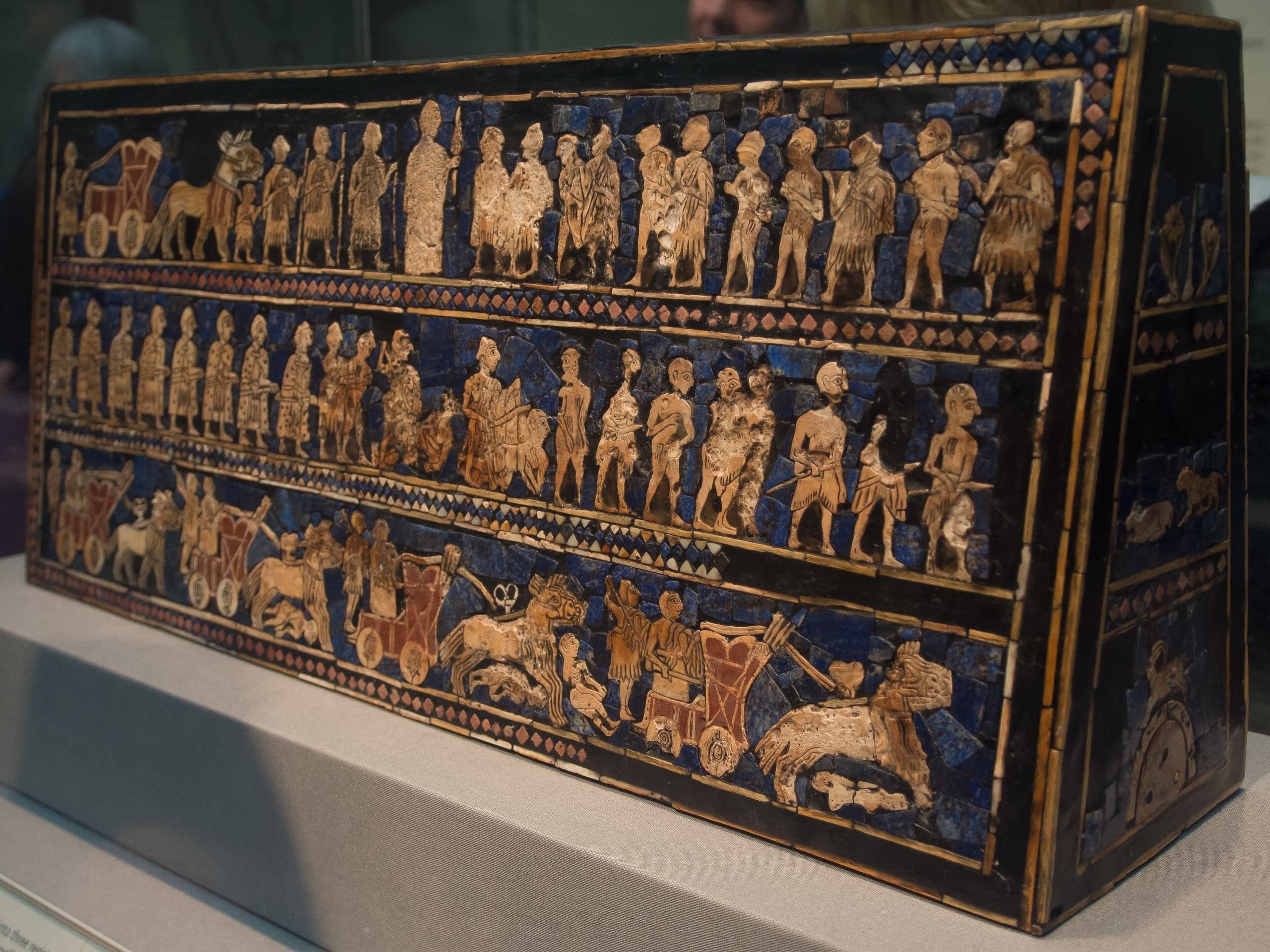
The images are built from thousands of tiny pieces set into bitumen on a wooden core. Shell provides the pale backgrounds and the clothing of most figures. Red limestone gives the colour to some garments and details. Lapis lazuli — a deep blue stone that had to be brought hundreds of miles from what is now Afghanistan — supplies the ground on which the figures stand in each register. The pieces are cut and fitted so closely that the scenes read as continuous pictures, not as assembled fragments.
Reading the war side
The war panel is arranged in three horizontal bands, read from bottom to top. The lowest register shows four chariots, each pulled by animals that might be donkeys or onagers — wild asses — trampling fallen enemies. The middle register shows soldiers in cloaks leading naked prisoners. The top register shows more prisoners being presented to a larger figure, presumably a ruler or commander. The narrative moves upward from the chaos of battle to the order of captivity.
Reading the peace side
The peace panel also has three registers. The bottom two show a procession of figures carrying goods, leading animals, and bearing what appear to be supplies or tribute. The top register shows a group of seated figures, larger than the others, holding cups. Attendants stand behind them. A musician plays a lyre. If the war side shows the taking of captives and plunder, this side may show the feast that followed, though that interpretation is a modern reading, not an ancient label.
The story
The object is a hollow wooden box, just under half a metre long and about twenty centimetres wide, decorated on both long faces and both short ends with mosaic inlay. The two main panels show contrasting scenes: one of warfare, one apparently of celebration or ceremony. The war panel depicts chariots, soldiers, and prisoners. The peace panel shows a banquet and a procession of figures bringing animals and goods. The short ends carry simpler geometric and figurative designs.
The panels are made by setting small shaped pieces of shell, red limestone, and lapis lazuli into bitumen on a wooden ground. The shell forms the pale areas — the bodies and garments of most figures, the backgrounds. The red limestone adds colour to some clothing and details. The lapis lazuli, a costly blue stone imported from far to the east, provides the registers on which the figures stand. The precision of the cutting and the density of the inlay suggest specialist work and considerable labour.
The box was found in 1927 in the Royal Cemetery at Ur, in what is now Iraq. It lay in a tomb next to the skeleton of a man whose skull and the soil around it were thick with thousands of tiny lapis lazuli beads. The excavators concluded he had worn a beaded cap. A cylinder seal found with the body carried the name "é-zi", though whether that was the man's name or someone else's is not recorded. The position of the box and the body suggested the man might have carried it, though that remains interpretation, not certainty.
The name "Standard of Ur" comes from the excavator's guess that it had been mounted on a pole and carried in processions, like a military or ceremonial standard. That is why the object is called what it is called. But the name is a hypothesis, not a description of known function. The box is too fragile and too elaborately decorated to have been carried on a pole through crowds or into battle without damage. No pole fittings or mounting holes have been identified. Other suggestions have been made: that it was a sound-box for a stringed instrument, that it sat on a piece of furniture, that it was simply a container. None of these suggestions is supported by physical evidence that rules the others out.
What is certain is the imagery. The war side shows violence and its aftermath: chariots, trampled enemies, prisoners brought before a seated figure. The peace side shows order and plenty: animals, goods, a seated gathering, a musician. Whether these are two halves of a single narrative — the spoils of war becoming the material for a feast — or two separate ideals of kingship, or something else entirely, is a matter of interpretation. The panels do not carry captions. The figures do not speak. We see what the maker wanted to show, but not why it was shown on this particular object, or what the object was for.
Why it mattered then
The object comes from a royal tomb in the cemetery at Ur, part of a burial complex that contained elaborate goods, musical instruments, jewellery, weapons, and the bodies of people who appear to have been killed as part of the burial rite. The wealth of the grave goods and the evidence of human sacrifice indicate that the people buried here held significant power. The imagery on the box aligns with that context: it shows a ruler receiving prisoners and presiding over a gathering, scenes that assert authority and celebrate the order that authority is supposed to bring. The materials themselves carried meaning. Lapis lazuli had to be transported over long distances, probably from what is now Afghanistan. Shell and red limestone were more local, but the labour of cutting and fitting thousands of tiny pieces into coherent images was not trivial. The box was expensive to make, and it was placed in a grave where it would not be seen again. That suggests its value lay not only in its appearance but in its role within the burial, whatever that role was.
Why it matters now
The Standard of Ur matters now for two reasons. One is the detail of its images. The panels show Sumerian warfare, ceremony, and material culture: clothing, weapons, musical instruments, chariots, and the animals that pulled them. We see how prisoners were treated and how feasts were arranged. The object is a snapshot of a society's priorities, rendered small and precise. The other reason is the uncertainty. The object has a confident name and a place in museum displays and textbooks, but its actual function remains unknown. That gap between the name and the evidence is a useful reminder of how much of what we say about the past is interpretation built on fragments. The box is real. The images are real. The guesses about what it was for are just guesses, and the fact that one guess became the standard name does not make it true. The object teaches what it shows, and it also teaches the limits of what we can know.
The surprising detail
The man buried next to the box wore a cap covered with thousands of tiny lapis lazuli beads. The excavators recorded that the beads lay over and under the broken skull and were thick in the soil around it. The density of the beads suggests the cap was entirely covered with them, a garment that would have shimmered blue in any light. Whether the man carried the box, or simply lay next to it in death, is not certain, but the pairing of the beaded cap and the lapis-inlaid box suggests both were part of the same display of wealth and craft.
What is disputed
The name "Standard of Ur" reflects the excavator's interpretation that the box was mounted on a pole and carried in processions, like a military standard. No physical evidence supports that interpretation. The box is fragile, and no pole fittings or mounting holes have been identified. Alternative suggestions include a sound-box for a stringed instrument or a decorative container, but none of these theories is conclusively supported by the object itself. The function remains unknown.
How it got here
The Standard of Ur was excavated in 1927 by a British-led expedition at the Royal Cemetery at Ur, in what was then the British Mandate of Mesopotamia and is now Iraq. The excavation was conducted under a division agreement that allowed finds to be split between the Iraq Museum in Baghdad and foreign institutions. The Standard was allocated to the British Museum, where it has remained since 1928. Iraq has not formally requested its return, but the broader context of objects removed from Iraq during the mandate period remains a subject of discussion in debates about colonial-era archaeology and the repatriation of cultural heritage.
Remember this
Two clear panels, four thousand six hundred years old, and a name that guesses at a purpose no evidence confirms.
Test yourself
Why does the fact that the box was found in a tomb make it harder, not easier, to know what it was used for?
Because objects placed in graves are often removed from their original contexts and given new roles in death. A box used in life for one purpose might be chosen for burial for a different reason — because of its materials, its imagery, its associations, or simply its value. The tomb tells us the object mattered enough to bury, but not what it was made for. The elaborate grave goods and evidence of human sacrifice show this was a high-status burial, but they do not explain whether the box was a musical instrument, a container, a ceremonial object, or something else. The context proves importance, not function.
Go deeper
Image: Denis Bourez from France, CC BY 2.0. Licence: CC BY 2.0. Source.