III · THE WORK · ART HISTORY
The Bayeux Tapestry
▶ Listen · narrated
The cloth that records 1066 was made by the people who lost. What they put in the margins is not what the patrons put in the centre.
At a glance
- Date
- 1070
- Material
- Wool embroidery on linen
- Dimensions
- 0.50 metre high, 68.30 metres long
- Country of origin
- England
- Collection
- Bayeux Tapestry Museum
Look closer
It is not a tapestry
The designs are embroidered — stitched with coloured wool onto a linen ground — rather than woven. A tapestry is made on a loom, with the image built into the weave itself. This is needlework, closer in technique to the embroidered vestments and hangings that survive from Anglo-Saxon England. The name stuck because the cloth hung like a tapestry and served the same purpose: covering a wall, telling a story to a room full of people who could not all read.
The borders are not decoration
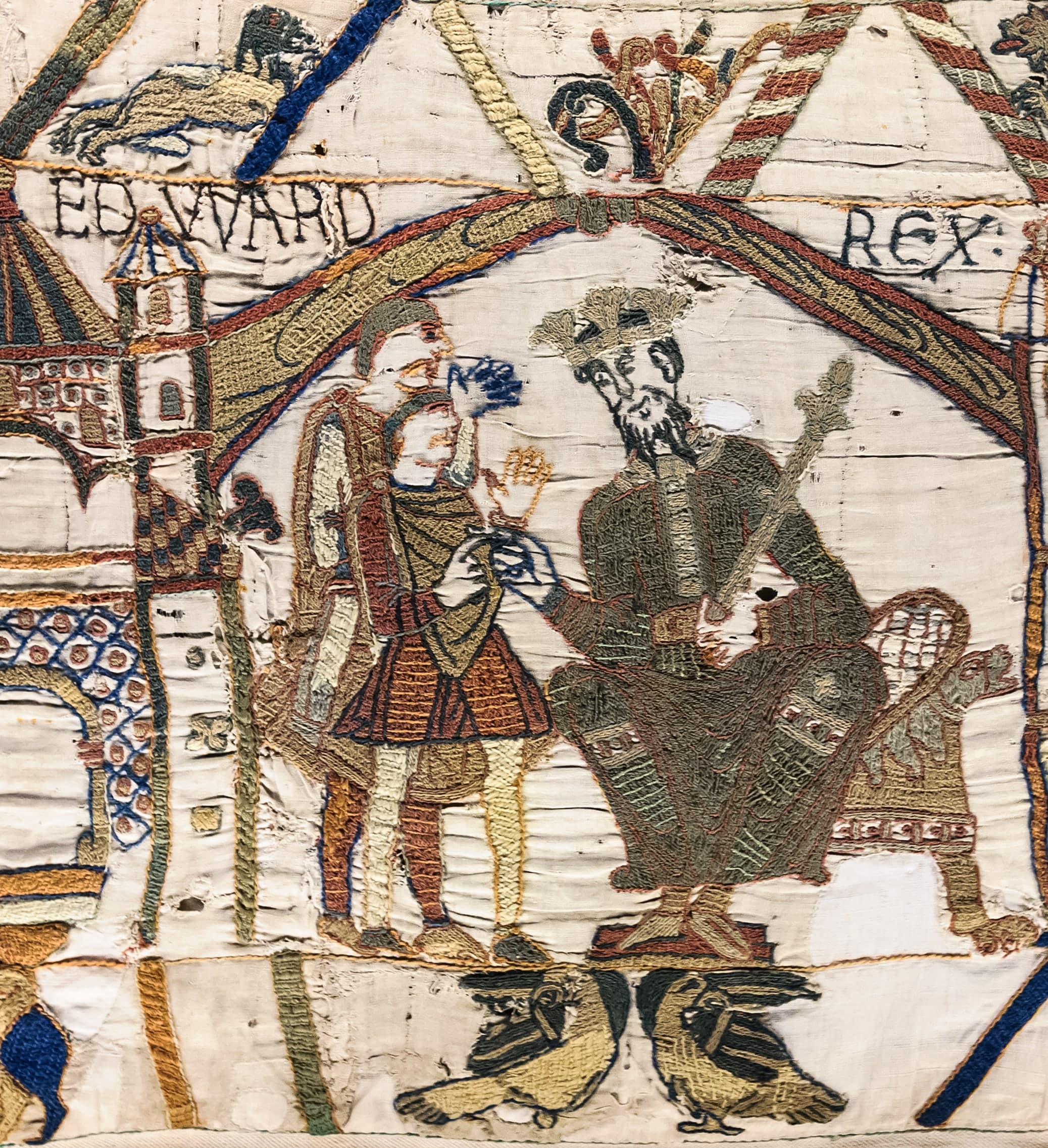
Above and below the main register, narrow strips carry animals, fables, and scenes that do not appear in the Latin captions. Some echo the action: where Harold is shown feasting, the lower border fills with servants and dogs. Others seem to comment: a fox dressed as a bishop preaching to birds appears near a scene of oath-taking. After the battle begins, the lower border fills with the stripped bodies of the dead, face down, while the main scenes show armed men still standing. The borders were planned as part of the whole, not added later.
Fifty-eight scenes, no chapter breaks
The narrative runs without pause from one scene to the next. Trees, buildings and Latin inscriptions mark where one episode ends and another begins, but the linen is continuous and so is the story. There are fifty-eight scenes in total, each with a caption embroidered in Medieval Latin. The thread is mostly wool, worked in a technique called stem stitch for outlines and laid-and-couched work for filling areas of colour. The linen background is left bare, so the figures stand clear.
The story
The Bayeux Tapestry is a strip of linen 68.30 metres long and half a metre high, embroidered in coloured wool with the story of the Norman conquest of England. It begins with Harold crossing the Channel and ends with the English in flight after the battle fought near Hastings in 1066. The Latin captions call William duke of Normandy and Harold king of England, and the story is told from the Norman perspective: Harold swears an oath, breaks it, and dies. What the cloth does not say is who made it, or quite when, or for whom.
The embroidery is thought to date to 1070, within a few years of the conquest. It is now widely accepted to have been made in England, perhaps as a gift for William. The needlework is consistent with Anglo-Saxon embroidery techniques, and England had a reputation for skilled work in thread. If it was made in England, it was made by people who had lived through the invasion it depicts, stitching the victory of the army that had defeated them.
The cloth was preserved in Bayeux, in Normandy, for centuries. In 1729 it was rediscovered by scholars at a time when it was being displayed annually in Bayeux Cathedral. It is now held at the Bayeux Tapestry Museum in Bayeux, though the museum is closed for renovations. The tapestry returned to England in 2026, to be displayed at the British Museum in London from September 2026 to July 2027 — the first time it had possibly been in England in over nine hundred years.
The designs are embroidered, not woven, so the cloth does not meet the narrower definition of a tapestry. It is a wall hanging, a piece of secular Romanesque art on a scale that is rare for anything that has survived from the period. Tapestries and embroidered hangings adorned churches and wealthy houses in medieval Western Europe, but a narrative embroidery 68 metres long is not a common survival.
The narrative is told in fifty-eight scenes, each with a caption in Medieval Latin. The figures are embroidered in wool on the linen ground, which is left bare. This gives the composition a clarity that a filled background would not: the figures and the architecture stand out sharply. Above and below the main scenes, borders run the length of the cloth, carrying animals, fables, and images that sometimes mirror the action and sometimes seem to comment on it. After the battle scenes begin, the lower border fills with the bodies of the dead, face down and stripped of their armour, while the main register shows the fighting still in progress.
Why it mattered then
The cloth was made within a few years of the conquest it depicts, at a moment when the fact of Norman rule was settled but the story of how it had come about was not yet fixed. An embroidered narrative seventy metres long, displayed in a hall or a church, told that story to everyone who saw it: Harold had sworn an oath to William, Harold had broken the oath, Harold had died and William had won. The Latin captions reinforced the message, but the pictures carried it to those who could not read. If the embroidery was made in England, as is now widely accepted, it was made by people who had lost the war and were now working for the victors. The needlework techniques are consistent with Anglo-Saxon practice, and England was known for skilled embroidery. The borders, with their fables and corpses, may carry a second layer of commentary that the patrons did not dictate. The main scenes tell the Norman version. The margins are less certain about what they are celebrating.
Why it matters now
The Bayeux Tapestry is one of the most complete narrative images to survive from the eleventh century, and it has survived almost intact. That makes it a rare witness to how stories were told in cloth, how needlework was used to cover walls and shape the space inside a building, and how a single long image could be designed to be read in sequence, scene by scene, as you walked past it. It also preserves a version of 1066 that was made by the winners, at a moment when the losers were still alive and, if the embroidery was made in England, still holding the needles. The borders, with their fables and their stripped corpses, suggest that the people who stitched the cloth may have been recording more than one story. The main narrative is clear. The margins are less sure what they are looking at. The tapestry has been in Bayeux for centuries, and it has been preserved in Normandy since the medieval period. It returned to England in 2026, possibly for the first time in over nine hundred years. The fact that its return was news is itself evidence of how firmly the object has been tied to the place where it was preserved, rather than the place where it was made.
The surprising detail
The cloth is called the Bayeux Tapestry, and it is not a tapestry. It is embroidery: the designs are stitched onto the linen with wool thread, not woven into the fabric on a loom. The name is wrong, and it has been wrong for centuries, and it is now too late to correct it. The object is catalogued as embroidery, described as embroidery, and universally called a tapestry. The mistake is part of the object's history, and the history is now longer than the mistake.
What is disputed
The date of 1070 is given in the Wikidata facts, but the Wikipedia article describes the dating as 'thought to date to the 11th century, within a few years of the battle'. The patron is not named in the verified facts, though the Wikipedia article says it is 'likely that it was commissioned by Bishop Odo of Bayeux'. The place of manufacture is given as England in the Wikidata facts, and the Wikipedia article says it is 'now widely accepted to have been made in England'. These are the strongest claims the verified material supports, and they are the claims made here.
Remember this
The Bayeux Tapestry is embroidery, not tapestry, probably made in England to tell the Norman story of 1066. The borders tell a second story.
Test yourself
If the Bayeux Tapestry was made in England shortly after 1066, as is now widely accepted, what does that imply about the relationship between the people who designed it and the people who stitched it?
It implies that the designers and the stitchers may not have been working toward the same goal. The main narrative is clear and unambiguous: Harold swears an oath, breaks it, and dies in battle. That is the story a Norman patron would want told. But if the embroidery was made in England, the people holding the needles were English, and they had lived through the invasion. The borders, with their fables and their corpses, carry a commentary that the main scenes do not. A fox dressed as a bishop appears near an oath-taking scene. The lower border fills with stripped bodies while the main register shows the battle still in progress. These are not the images a straightforward celebration would choose. The stitchers may have been recording the patron's version in the centre and their own version in the margins, in a visual language the patrons did not control. The embroidery would then be two things at once: a propaganda object and a record of what propaganda leaves out.
Go deeper
Image: Myrabella, Public domain. Licence: Public domain. Source.