I · THE OBJECT · BRITISH MUSEUM
The Tahitian Mourner's Costume
▶ Listen · narrated
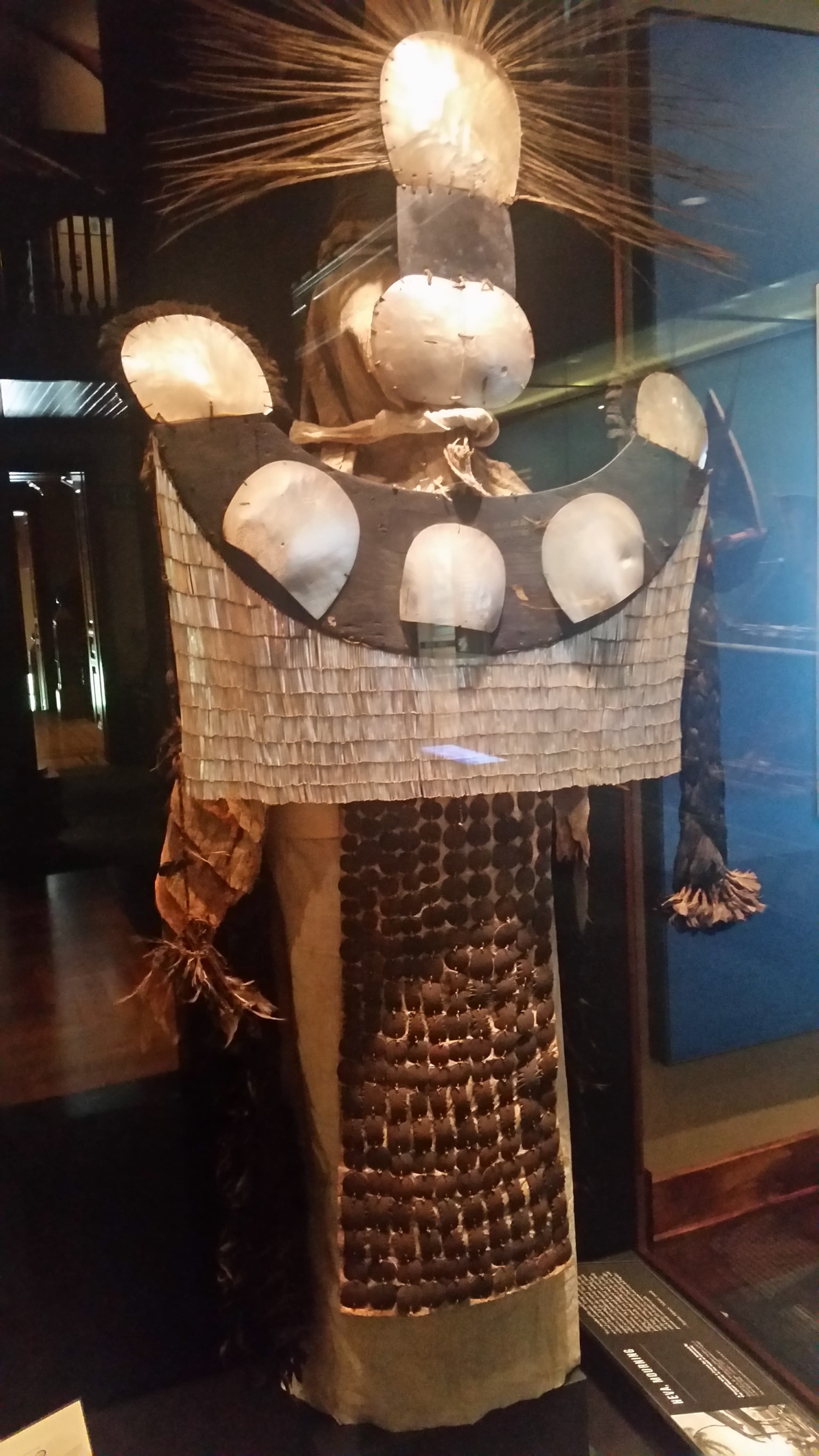
After certain deaths in Tahiti, someone dressed in this — pearl shell breastplate, feather cape, barkcloth train — and became ritually dangerous for weeks or months.
At a glance
- Name
- Heva Tūpāpāʻu (Mourner's Dress)
- Materials
- Coconut fibres and shells, pearls, feathers, barkcloth
- Collected
- 1775, during Cook's expeditions
- Survival
- Very few examples survive today
Look closer
Ritually significant materials
The costume combined coconut fibres and shells, pearls, feathers, and barkcloth — materials that carried ritual significance in Tahitian culture. Each element was chosen not just for appearance but for meaning within the mourning ceremony. The pearl shell, the feathers, the plant fibres: all marked the wearer as set apart from ordinary life.
A costume that made the wearer dangerous
The person wearing the Heva Tūpāpāʻu became dangerous to approach during the mourning period. This was not metaphor: the ritual role transformed the wearer into someone others had to avoid. The costume signalled that transformation visibly, making the danger legible at a distance. The mourning ceremony could last weeks or months, and throughout that time the wearer moved through the community in this marked state.
Worn after the death of an important person
The costume was not for every death, but for the loss of someone important within Tahitian society. The length and elaboration of the mourning ceremony reflected the status of the deceased. What determined importance, and who decided when the mourning period ended, the surviving records do not make clear.
The story
A Heva Tūpāpāʻu is a costume worn in Tahiti as part of mourning ceremonies. The name translates as Mourner's Dress. It was worn after the death of an important person in Tahitian culture, in a ceremony that could last weeks or months.
The costume was assembled from materials that carried ritual significance: coconut fibres and coconut shells, pearls, feathers, and barkcloth. These were not decorative choices but meaningful ones, marking the wearer as occupying a specific ceremonial role. The person wearing the Heva Tūpāpāʻu became dangerous to approach — ritually set apart from ordinary social life for the duration of the mourning period.
How that danger was understood, and what would happen if someone approached too closely, the records available do not specify. But the costume itself made the wearer's status visible: anyone seeing the pearl shell, the feathers, the barkcloth train would know to keep their distance. The transformation was public and legible.
Very few Heva Tūpāpāʻu survive today. It is estimated that James Cook brought approximately ten back with him to Europe in 1775 after collecting them during his expeditions. Those objects entered European collections and inspired European artists. Herman Spöring Jr and Sarah Stone both painted Heva Tūpāpāʻu, translating the costumes into images that circulated far from Tahiti.
The British Museum holds one of these costumes and describes it as among the important objects in their collections. That importance rests partly on rarity — so few survive — and partly on what the costume represents: a complex mourning practice, recorded at a moment of contact between Tahitian and European worlds, now mostly known through the objects and images that left the islands in the eighteenth century.
Why it mattered then
The Heva Tūpāpāʻu marked a person as occupying a dangerous ritual role during an extended mourning ceremony. The costume made that role visible and enforceable: anyone who saw it knew to keep away. The mourning ceremony itself reflected the importance of the deceased and could stretch across weeks or months, during which the wearer moved through the community in this transformed state. The materials — pearl shell, feathers, barkcloth, coconut fibre and shell — were all ritually significant, which means they carried meanings within Tahitian culture that went beyond their physical properties. The costume was not decoration but a working part of the ceremony, a way of making the ritual transformation legible and real. That so few survive suggests they were either not preserved after the mourning period ended, or that the ceremonies themselves became less common after European contact. The costumes Cook collected in 1775 left Tahiti during a period of rapid change, when mourning practices and the social structures they reflected were already under pressure.
Why it matters now
The Heva Tūpāpāʻu survives as evidence of a mourning practice that is no longer performed in the same way, if at all. The costume records a ritual that transformed the wearer into someone dangerous to approach, a role that lasted weeks or months and was marked by materials chosen for their ritual significance. Because very few of these costumes survive, and because the mourning ceremonies themselves are known largely through European accounts and the objects Cook collected, the Heva Tūpāpāʻu now carries a double weight: it is both a ritual object and a record of contact, a moment when Tahitian ceremonial life was observed, collected, and removed to European museums. The British Museum's description of their Heva Tūpāpāʻu as among the important objects in their collections reflects that double weight. The costume is rare, it is materially complex, and it represents a practice that cannot now be fully reconstructed from the surviving evidence. What the mourning ceremony felt like to participants, what the danger of approaching the wearer meant in practice, how the ritual ended — these are questions the object raises but cannot fully answer.
The surprising detail
The Heva Tūpāpāʻu inspired paintings by European artists who never saw the costumes worn in ceremony. Herman Spöring Jr and Sarah Stone painted them as objects in collections, translating the pearl shell, feathers and barkcloth into images that circulated in Europe. Those paintings became, for many European viewers, the primary way of encountering Tahitian mourning practice — not the ceremony itself, but a costume removed from it, painted in a studio, and reproduced in books. The costume reached Europe; the ritual did not.
How it got here
It is estimated that James Cook brought approximately ten Heva Tūpāpāʻu back to Europe in 1775 after collecting them during his expeditions to Tahiti. The circumstances of those exchanges — whether the costumes were given, traded, or taken, and whether the mourning ceremonies they belonged to had ended or were interrupted — are not recorded in detail. The costumes entered European collections during a period of first sustained contact between Tahitian and European societies, when mourning practices and the social structures they reflected were beginning to change. Very few Heva Tūpāpāʻu survive today, making those that do remain in museums both rare examples of Tahitian ceremonial practice and objects whose presence in Europe reflects the broader history of collection and removal during Cook's voyages.
Remember this
A mourning costume that made the wearer ritually dangerous, worn for weeks or months after the death of an important person.
Test yourself
Why might the fact that very few Heva Tūpāpāʻu survive today tell us something about the mourning ceremony itself, not just about collection and preservation?
If the costumes were ritually significant during the mourning period but not meant to be kept afterwards, then their rarity might reflect Tahitian practice rather than European neglect. Ritual objects are sometimes destroyed, buried, or allowed to decay once their ceremonial purpose is fulfilled — preserving them would be the wrong thing to do. The costumes Cook collected in 1775 may have survived precisely because they were removed from the context where they would normally have been disposed of. That means the objects in museums might be exceptions, kept by accident of removal, while the ceremony itself required that they not be kept. The absence of many Heva Tūpāpāʻu could be evidence of the ritual working as intended.
Go deeper
Image: Pi3.124, CC BY-SA 4.0. Licence: CC BY-SA 4.0. Source.