I · THE OBJECT · BRITISH MUSEUM
Chola Bronze of Shiva Nataraja
▶ Listen · narrated
Four arms, one raised leg, a circle of fire — and every detail is a statement about how the universe works, not decoration.
At a glance
- Subject
- Hindu deity
- Form
- Nataraja — Shiva as cosmic dancer
- Culture
- Chola Indian
- Period
- Medieval era
Look closer
The balance is structural, not symbolic
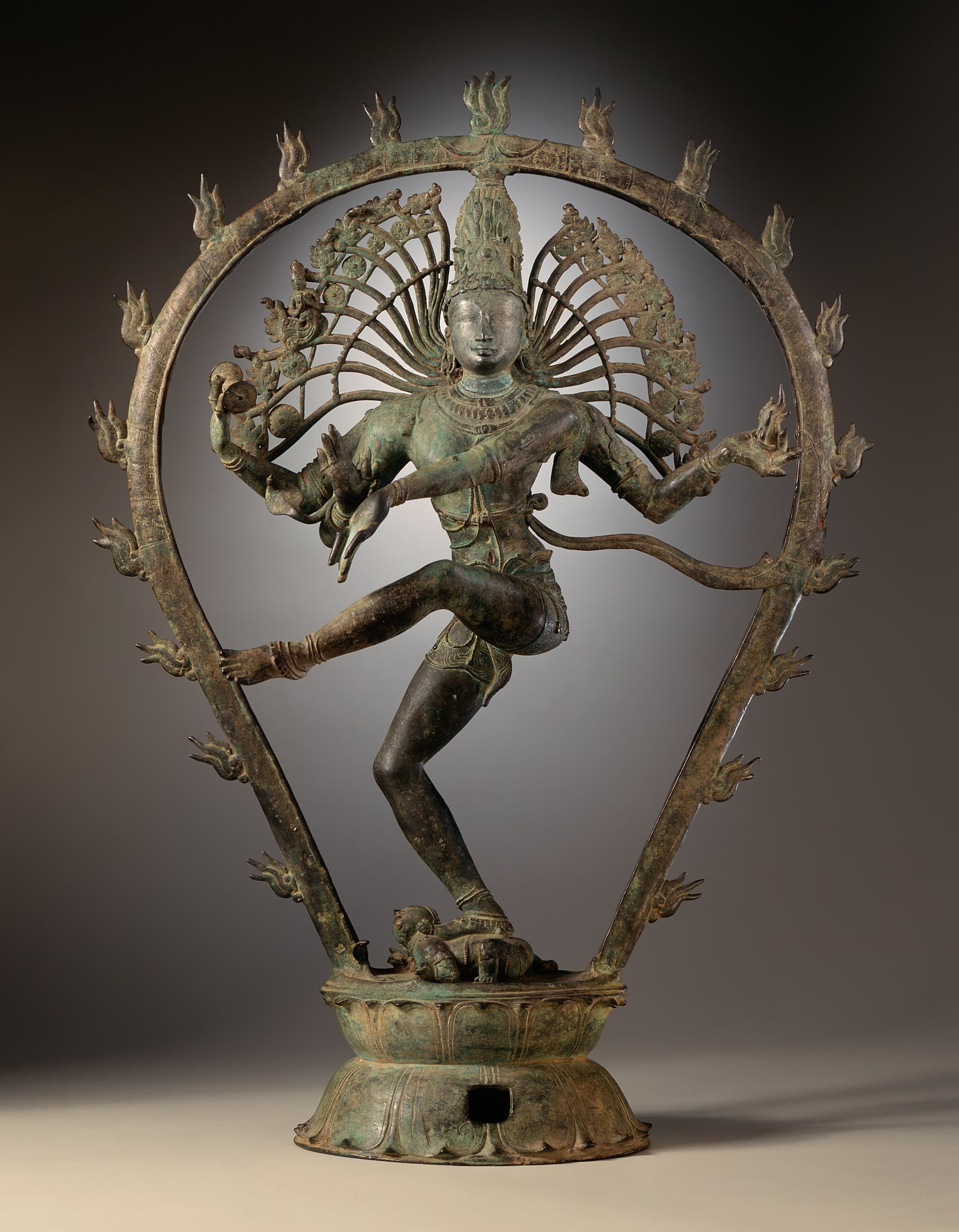
The figure stands on one foot, the other leg raised and bent across the body. That pose is difficult to stabilise in bronze, especially when the metal is hollow. The ring of fire provides the answer: it is not just iconography but engineering, a continuous hoop that anchors the weight and lets the dancer remain airborne. Lost-wax casting — where a wax model is encased in clay, melted out, and replaced with molten metal — allowed the whole assembly to be cast as a single piece, flame and figure together.
Read the hands in order
The upper right hand holds a drum, the upper left a flame. The lower right hand is raised with the palm facing outward, a gesture of reassurance; the lower left points downward across the body toward the raised foot. Each object and gesture has a meaning recorded in Hindu texts. The drum represents creation through sound, the flame destruction, the raised palm protection, and the pointing hand a promise of release. Together, they describe a cycle: the universe is created, sustained, destroyed, and renewed.
The figure beneath the foot
Shiva tramples a small figure, shown as a dwarf. This is Apasmara or Muyalaka, who represents spiritual ignorance. The trampling is not violent triumph but a necessary act: ignorance must be subdued for the cycle to continue. The dwarf is not destroyed — he remains beneath the foot, part of the composition. The dance happens above him, not because of his absence but despite his presence.
The story
Nataraja means lord of dance. The form shows Shiva performing the tandava, a dance described in Hindu texts written in Sanskrit and Tamil. The pose and the objects the figure holds follow instructions set out in those texts, which specify how the deity should be depicted and what each element means.
The sculpture is not illustrating a story. It is a diagram of cosmology, rendered in bronze. The dance represents the functions attributed to Shiva: creation, preservation, destruction, the veiling of truth through maya — illusion — and the granting of release from the cycle. Each of the four hands performs one of these functions. The drum in the upper right hand sounds the rhythm that brings the universe into being. The flame in the upper left hand will eventually consume it. The lower right hand, palm outward, offers protection to those watching. The lower left hand points toward the raised foot, which in the texts represents liberation.
The ring of fire surrounding the figure is described in the texts as prabhamandala, a halo of flames. It represents the universe itself, or in some readings the energy that animates it. The flames are not attacking Shiva; they are the boundary of the space in which the dance occurs. Everything happens within that circle.
The figure Shiva stands on is Apasmara or Muyalaka, a dwarf who embodies spiritual ignorance. His presence is essential. The texts describe the dance as taking place over ignorance, not in its absence. The dwarf is subdued but not destroyed, because ignorance cannot be eliminated entirely — it can only be kept underfoot while the cosmos unfolds above it.
The proportions and gestures of the figure are specified in texts on Hindu arts. The Natya Shastra, a Sanskrit text on performance, describes poses used in dance, and the Nataraja figure adopts one of them. Other texts, including Tamil devotional poetry and Sanskrit agamas — ritual manuals — describe the iconography in detail. The sculpture is not a free interpretation but a rendering of a set of instructions, followed closely enough that a viewer familiar with the texts would recognise each element.
Stone reliefs showing Shiva dancing appear in cave temples by around the sixth century. Bronze castings in the form now called Nataraja emerged in Tamil Nadu in the medieval period, during the rule of the Chola dynasty. These bronzes were made using the lost-wax method, which allows fine detail and complex poses. The wax model is destroyed in the process, so each bronze is unique. Heights vary, typically less than four feet, though some are taller.
The Nataraja form is described in Tamil devotional songs written during the Bhakti movement, a period of religious poetry and temple worship. Four poets — Sambandar, Appar, Manikkavacakar, and Sundarar — wrote about Nataraja and about the temple at Chidambaram, where Nataraja is the main deity. These songs place Nataraja worship before the seventh century.
Sculptures showing the dancing form have been found beyond India, in Southeast Asia, including at Angkor Wat in Cambodia, in Bali, and in Central Asia. The form travelled with Hindu and Buddhist traditions, adapted in each place but recognisable in its structure: the dancer, the ring, the raised leg, the multiple arms.
Why it mattered then
The Nataraja bronzes were made for temples, where they were worshipped as representations of Shiva. They were not static installations. Many were carried in processions during festivals, taken out of the inner sanctum and paraded through the temple complex or the surrounding town. The bronze had to be light enough to be carried but detailed enough to be seen from a distance. Lost-wax casting met both needs. The iconography was legible to anyone familiar with the texts or the oral traditions that explained them. A devotee looking at the figure would recognise the drum, the flame, the gestures, the dwarf, and understand the cosmology being depicted. The sculpture was a teaching tool as well as an object of worship. It made abstract ideas — creation, destruction, liberation — visible and specific. The Chola dynasty, which ruled Tamil Nadu during the medieval period, built and renovated temples across the region. Bronze casting workshops were attached to major temples, and the Nataraja form became widespread during this period. The bronzes were commissioned by rulers, by temples, and by wealthy patrons. They were signs of devotion, but also of resources and skill. A well-made bronze demonstrated the patron's piety and the workshop's technical ability.
Why it matters now
The Nataraja form is now used as a symbol of Indian culture, appearing in museums, in official contexts, and in popular representations of Hindu art. It is recognised globally, often without the viewer knowing the specific meanings of the drum, the flame, or the dwarf. The image has become shorthand for Hindu thought, for Indian artistic tradition, and for the idea of cosmic balance. In Tamil Nadu, the form remains central to temple worship. Nataraja is worshipped in Shiva temples across the region, and the temple at Chidambaram, where Nataraja is the main deity, continues to draw pilgrims. The bronzes are not historical artifacts in that context — they are active religious objects, still carried in processions, still dressed and garlanded, still addressed in prayer. The technical achievement of the bronzes is studied by art historians and metallurgists. The lost-wax method, the balance of the pose, the integration of the flame ring — all of these are examined as examples of medieval Indian metalworking. The sculptures are also read as texts, their iconography decoded using the Sanskrit and Tamil sources that describe them. The relationship between the written instructions and the finished bronze is a subject of ongoing study: how closely did the workshops follow the texts, and where did they innovate or adapt?
The surprising detail
The Nataraja bronzes were made to move. They were not bolted to pedestals but carried, and the engineering had to account for that. The flame ring is not just a visual frame — it is a handle. The hoop could be gripped and lifted, and the weight of the bronze distributed around it. Some bronzes show wear on the ring, evidence of repeated handling. The dance is frozen in metal, but the object itself was in motion, carried through streets and temple courtyards, seen from different angles as it passed.
What is disputed
The dating of individual Nataraja bronzes is often uncertain. Stone reliefs showing Shiva dancing appear by around the sixth century, and Tamil devotional poetry describing Nataraja is dated before the seventh century, but the bronzes in the mature form are generally attributed to the medieval period under the Chola dynasty, without more specific dates for most examples. Inscriptions or provenance records are rare, so attributions rely on style and technique, both of which can be difficult to date precisely.
Remember this
Four hands, four cosmic functions — and the whole thing cast in one piece, balanced on a single foot inside a ring you could lift.
Test yourself
The dwarf beneath Shiva's foot represents ignorance, but he is not destroyed. Why does the iconography require him to remain in the composition?
Because the cosmology being depicted does not claim that ignorance can be eliminated. The dance of creation, preservation, and destruction happens in a universe where ignorance persists — it is subdued, kept underfoot, but not absent. If the dwarf were removed, the sculpture would be depicting a different claim: that liberation means the end of ignorance rather than its management. The texts describe the dance as taking place over Apasmara, not after his defeat. The bronze follows that logic. The lesson generalises: religious art is often encoding theological positions, not just illustrating them, and a missing element can be as meaningful as a present one.
Go deeper
Image: Public domain. Licence: Public domain. Source.