III · THE WORK · ART HISTORY
The Ardabil Carpet
▶ Listen · narrated
The weaver signed his work, dated it, and built the pattern around the lamp that would hang above it — then someone cut the carpet in half.
At a glance
- Origin
- Iran
- Date
- 1540
- Material
- Wool pile on silk
- Dimensions
- 1044 × 529.5 cm
- Collection
- Victoria and Albert Museum, London
Look closer
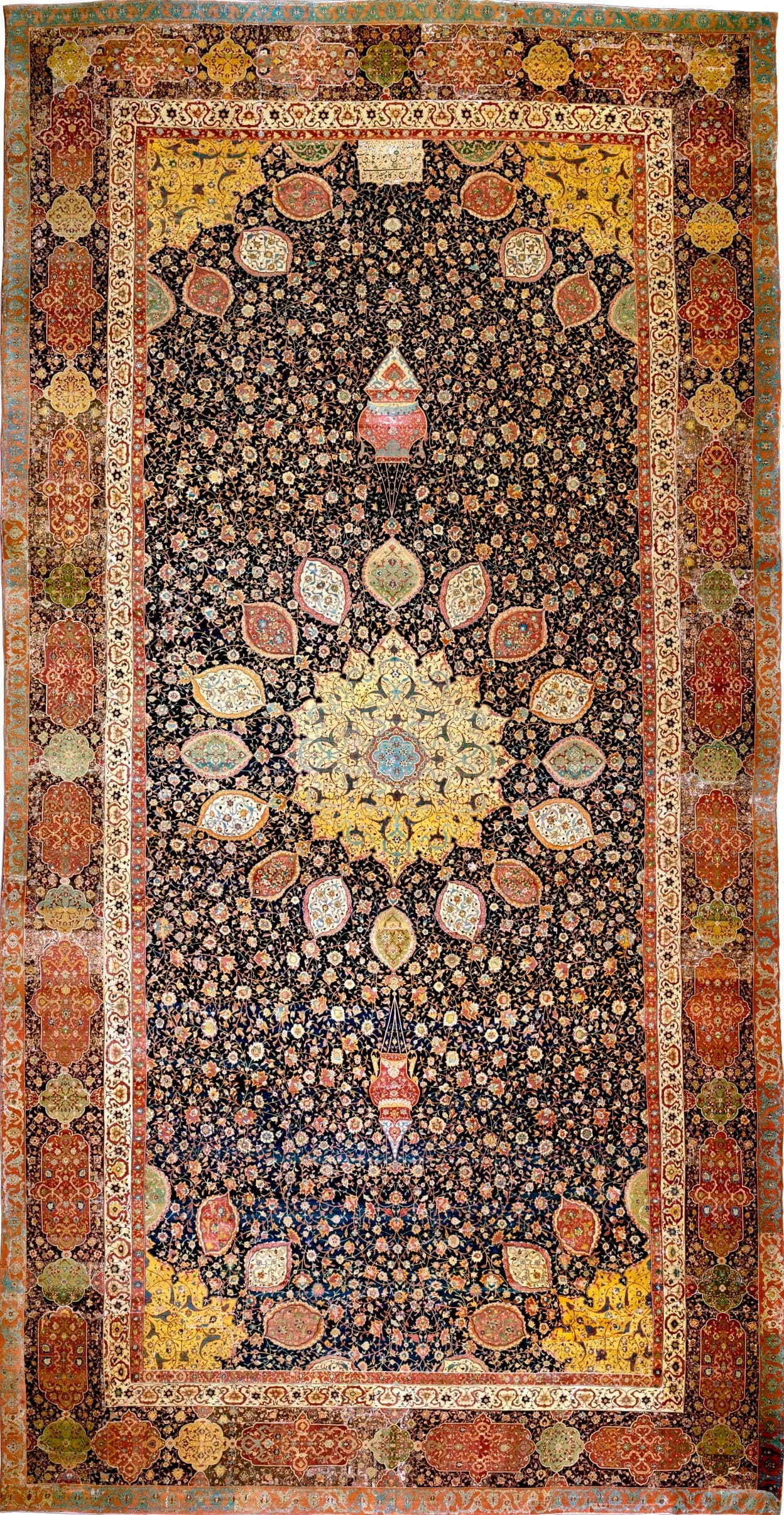
The central medallion answering an overhead lamp
The design centres on a sixteen-lobed medallion in gold and blue, its edges sending out points like a star. This shape was not decorative whimsy: it was made to sit directly beneath a lamp hanging from the ceiling, so that the light fixture and the pattern on the floor would mirror one another. The carpet was woven for a specific room, with a specific object above it, and the medallion is the record of that relationship.
Two mosque lamps, deliberately different sizes
At either end of the central axis, a hanging mosque lamp is woven into the design. The lamp at one end is noticeably smaller than the lamp at the other. This asymmetry is intentional: it creates the illusion of perspective, as though the viewer is standing at one end of the carpet looking toward the other. The lamps recede in size the way objects do in space, turning a flat textile into a suggestion of depth.
The woven signature cartouche at the end
At one end of the carpet, a rectangular cartouche contains a woven inscription. It names the maker and gives the date of completion as 1540. Signing a carpet was not standard practice; that this one carries both a name and a year makes it a rare document as well as a textile. The inscription is worked into the pile itself, knotted in the same technique as the rest of the design.
The story
The carpet now in the Victoria and Albert Museum measures just over ten metres long and just over five metres wide. It is made of wool pile knotted onto a silk foundation, with an estimated twenty-six million knots across its surface. The design is built around a central medallion, sixteen-lobed and radiating points, surrounded by smaller ornamental motifs and two hanging lamps woven into the field at either end. A woven inscription at one end names the maker and gives the date as 1540.
The medallion was designed to sit beneath a lamp hanging from the ceiling, so that the light fixture and the carpet pattern would answer one another. This was not a general design adapted to a space; it was a design made for a specific room, with a specific object overhead. The two mosque lamps woven into the field are different sizes, the one at the far end smaller than the one near the viewer, creating an illusion of depth on a flat surface.
The carpet is a fragment of something larger. Originally there were two carpets, presumably identical or near-identical. By the nineteenth century both were damaged. In the 1890s, sections from both were combined to reconstruct a single carpet — the one now in London. The unused sections, those in adequate condition but not required for the reconstruction, were assembled into a second, smaller carpet, now in the Los Angeles County Museum of Art. That carpet measures approximately seven metres by four metres. Both carpets are shorter than they would have been originally, and fragments that appear to come from the reconstruction process are held in various collections. What we see in London is a composite: parts of two carpets, reassembled.
The design is characteristic of work associated with Tabriz, a city in northwest Iran. The central medallion, the surrounding ornament, and the use of garden-derived motifs — shapes that evoke the ordered, paradisiacal gardens central to Islamic thought — are all consistent with that tradition. The inscription is unusual. Most carpets of this period were not signed, and few carry a date. That this one does makes it a document as well as a textile: evidence of a maker, a place, and a moment.
The wool is knotted onto a silk foundation. Silk warps and wefts — the threads that run lengthwise and crosswise, forming the structure onto which the pile is tied — allow for finer knots and a denser weave than cotton or wool foundations would. The pile itself is wool, dyed and knotted in a technique that produces a surface both durable and capable of holding fine detail. Twenty-six million knots is an estimate, not a count, but it gives a sense of the labour involved: each knot tied by hand, each one contributing to a pattern that reads clearly from a distance and rewards close inspection.
Why it mattered then
The carpet was made in 1540, during the Safavid period in Iran, when the production of large, complex textiles for palace and religious settings was supported by court patronage. A carpet of this size and intricacy required substantial resources: skilled weavers, dyed materials, and the time to complete the work — likely several years. The fact that it was signed suggests the maker had a recognised status, and the fact that it was designed for a specific architectural setting suggests it was commissioned for a space of importance. The design reflects ideas central to Islamic art and thought. The medallion and the garden-derived motifs are not merely decorative; they evoke the ordered, geometric beauty associated with paradise in Islamic tradition. The hanging lamps are mosque lamps, objects with religious significance, and their inclusion in the design places the carpet within a devotional or ceremonial context. The illusion of perspective — the lamps receding in size — is a technique borrowed from painting and applied to textile, showing that weavers were working with ideas about space and representation that crossed media. That the carpet was made to answer a specific lamp overhead tells us something about how such objects were conceived. They were not general-purpose furnishings but designed elements of an interior, part of a larger aesthetic and symbolic programme. The room, the lamp, and the carpet were meant to be read together.
Why it matters now
The carpet is studied as evidence of technical achievement and as a document of a specific moment. The signature and date make it a fixed point: we know when it was made, which is rare for textiles of this period. The design is analysed for what it reveals about the transmission of motifs, the relationship between textiles and other media, and the ways perspective and spatial illusion were handled in non-European traditions. The reconstruction raises questions about how we preserve and present fragmentary objects. The carpet in London is not the carpet as it was made in 1540; it is a composite assembled in the 1890s from two damaged carpets. The decisions made during that reconstruction — which sections to use, how to join them, what to discard — shaped what we see now. The second carpet in Los Angeles and the scattered fragments are part of the same story, but they are rarely discussed together. The object we study is the product of both sixteenth-century weaving and nineteenth-century restoration. The carpet also matters as an example of an object made for a setting it no longer occupies. It was designed to sit beneath a lamp, in a room, as part of an architectural whole. Now it hangs on a wall in a museum, lit by gallery fixtures, in a building and a city that did not exist when it was made. What we see is accurate in its details — the knots, the dyes, the pattern — but disconnected from the spatial relationship that gave the design its meaning.
The surprising detail
The carpet in the Victoria and Albert Museum is not one carpet but two, cut apart and reassembled. Originally there were two carpets, presumably identical. By the time they reached Europe in the nineteenth century, both were damaged. In the 1890s, sections from both were combined to create the reconstructed carpet now in London. The leftover sections, those in adequate condition but not needed for the London reconstruction, were assembled into a second, smaller carpet, now in Los Angeles. Both carpets are shorter than they would have been originally, and fragments that appear to come from the process are held in other collections. The object we see is a composite, the result of a nineteenth-century decision about how to salvage two incomplete textiles.
What is disputed
The carpets are described as presumably identical originally, but the extent to which they matched before damage occurred is not documented. The estimate of twenty-six million knots is widely cited but is an approximation, not a verified count. The maker's name appears in the woven inscription, but details of his life and other works are not recorded.
Remember this
A carpet woven to mirror the lamp above it, signed and dated, then cut in half and reassembled a century ago from two damaged originals.
Test yourself
The two mosque lamps woven into the carpet are different sizes. What does this difference achieve, and why is it notable in a textile?
The lamps are different sizes to create an illusion of perspective: the lamp at the far end is smaller, as though receding into the distance, while the nearer lamp is larger. This makes the flat surface of the carpet suggest depth, as though the viewer is standing at one end looking toward the other. It is notable because perspective — the technique of representing three-dimensional space on a two-dimensional surface — is more commonly associated with painting than with textiles. That a weaver in 1540 applied this idea to a knotted wool carpet shows that such techniques were being adapted across media, and that the design was conceived not just as ornament but as a spatial illusion.
Go deeper
Image: Unknown author Unknown author dhdfhg, Public domain. Licence: Public domain. Source.