I · THE OBJECT · BRITISH MUSEUM
The Portland Vase
▶ Listen · narrated
It survived seventeen centuries intact, then spent the next century and a half in fragments, glued together, taken apart, and glued again as conservation methods changed.
At a glance
- Date
- Between AD 1 and AD 25, though earlier dates have some support
- Material
- Cameo glass: violet-blue glass cased in white
- Dimensions
- Height 24.5 cm, diameter 17.7 cm
- Discovery location
- Monte del Grano
- First recorded
- Rome, 1600–1601
Look closer
Two layers, carved through
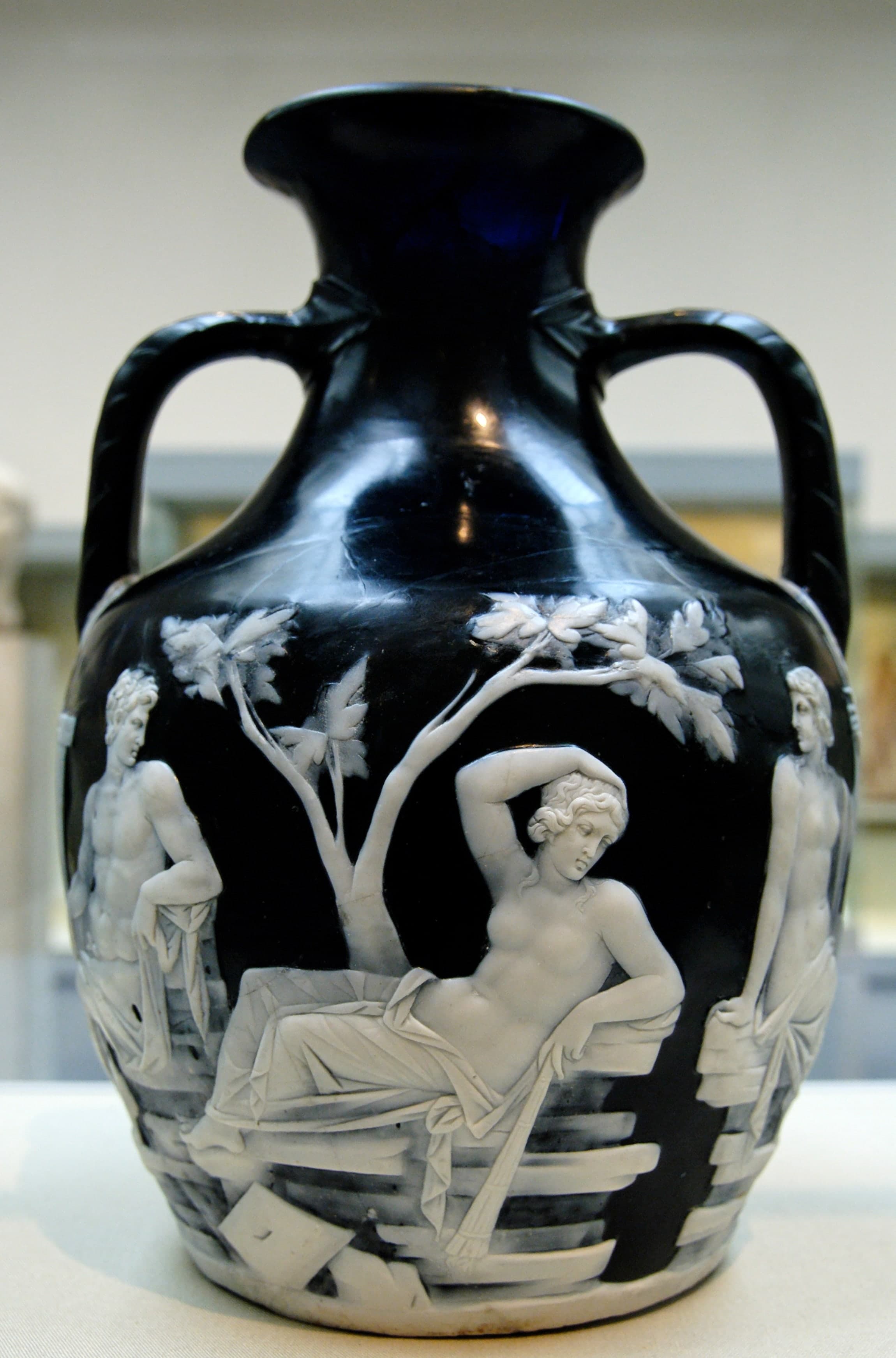
Cameo glass means a dark core — here violet-blue — covered in a second layer of contrasting colour, then carved away so the design stands out in relief. The white figures and details sit proud of the blue background because a glassworker ground through the white casing, leaving it only where the design required it. The technique existed elsewhere in the Roman world, but surviving examples are rare, and the scale and detail here are exceptional among what remains.
A continuous scene wrapped around the body
The white relief forms a single band encircling the vase, showing seven human figures, a large snake, and two bearded heads with horns beneath the handles. The heads mark the division between two scenes. Scholars have proposed many interpretations — mythological, historical, allegorical — but no consensus exists. The figures are finely modelled, with drapery and anatomy rendered in shallow carving, and the composition uses the curve of the vase so that no view shows the whole narrative at once.
A base that does not belong
The bottom was a separate cameo disc, also blue and white, showing a head wearing a cap. It has been displayed apart from the vase since 1845. The disc clearly does not belong: it may have been added in antiquity, or later, or the vase may originally have had a different form — perhaps an amphora with a pointed base, later converted by adding the flat disc. A similar blue cameo vessel from Pompeii shows a comparable conversion, so the possibility is not speculative.
The story
The vase is made by a process that begins with molten glass. A glassworker formed the violet-blue body, probably by blowing or casting, then covered it entirely in a layer of white glass while both were still workable. Once cooled, the white surface was carved away — cutting, grinding, polishing — so that the design emerged in relief against the blue ground. The work is slow and unforgiving: a slip removes material that cannot be replaced, and the thinness of the white layer means the carver is working within a margin of a few millimetres.
The technique is called cameo glass, by analogy with cameo gemstones, where a similar effect is achieved by carving through layers of differently coloured stone. In glass the difficulty is greater, because the two layers must fuse without cracking as they cool, and the finished piece remains fragile. Surviving examples are few, and the combination of size, detail and preservation in the Portland Vase is unusual within that small group.
The vase was first recorded in Rome in 1600 or 1601. By 1810 it had reached the British Museum, on loan from the dukes of Portland. It remained on loan until 1945, when the museum purchased it.
In 1845 a visitor smashed it. The vase broke into many pieces — sources describe around two hundred fragments. It was reassembled shortly afterward, the pieces glued together and the joins filled where necessary. That first restoration held for a period, but the adhesive eventually discoloured and the fills became obvious. The vase was taken apart and reassembled again, using newer materials. It was later dismantled a third time and put back together with methods and adhesives that had advanced further, and with a different philosophy: less filling, more acceptance of the breaks as part of the object's history.
Each reassembly required deciding how much to restore and how much to leave visible. The 1845 repair aimed to make the vase look whole; the most recent version aimed for honesty about the damage. Both are defensible. Both are also provisional, because adhesives age, and what seems stable now may not remain so. The vase has spent more time in pieces, or in a repaired state, than it spent intact in the Roman world.
The scenes on the vase have been interpreted many ways, but none commands agreement. The figures are clearly mythological or allegorical, but which myth, or which allegory, remains open. Proposals have included scenes from the life of Peleus and Thetis, the story of Paris, and various other narratives drawn from Greek and Roman tradition. The lack of inscriptions or attributes clear enough to settle the question means the interpretation remains speculative, and the vase has accumulated centuries of competing readings without resolution.
Why it mattered then
Cameo glass of this scale and refinement required significant resources: skilled labour, time, and the technical knowledge to fuse two layers of glass without cracking. The object itself suggests a patron with the means to commission it and the taste to value the technique. The form — a vase with handles — and the material mark it as a luxury item, not a functional one. The scenes, whatever they depict, were clearly intended to be read by someone familiar with the visual language of Roman and Greek mythology. The figures are rendered with attention to pose, drapery and anatomy, and the composition assumes a viewer who will turn the vase and follow the narrative around its surface. That implies an audience for whom such objects were both legible and desirable, and for whom the combination of technical virtuosity and learned subject matter carried social meaning.
Why it matters now
The vase has mattered to later periods as much as to its own. From the eighteenth century onward it served as a model for glassmakers and potters trying to recreate or imitate the cameo technique. The form and decoration were copied in ceramic, in glass, and in other materials, and the vase became a reference point for neoclassical design. The breaking and repair matter differently. The 1845 incident turned the vase into a problem of conservation, and each subsequent reassembly has been a test of what restoration means: how much to reconstruct, how much to leave broken, how to balance the desire for a whole object against the honesty of showing damage. Those questions remain live in conservation practice, and the Portland Vase, because it has been taken apart and put together three times with three different philosophies, is a record of how those answers have changed. The vase is normally on display in the British Museum. It has been there, on loan or owned, since 1810, and it remains one of the most discussed objects in the collection.
The surprising detail
The visitor who smashed it in 1845 has been named in some accounts, but contemporary records differ on the details. The incident was widely reported, and the vase was famous enough that its destruction was news, but the exact circumstances — whether the act was deliberate or accidental, and what the visitor's motivations were — are less clear than the popular story suggests. What is certain is that the vase broke into many pieces, that it was reassembled soon afterward, and that the reassembly was considered successful enough that the vase went back on display.
What is disputed
The date is usually given as between AD 1 and AD 25, but some scholars support a date in the decades before the turn of the era, so a range into the late first century BC has some support. The identification of the scenes remains unresolved: many interpretations have been proposed, but none has achieved consensus, and without inscriptions or clearer attributes the question remains open.
Remember this
Blue glass, white figures, carved through — then smashed, and put back together three times as ideas about restoration changed.
Test yourself
Why has the Portland Vase been taken apart and reassembled three times since it was broken, rather than left in the state of the first repair?
Because adhesives and conservation philosophy both change over time. The first repair, in 1845, used materials that eventually discoloured and became obvious, and the fills aimed to make the vase look whole. Later, newer adhesives became available, and the vase was taken apart and put back together with them. It was later dismantled again: conservators had better adhesives still, and a different view of what a repair should show. The most recent reassembly used less filling and left more of the breaks visible, reflecting a philosophy that the damage is part of the object's history and should not be hidden. Each generation inherits not just the object but the previous repair, and has to decide whether that repair still serves the object well. The Portland Vase, because it has been through this process three times, is a record of how those decisions have evolved.
Go deeper
- Portland Vase · Wikipedia
- Portland Vase — Wikidata · Wikidata
- The Portland Vase — collection record · britishmuseum.org
Image: Unknown artist Unknown artist, CC BY 2.5. Licence: CC BY 2.5. Source.