I · THE OBJECT · BRITISH MUSEUM
A Folio from the Shahnameh
▶ Listen · narrated
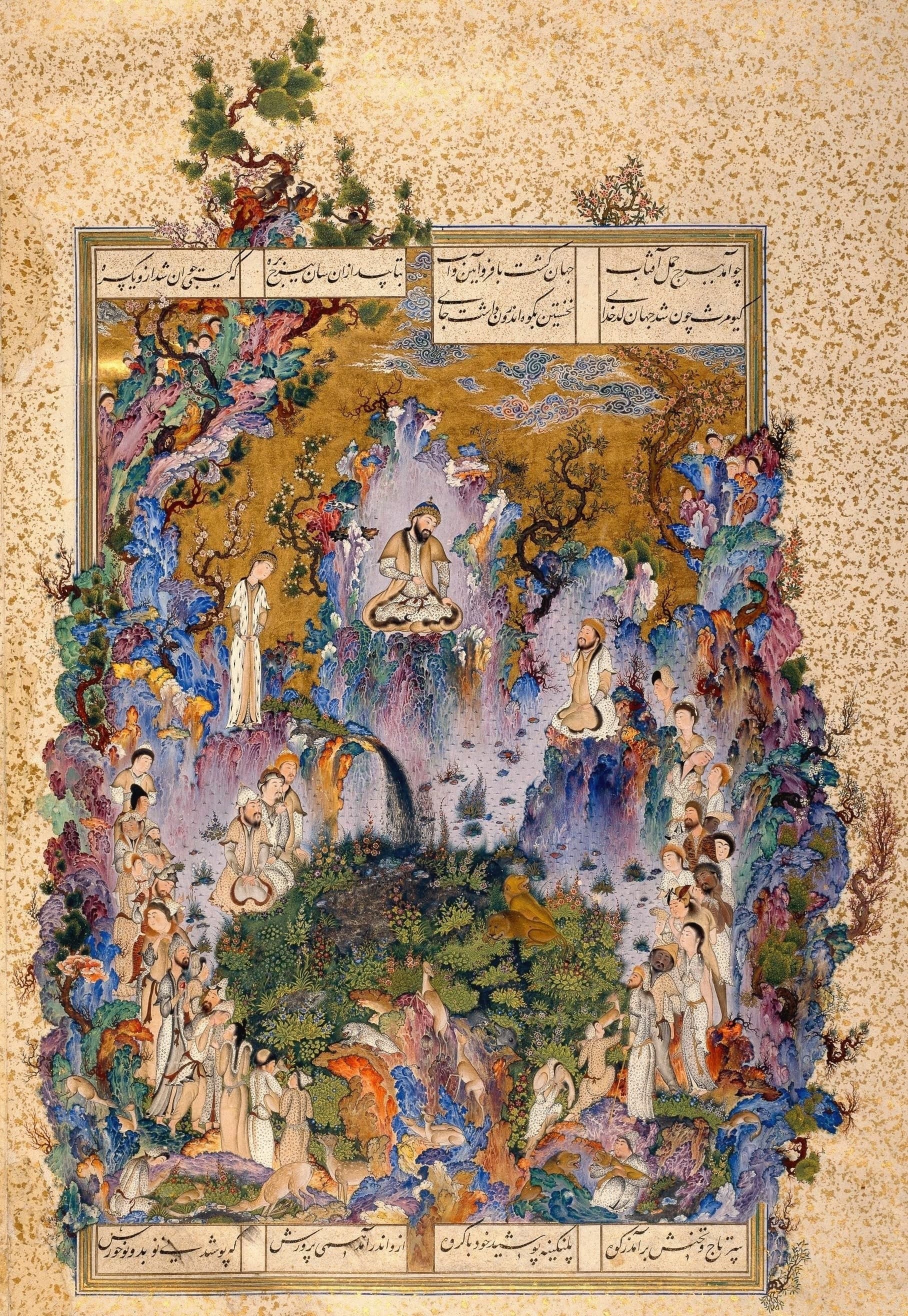
No horizon line, no single viewpoint, figures arranged in tiers — Persian manuscript painting worked to a different geometry, and for good reason.
At a glance
- Epic composed
- Between 977 and 1010 CE
- Author
- Ferdowsi
- Length
- Approximately 50,000 couplets
- Subject
- Iran's mythical and historical past to the seventh century
Look closer
Figures stacked in tiers, not receding into depth
The composition arranges people and objects in horizontal bands up the page. A figure higher on the surface is not necessarily farther away — it may be at the same depth, or closer, or the spatial relationship may be ambiguous. This is not a failure to achieve perspective. It is a system that lets the painter show multiple events, or a crowd of participants, without forcing them into a single frozen moment seen from a single spot.
Patterned surfaces rendered flat
Tiles, carpets and textiles appear as flat fields of decoration. The geometric patterns do not curve around a form or shrink as they recede. This keeps the surface active and legible. A floor can be read as a floor and as an ornamental panel at the same time. The approach privileges clarity and decorative richness over the illusion that the painted surface is a window.
No single vanishing point
Where architectural elements appear, they do not converge on a shared horizon. Different parts of a building may be shown from different angles in the same image. This lets the painter reveal an interior and an exterior simultaneously, or show a throne room and a courtyard without cutting away. The logic is one of disclosure, not optical consistency.
The story
The Shahnameh was written by the Persian poet Ferdowsi between approximately 977 and 1010 CE. It runs to some 50,000 couplets — pairs of rhyming lines — and recounts the mythical and historical past of Iran from the creation of the world to the Muslim conquest in the seventh century. Ferdowsi is reported to have spent thirty-three years completing it. The poem is the national epic of Greater Iran, and it holds a central place in Persian culture and the Persian language.
The work originated in the Ghaznavid Empire and belongs to the literary culture of Greater Iran, a region that includes present-day Iran, Afghanistan, Tajikistan, and areas influenced by Persian language and tradition. Communities in Armenia, Azerbaijan, Dagestan, Georgia, Turkey, Turkmenistan and Uzbekistan also celebrate the epic.
Manuscript copies of the Shahnameh were produced for centuries after Ferdowsi's death, many of them illustrated. This folio comes from a Safavid-period manuscript made during the early modern era, several centuries after the text was composed. Safavid workshops employed painters who worked within a well-established tradition of Persian manuscript illustration, one with its own spatial and decorative principles.
Persian painting does not use a single vanishing point. Figures are often stacked in horizontal tiers up the page, and a person positioned higher is not necessarily farther away. This arrangement lets the painter show a sequence of events, or a gathering of many people, without compressing them into a single moment frozen in optical perspective. The system privileges narrative clarity and the inclusion of multiple actors over the illusion of a unified viewpoint.
Patterned surfaces — tiles, textiles, carpets — are rendered flat. The decorative motifs do not curve around forms or diminish with distance. This keeps the ornamental richness of the surface legible and allows a floor or wall to function both as a spatial indicator and as a field of pattern. The picture plane remains active rather than transparent.
Architectural elements may be shown from multiple angles within the same image. An interior and an exterior can appear together, or a building's plan and elevation can be implied simultaneously. The aim is disclosure: the painter reveals what matters to the story, not what a single observer standing in one spot could see.
This approach is coherent and deliberate. It developed in a manuscript tradition where images accompanied text, and where the reader moved through the book over time, turning pages and returning to earlier scenes. The painting does not need to simulate a window onto a frozen moment. It can unfold the story spatially, guiding the eye across the surface in a way that complements the unfolding of the poem itself.
Why it mattered then
The Shahnameh mattered because it preserved and codified the mythical and historical memory of Iran in Persian, at a time when Arabic was the dominant literary and administrative language across much of the Islamic world. Ferdowsi's decision to write in Persian, and his success in creating a work of this scale and ambition, helped secure the language's status as a vehicle for high literature and cultural identity. The poem was completed during the Ghaznavid period, and it continued to be copied, read and illustrated under successive dynasties. Commissioning a fine manuscript of the Shahnameh became a way for rulers and wealthy patrons to assert their connection to Persian cultural tradition and to demonstrate their refinement and learning. The text provided a shared repertoire of stories, heroes and moral examples that could be invoked in courtly life and political rhetoric.
Why it matters now
The Shahnameh remains a foundational text for Persian-speaking communities and for the broader region influenced by Persian culture. It is studied, recited and celebrated in Iran, Afghanistan, Tajikistan and elsewhere. The poem's stories are widely known, and its language has shaped literary Persian for a millennium. The manuscript tradition also offers a sustained example of a pictorial system that does not rely on linear perspective. Persian painting's approach to space, surface and narrative has influenced artists and designers outside the tradition, and it provides a clear case that optical perspective is one solution to the problem of representation, not the only one. The paintings demonstrate that spatial coherence and narrative clarity can be achieved through other means, and that a flat, patterned surface can carry complex information without simulating depth.
The surprising detail
Ferdowsi is said to have spent thirty-three years writing the Shahnameh, completing it in or around 1010 CE. The figure is recorded in later accounts, though the exact chronology of composition is not fully documented. If accurate, it would mean he worked on the poem for much of his adult life, assembling and versifying a body of material that drew on older sources, some of them lost, and shaping them into a coherent narrative running to approximately 50,000 couplets. The scale of the undertaking, and the fact that it was the work of a single author, is remarkable even by the standards of long epic poems.
What is disputed
The exact chronology of Ferdowsi's composition is not fully documented. The thirty-three-year span is reported in later biographical accounts, but the precise start and end dates are uncertain. The text is usually dated to between approximately 977 and 1010 CE, with some sources giving 1000 or 1011 as the completion year.
Remember this
Persian manuscript painting used a spatial logic of disclosure, not perspective — it showed what mattered to the story, not what one viewpoint could see.
Test yourself
Why does the absence of a single vanishing point in Persian painting make narrative sense in the context of an illuminated manuscript?
Because the reader encounters the images over time, turning pages and moving through the book. The painting does not need to freeze a single moment seen from one spot. Instead, it can unfold events spatially across the surface, showing multiple actors or successive actions in a way that complements the poem's own unfolding. The stacked, non-perspective composition lets the painter include more information — more figures, more architectural detail, more of the story — than a unified perspective view would allow, and it keeps the decorative surface active and legible. The system matches the medium: a bound book read sequentially, not a framed window onto a single scene.
Go deeper
Image: Attributed to Sultan Muhammad, Public domain. Licence: Public domain. Source.