III · THE WORK · ART HISTORY
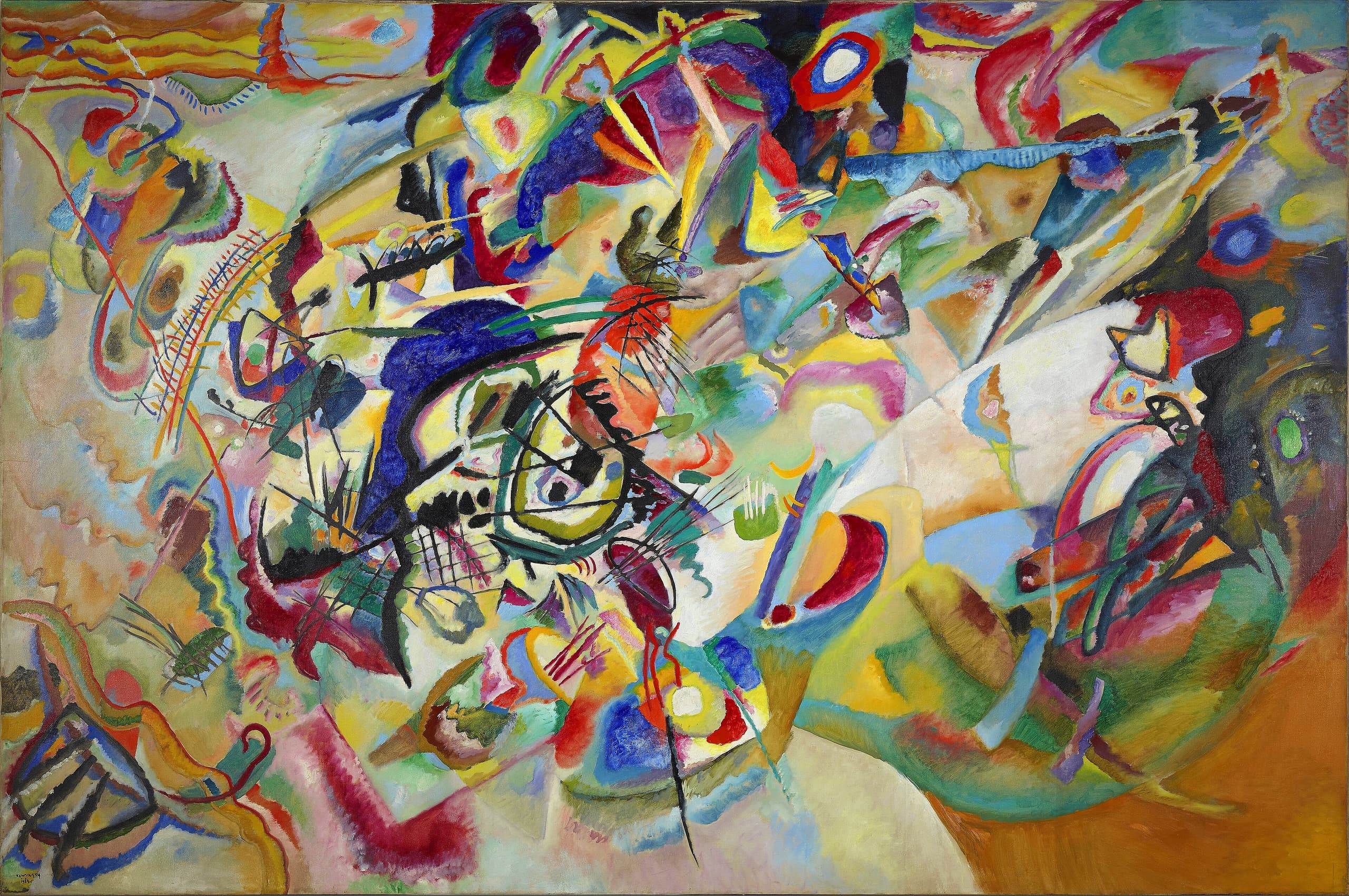
Kandinsky's Composition VII
▶ Listen · narrated
The painting looks like a storm of colour poured onto canvas in a single session. It took months of preparation and more than thirty preliminary studies.
At a glance
- Artist
- Wassily Kandinsky
- Date
- 1913
- Medium
- Oil paint on canvas
- Dimensions
- 200 × 300 centimetres
- Collection
- Tretyakov Gallery, Moscow
Look closer
The dark oval nucleus
Off-centre in the composition sits a dark, swirling oval form. It anchors the surrounding chaos of colour and line. The oval is not purely black — closer inspection shows it contains blues, purples and traces of other hues worked into the darkness. Lines radiate outward from it, and patches of intense colour press against its edges. Whether it is a void, a centre of gravity, or something being born or destroyed is left unresolved.
Traces of earlier imagery
Art historians have identified themes woven into the abstraction: Resurrection, Judgment Day, the Flood, and the Garden of Eden. These are not literal depictions but traces — shapes that suggest boats, waves, figures, or catastrophic motion. The painting does not illustrate these events so much as evoke their emotional registers: upheaval, renewal, destruction, paradise. How much of this was Kandinsky's intention and how much is projection remains debated.
Black lines over finished colour
Dark linear marks cut across areas of colour that appear otherwise complete. These lines are not underdrawing visible through thin paint — they sit on top, added after the colour was laid down. They create boundaries, direct the eye, and occasionally contradict the forms beneath them. This technique suggests that Kandinsky worked in layers, building up fields of colour and then imposing structure over them, rather than painting forms with edges from the start.
The story
Composition VII is an oil painting on canvas, two metres high and three metres wide, made by Wassily Kandinsky in 1913. It is held by the Tretyakov Gallery in Moscow. The painting is abstract — it does not depict recognisable objects or spaces — and is composed of swirling, overlapping forms in intense colours: reds, blues, yellows, greens, purples, blacks and whites. Lines, both thick and thin, cross the surface in curves and diagonals. The overall effect is one of turbulent motion, as though the forms are colliding, dissolving or being born.
Kandinsky made more than thirty preparatory studies for this painting. These included sketches, watercolours and smaller oil paintings, in which he worked out the composition's structure, colour relationships and emotional tone. The final canvas was not improvised. It was the result of sustained planning, though the finished work retains a sense of energy and spontaneity. The studies show that Kandinsky refined the placement of forms, the balance of light and dark areas, and the rhythm of the lines over many iterations.
Art historians have identified several themes embedded in the painting: Resurrection, Judgment Day, the Flood, and the Garden of Eden. These are not literal illustrations. There are no recognisable figures, boats or landscapes. Instead, the themes are suggested through the painting's emotional character and through forms that evoke movement, upheaval and transformation. Whether these associations were Kandinsky's explicit intention, or whether they are interpretations imposed by viewers looking for meaning in abstraction, is not settled. What is documented is that Kandinsky believed colours and forms could convey spiritual and emotional content without representing the physical world.
Kandinsky claimed that colours produced effects analogous to sounds, and that painting could function like music, creating emotional responses through relationships of hue, tone and form rather than through depiction. He described these beliefs in his writings, and they shaped his approach to abstraction. Whether colours do in fact produce consistent emotional or sensory effects across viewers is a separate question. The painting embodies Kandinsky's belief that they do, but the lesson does not require the viewer to accept that belief as fact.
The painting is associated with the movements of Expressionism and abstract art. Expressionism emphasised emotional intensity and subjective experience over objective representation. Abstract art dispensed with recognisable subject matter altogether, exploring what painting could do when freed from the obligation to depict the visible world. Composition VII sits at the intersection of these two impulses: it is abstract in form, but it aims to express something — whether spiritual crisis, cosmic upheaval, or the structure of inner experience.
Why it mattered then
In 1913, the question of what painting was for had become urgent. Photography had made exact representation of the visible world routine and inexpensive. If a machine could record appearances, what was left for a painter to do? One answer was to abandon appearances entirely and explore what painting could communicate through colour, form and composition alone, without depicting anything. Kandinsky was among those testing this possibility. He was not working in isolation — other painters in Europe were also moving toward abstraction — but the scale and ambition of Composition VII marked a commitment to the idea that a painting could function as an autonomous visual event, not a picture of something else. The preparatory studies indicate that he treated this as a serious technical and conceptual problem, not as a spontaneous gesture. The themes identified by art historians — Resurrection, the Flood, Judgment Day, the Garden of Eden — suggest that Kandinsky was not interested in abstraction for its own sake, but as a means of addressing subjects that were difficult or impossible to depict literally. These are events and concepts that resist straightforward representation: they are too large, too metaphysical, or too interior. By moving away from depiction, Kandinsky was attempting to find a visual language adequate to them.
Why it matters now
Composition VII remains in the collection of the Tretyakov Gallery in Moscow, where it has been since the Soviet period. It is one of the works through which the history of abstraction is taught and understood. The painting is frequently reproduced, and it appears in surveys of modern art as an example of early abstract painting on a large scale. The questions it raises have not been resolved. Whether non-representational painting can communicate specific meanings, or whether viewers simply project meanings onto it, is still debated. Whether colours have intrinsic emotional effects, as Kandinsky believed, is a claim that has been investigated by psychologists and found to be more culturally variable and context-dependent than he supposed. The painting does not settle these questions, but it remains a vivid instance of them. For viewers encountering abstraction, Composition VII is useful because it is not minimal or austere. It is dense, layered and busy, and it invites the question of what one is supposed to be looking at when there is nothing to recognise. The preparatory studies complicate the idea that abstract painting is simply about spontaneous expression. They show that this painting, at least, was constructed with as much deliberation as a figurative composition. That does not make it better or worse, but it does make it a different kind of thing than it first appears to be.
The surprising detail
Kandinsky made more than thirty studies for Composition VII, working out the structure and colour relationships over months. When he finally painted the canvas, he is said to have completed it in a matter of days. The appearance of spontaneity was the result of extended preparation. The swirling, chaotic forms were not improvised in the moment — they were rehearsed.
What is disputed
Art historians have identified themes of Resurrection, Judgment Day, the Flood and the Garden of Eden in the painting, but how much of this was Kandinsky's explicit intention and how much is interpretive projection is not settled. The painting is abstract, and these associations are inferred from the emotional character of the forms rather than from any literal depiction. The claim that Kandinsky completed the final canvas in a few days after months of preparation is repeated in the literature but is not documented with a primary source.
Remember this
The painting looks spontaneous but was preceded by more than thirty studies. The chaos was planned.
Test yourself
Kandinsky believed that colours could produce effects analogous to sounds, and that painting could function like music. Why does the lesson report this as Kandinsky's belief rather than as a fact about how colour works?
Because whether colours produce consistent emotional or sensory effects across viewers is not established as fact. Kandinsky held this belief, described it in his writings, and structured his paintings around it, so it is essential to understanding his intentions. But the lesson distinguishes between what Kandinsky believed and what can be verified about perception. Reporting it as his belief respects both the historical record and the limits of what is known. It allows the reader to take the painting seriously on Kandinsky's terms without requiring them to accept a claim about perception that remains contested.
Go deeper
Image: Wassily Kandinsky, Public domain. Licence: Public domain. Source.