I · THE OBJECT · BRITISH MUSEUM
The Gayer-Anderson Cat
▶ Listen · narrated
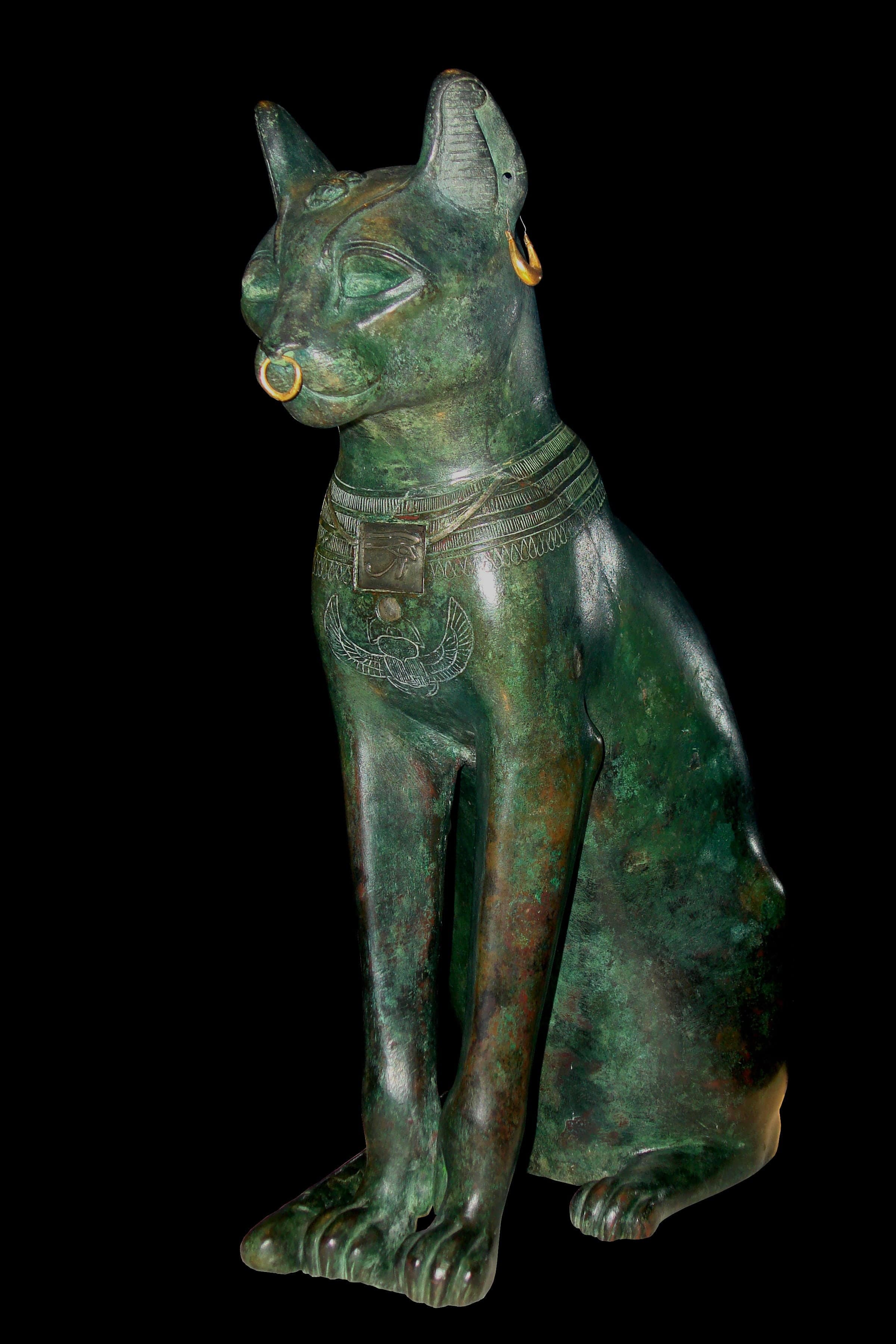
This cat wears silver earrings and a gold necklace. The jewellery tells you it was not made to sit on a shelf, but to stand in a temple as a gift to Bastet.
At a glance
- Date
- 664–332 BC
- Material
- Copper-based alloy (bronze), gold, silver
- Collection
- British Museum
Look closer
Pierced ears and a protective amulet
The cat's ears are pierced, and silver earrings still hang from them. Around its neck is a gold necklace with a pendant — a protective amulet called an aegis, showing a deity's head. These are not decorative touches added later. They were part of the original design, cast or fitted when the statue was made, and they signal that this object had a ritual function. The jewellery marks the cat as sacred, dressed in the manner of a deity's image.
Seated upright, alert, not sleeping
The cat sits with its tail wrapped around its front paws, head upright, ears forward. The pose is formal and attentive, not the curled or sprawling posture of a resting animal. This is the conventional stance for votive cats — objects made to be dedicated in temples. The posture signals readiness and presence, qualities associated with Bastet, the goddess to whom cats were sacred.
Modern repairs revealed by X-ray
X-ray examination has shown that parts of the statue were repaired or restored in modern times, after it was excavated. The details of these interventions are visible in radiographs but not always obvious to the eye. This is common for ancient bronzes that have been cleaned, consolidated or reassembled by collectors or museums. The X-rays allow scholars to distinguish the ancient metalwork from later additions, though the published record does not specify which sections were repaired.
The story
This is a votive statue — an object made to be given to a deity. It was not a portrait of a household pet, nor was it made to ornament a room. It was commissioned, or bought ready-made, to be dedicated in a temple of Bastet, the cat-headed goddess associated with protection, fertility and the containment of dangerous forces. The practice of dedicating animal statues, especially cats, became widespread in Egypt during the Late Period, the centuries between 664 and 332 BC.
Votive practice worked as a form of permanent prayer. You brought the statue to the temple, paid the priests, and left it there. The object remained in the goddess's presence on your behalf, a standing petition or act of thanks that did not depend on your returning. Temples accumulated thousands of these figures — cats, ibises, dogs, bulls — and when the sacred precincts became too crowded, the priests buried the older votives in pits near the temple. Archaeologists have excavated these caches, which is why so many bronze animal figures survive.
The Gayer-Anderson cat is made of bronze — a copper-based alloy — and it is larger and more elaborate than many votive cats. The pierced ears, the silver earrings, the gold necklace with its protective aegis: all of this marks it as a high-status offering. The materials and the workmanship would have been expensive, so this was likely commissioned by someone with resources, or bought from a temple workshop that catered to wealthier patrons. The jewellery is not symbolic of wealth in a human sense; it is the dress of a divine image, and it signals that the cat is to be understood as a sacred being, not a naturalistic animal.
X-ray imaging has revealed that parts of the statue were repaired or restored in modern times, after it entered a collection. This is not unusual. Bronze objects that have been buried for centuries often emerge in fragments, or with corroded sections that later restorers have cleaned, patched or reassembled. The X-rays allow us to see where ancient metal ends and modern intervention begins, though the specifics of what was repaired are not detailed in the available record. The statue as it appears now is a combination of ancient craft and modern conservation.
The name "Gayer-Anderson cat" comes from a collector, but the circumstances of the statue's excavation are not recorded in the material available here. What is clear is that it was made during the Late Period, a span of over three centuries, and that it was intended for a temple context. Beyond that, the details of its original setting — which temple, which city, which dedicant — are not known.
Why it mattered then
Votive offerings were a major part of religious life in Late Period Egypt, and they created a relationship between worshipper and deity that was both personal and permanent. You did not need to be a priest or a member of the elite to participate. Modest bronze figures were available at a range of prices, and even a small offering established your presence in the sacred space. The Gayer-Anderson cat, with its precious-metal jewellery, represents the higher end of this practice — a costly gift that signalled devotion, resources, or both. Bastet's role had shifted by this period. In earlier times she had been a lioness goddess, fierce and solar. By the Late Period she was more commonly shown as a domestic cat, and her cult centred on protection, fertility and the regulation of dangerous forces. Cats were sacred to her, and live cats were kept in her temples. Mummified cats have been found in enormous numbers at sites associated with her worship. Dedicating a bronze cat in her temple was a way of invoking her favour, or thanking her for it, in a form that would last.
Why it matters now
The Gayer-Anderson cat is one of the clearest examples of how religious practice in ancient Egypt was not confined to grand temples and royal ritual. Votive offerings show us a more everyday kind of devotion — people bringing objects to gods, hoping for protection, health, children, safe travel. The practice was transactional, but it was also intimate. The object stood in for you. It kept praying when you went home. The modern restorations, visible under X-ray, also matter. They remind us that the objects we see in museums have histories that extend beyond antiquity. They have been excavated, cleaned, repaired, bought, sold, and displayed. Understanding what is ancient and what is modern is part of understanding the object. The X-rays do not diminish the statue; they add a layer of evidence about how it has been handled, and what we can and cannot know about its original state.
The surprising detail
X-ray imaging revealed modern repairs to the statue, but the published material does not specify which parts were restored or when the work was done. This is frustrating for scholars, because it means we cannot be certain which details — the attachment of the jewellery, the surface finish, even the completeness of the tail or ears — reflect ancient workmanship and which reflect a restorer's decisions. The X-rays prove that intervention happened, but without a conservation report we are left looking at a composite object whose seams are invisible to the naked eye.
What is disputed
The date range is broad — over three centuries — and the material does not narrow it further. The original temple setting is not recorded, nor is the identity of the person who commissioned or dedicated it. The modern restoration history is confirmed by X-ray but not detailed in the available sources.
Remember this
A votive statue was not a portrait or a decoration. It was a prayer made permanent, left in a temple to stand in the presence of a god on your behalf.
Test yourself
Why would a temple bury votive offerings that were meant to remain in the goddess's presence forever?
Because the temples ran out of space. Votive practice was popular, and over decades or centuries the sacred precincts filled with thousands of bronze figures. The priests could not throw them away — the objects were sacred, and they had been dedicated to the deity. So they buried them in pits within or near the temple complex, returning them to the ground in a way that respected their ritual status. This created the archaeological caches that modern excavators have found. The burial was not a rejection of the offerings; it was a solution to a practical problem that preserved the sanctity of the objects.