I · THE OBJECT · BRITISH MUSEUM
The Basse-Yutz Flagons
▶ Listen · narrated
Celtic metalwork is often described as abstract and swirling. These flagons are precise, disciplined, and full of animals — and they show trade routes running long before any Roman army marched north.
At a glance
- Date
- 5th century BC, around 450 BC
- Material
- Copper, coral, vitreous enamel
- Type
- Oenochoe (wine jug)
- Found
- Yutz
- Museum number
- 1929,0511.1 and 1929,0511.2
Look closer
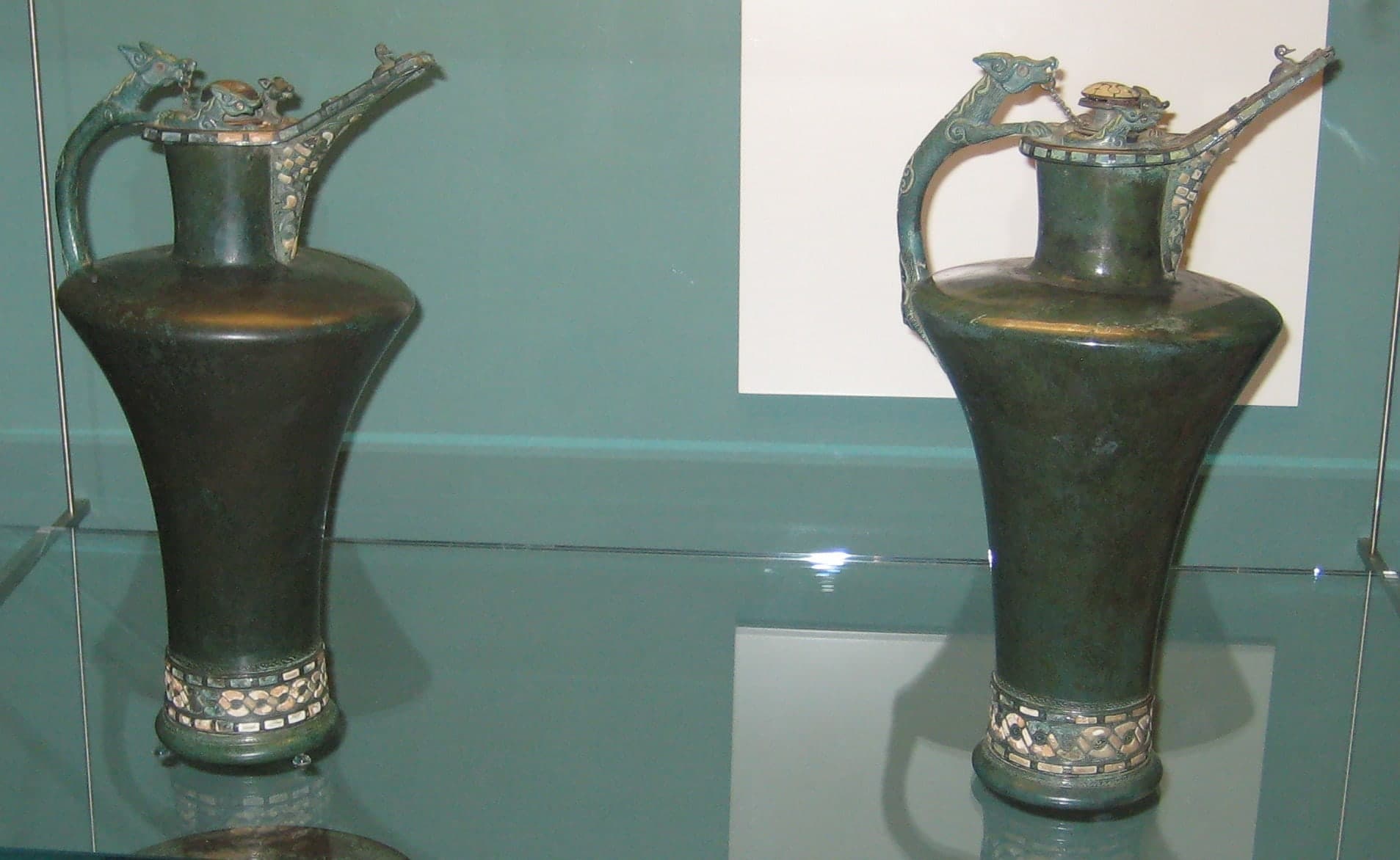
The duck on the rim
A small bronze duck sits at the base of each handle, head turned toward the spout. When you tip the flagon to pour, the duck appears to swim forward into the stream of wine. The body is cast in one piece with the handle; the head was made separately and attached. The duck's eyes are inlaid with red enamel, a glassy material fused onto metal. This is not decoration applied afterward — the enamel was part of the original design, planned before the bronze was cast.
Coral from the Mediterranean
The red studs set into the body and handle are coral, not stone or enamel. Coral is the skeleton of a marine animal, and it does not grow in northern Europe. The nearest sources in the fifth century BC were the Mediterranean coast — the Tyrrhenian Sea off Italy, or the waters near Marseille. Someone carried it north, either as raw branches or already cut into beads, and a Celtic craftsman set it into the bronze. The coral tells you the flagon was made inside a trade network that reached hundreds of miles south.
The shape is Etruscan
An oenochoe is a Greek and Etruscan form: a wine jug with a trefoil spout — a spout pinched into three lobes so the wine pours cleanly and does not drip. The Etruscans, who lived in what is now Tuscany, made bronze flagons in this shape for their own symposia, the formal drinking gatherings that structured elite social life in the Mediterranean. The Celtic maker knew that form and reproduced it, but covered it with a different vocabulary of ornament: animals, spirals, and geometric bands that belong to La Tène art, the style practised north of the Alps in the fifth and fourth centuries BC.
The story
The flagons are a pair, not identical but clearly made together. Each stands roughly forty centimetres tall, cast in bronze — more precisely copper, since bronze is copper alloyed with tin, and the metal here is primarily copper with other elements. The body is ovoid, swelling at the shoulder and tapering toward the base. A curved handle rises from the rim and loops down to the belly. The spout is trefoil, pinched into three lobes.
The surface is dense with ornament. The neck carries a band of palmettes — stylised palm leaves, a motif borrowed from Greek and Etruscan art. The body is divided into zones: some filled with geometric patterns, others with animals. You can make out a wolf, a horse, and what may be a boar or a bear, their bodies elongated and their legs tucked under them in the conventions of La Tène art. The animals are not random: they appear in pairs, facing each other across the vertical axis of the flagon, and they are framed by borders of zigzag and running spirals.
The handle is not a plain strap of metal. It is built up in sections, with a bronze dog or wolf lying along the upper curve, its body forming the grip. At the base, where the handle meets the rim, sits the duck. The duck is not swimming in the wine — it is fixed to the bronze — but when you pour, the angle of the flagon makes it look as though the bird is paddling toward the spout.
The coral and enamel are set into the bronze at specific points: the eyes of the animals, the centres of palmettes, and nodes along the handle. Coral is brittle and difficult to work, and enamel requires controlled heat to fuse the glass onto metal without cracking it. Both materials show technical confidence. The enamel is red, the coral is red, and the bronze would have been a warm golden colour when new, before it oxidised to the green patina you see now.
The flagons were found at Yutz, a town in what is now northeastern France, near the border with Germany. The circumstances of the discovery are not well documented. They were acquired by the British Museum in 1929, but the details of how they were uncovered, and whether they were part of a grave or a hoard, are not recorded in the museum's files.
The form — the oenochoe shape — is not Celtic in origin. It comes from the Mediterranean, where Greek and Etruscan workshops made bronze wine jugs for symposia. The trefoil spout, the ovoid body, and the high looping handle are all features of Etruscan metalwork in the sixth and fifth centuries BC. But the ornament is Celtic. The animals, the spirals, the way the handle is built up into a sculptural form — all of that belongs to the La Tène tradition, named after a site in Switzerland where hundreds of objects in this style were found in the nineteenth century.
What you are looking at, then, is a hybrid: a Mediterranean form made by a Celtic craftsman, using materials that came from the south. The coral proves it. Coral does not grow in rivers or lakes; it grows in warm seas. The nearest sources were the Mediterranean coast, and the coral had to travel north, either as raw material or as finished beads, before it could be set into the bronze.
The same is true of the oenochoe form itself. Someone north of the Alps had seen an Etruscan wine jug, or had access to one, and understood it well enough to reproduce the proportions and the spout. That does not mean the maker was Etruscan. It means the form had been transmitted — through trade, through gift exchange, through the movement of objects and people — and had become part of the repertoire available to a Celtic workshop.
Wine itself was a Mediterranean import. The Celts of the fifth century BC did not grow grapes for wine; they drank beer and mead. Wine came from the south, carried in amphorae — large ceramic jars — and it was a prestige good, consumed at feasts by people who wanted to display their access to long-distance trade. The flagon is the vessel that poured that wine, and its hybrid design — Etruscan shape, Celtic ornament, Mediterranean materials — is a record of the networks that brought the wine north.
Why it mattered then
Wine was not a Celtic drink in the fifth century BC. It was a foreign substance, carried north from the Mediterranean in ceramic amphorae, and it arrived in the hands of people who already had their own fermented drinks — beer made from barley, mead made from honey. Wine was adopted not because it tasted better, but because it came from the south, and because serving it at a feast signalled that you had access to trade routes that reached into the Etruscan and Greek worlds. The flagon is the vessel that made that display possible. You did not pour wine from the amphora it arrived in; you decanted it into a bronze jug, and you poured it in front of your guests, using a vessel that was itself a demonstration of wealth and connection. The oenochoe form was the correct form for that act in the Mediterranean — it was the shape used at Etruscan symposia — and the Celtic maker reproduced it, not because the shape was functionally necessary, but because the shape carried meaning. It said: this is how wine is served in the south, and I am serving it to you in the same way. The coral and enamel amplified that message. Coral was rare and difficult to obtain; enamel required specialist knowledge to produce. Both materials were expensive, and both were visible. The flagon was not meant to be used in private. It was meant to be seen, and its materials were chosen to be legible to people who understood what they cost.
Why it matters now
The flagons matter now because they complicate the story of Celtic and Mediterranean contact. The usual narrative is conquest: Rome marches north, subjugates Gaul, and Mediterranean culture follows the legions. But these flagons were made in the fifth century BC, three centuries before Rome crossed the Alps in force. They show trade, not conquest — the movement of goods, forms and materials along routes that were already old when the Romans arrived. They also show that Celtic craftsmen were not working in isolation. The oenochoe form is reproduced accurately enough that the maker must have seen an Etruscan original, or worked from detailed knowledge of one. That implies contact that was sustained and specific, not the occasional arrival of a single exotic object. The coral implies the same thing: it had to be imported, and it had to arrive in quantities large enough that a workshop could afford to set it into bronze. The hybrid nature of the flagons — Mediterranean form, Celtic ornament, southern materials — is the point. They are not copies and they are not purely Celtic inventions. They are objects made by someone who had access to multiple traditions and who combined them deliberately, producing something that worked in a Celtic context but carried references that would have been legible to anyone who knew Mediterranean metalwork. That is not the art of a peripheral culture imitating a dominant one. It is the art of a culture that was connected, confident, and selective about what it adopted.
The surprising detail
The flagons were acquired by the British Museum in 1929, but the circumstances of their discovery are not well recorded. The museum's files do not state who found them, or whether they were part of a grave assemblage or a hoard. That absence is not unusual for objects acquired in the early twentieth century, when documentation standards were less rigorous, but it means we do not know what else was buried with them, or whether they were buried at all. They may have been found during construction work or agricultural digging, and sold without a detailed record of the find context. That gap in the record is permanent: the information was never written down, and it cannot be recovered.
What is disputed
The discovery circumstances are not well documented. The museum's acquisition records from 1929 do not state how the flagons were found, who found them, or whether they were part of a grave or hoard. That means the original archaeological context — what else was buried with them, and what that assemblage might have told us about their use and meaning — is not recorded and cannot be recovered.
Remember this
Celtic metalwork absorbed Mediterranean forms and materials long before Roman conquest — these flagons are the proof, cast in bronze and set with southern coral.
Test yourself
The flagons combine an Etruscan form with Celtic ornament and Mediterranean materials. Why does that combination matter more than it would if they were purely Celtic or purely Etruscan?
Because the combination is evidence of choice, not accident. A purely Celtic object would tell you what Celtic workshops could do on their own; a purely Etruscan object would tell you what arrived from the south. But a hybrid tells you that someone north of the Alps had access to Etruscan forms, understood them well enough to reproduce the proportions and the trefoil spout, and then made a deliberate decision to cover that form with Celtic ornament and set it with coral that had to be imported. That sequence — access, understanding, selection — implies trade networks that were sustained and specific, and it implies that Celtic craftsmen were not passively receiving Mediterranean influence, but actively choosing which elements to adopt and how to combine them. The hybrid nature of the object is the evidence of agency, and that is what makes it historically significant.