I · THE OBJECT · BRITISH MUSEUM
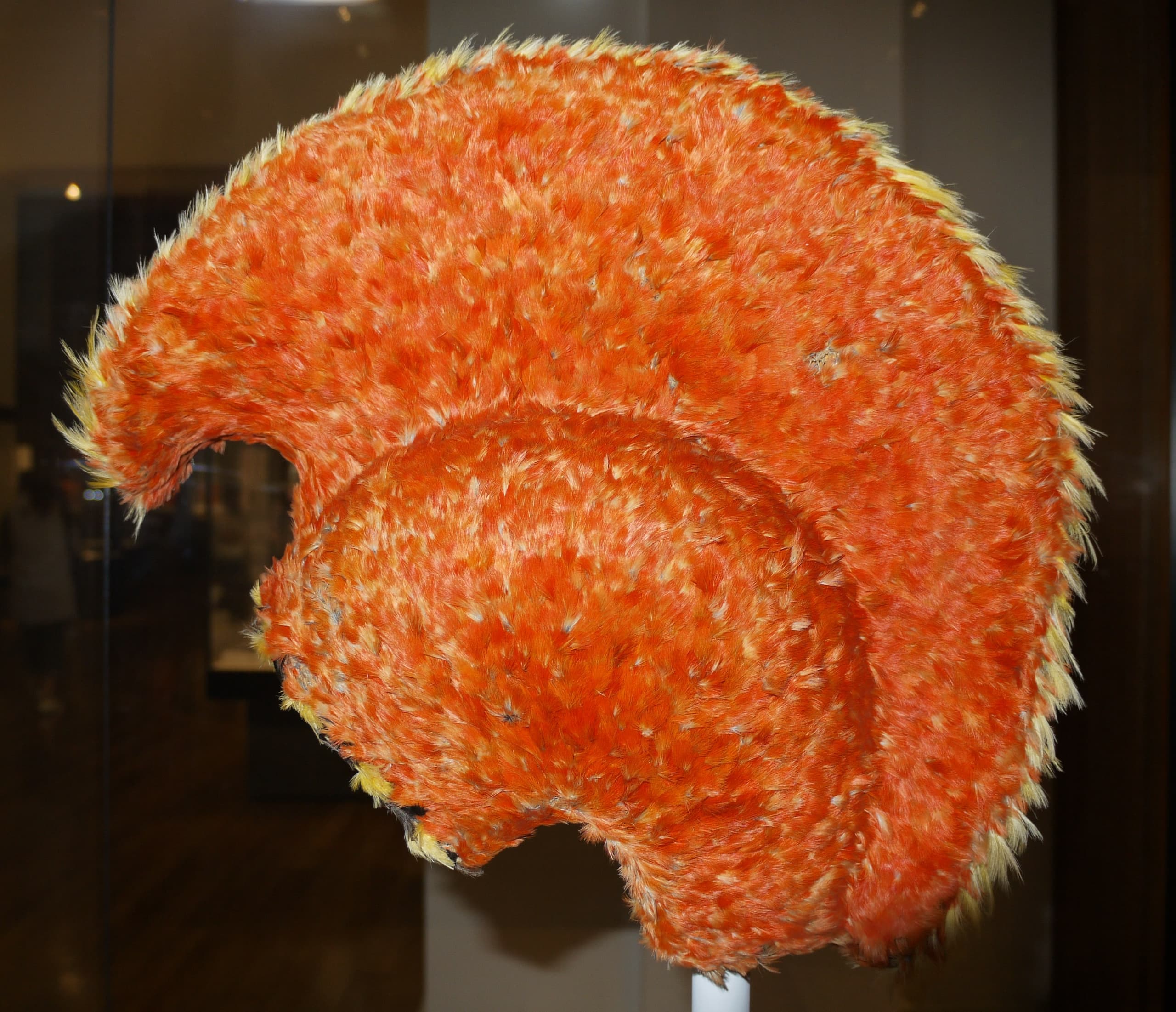
Hawaiian Feathered Helmet
▶ Listen · narrated
Some status symbols announce themselves through rarity of material. Others, like this Hawaiian helmet, declare rank through something harder to fake: the sheer quantity of careful work.
At a glance
- Culture
- Native Hawaiian
- Period
- Early Modern
- Technique
- Featherwork
- Hawaiian name
- Mahiole
Look closer
A woven frame under the feathers
The feathers sit on a structure woven from plant fibre, shaped to fit the head and rise in a crest. The frame had to be rigid enough to hold its form but light enough to wear. Each feather was then attached individually to this base, a process that required the frame to be complete before the surface work could begin.
Thousands of feathers, most from living birds
The density of coverage meant a single helmet required tens of thousands of feathers. Many came from birds that were caught, had a few feathers plucked, and were released to grow them back. This was not efficiency but deliberation: the method multiplied the labour required, and labour was what the object was meant to display.
Worn with a feathered cloak
The mahiole was part of a paired set of regalia. It was worn together with an ʻahu ʻula, a feathered cloak that used the same techniques and materials. The combination covered the wearer from shoulders to crown in worked feathers, a surface that moved and caught light as the wearer moved.
The story
A mahiole is a helmet made almost entirely of feathers. The base is a frame woven from plant fibre, shaped to cover the head and often rising into a crest at the back. Onto this frame, feathers are attached one by one until the surface is completely covered. The result is a rigid structure that looks soft, and a functional piece of headgear that is also a textile.
The feathers came from native Hawaiian birds. Some species provided yellow feathers, others red, and the colours were arranged in patterns across the surface. The birds themselves were often caught and released: a hunter would trap a bird, pluck a small number of feathers, and let it go. Some feathers came from birds that were killed, but the catch-and-release practice was widespread enough to shape the labour involved. It meant that accumulating enough feathers for a single helmet required many separate captures, each yielding only a few usable feathers.
The attachment process was painstaking. Each feather had to be tied or sewn to the frame in a way that held it securely and allowed it to overlap with its neighbours, creating a continuous surface with no gaps. The direction of the feathers mattered: they had to lie in a consistent orientation so that the finished surface looked uniform and moved correctly when the wearer moved.
The mahiole was worn by men of the aliʻi, the chiefly class. It was paired with a feathered cloak, and together the two pieces covered the wearer in worked feathers from shoulder to crown. The combination was reserved for the highest ranks. The restriction was not just about access to materials but about the labour the materials represented: the time required to gather the feathers, weave the frame, and attach each one in place.
Examples of these helmets were collected during the voyages of Captain Cook, and at least sixteen mahiole were taken back from those expeditions. One appears in a painting of Cook's death. Museums around the world now hold examples, though the total number that survive and where they are held is not fully catalogued in the sources here.
Why it mattered then
The mahiole made rank visible in a specific way: through accumulated labour that could not be faked or rushed. Feathers were not rare in the sense that gold or jade might be rare. Native Hawaiian birds were part of the environment. What was rare was the willingness to spend the time required to catch thousands of birds, handle each one carefully enough to release it alive, collect the feathers, prepare the frame, and attach each feather in the correct orientation. This method of signalling status had a built-in honesty. You could not substitute a cheaper material or take a shortcut without the result being immediately visible. A mahiole with too few feathers, or feathers attached carelessly, would not look right. The surface would have gaps or lie incorrectly. The labour was the point, and the labour showed. Wearing the helmet and cloak together covered the body in a surface that moved and reflected light differently from cloth or skin. In a society where rank shaped every interaction, this was a form of communication that worked at a distance and in motion. The wearer was identifiable before they spoke, and the regalia carried information about their position that everyone present could read.
Why it matters now
The mahiole is evidence of a way of thinking about value that does not map neatly onto modern economic logic. The catch-and-release practice, in particular, represents a choice to make the work harder rather than easier. From a perspective that measures efficiency in time or output, it looks irrational. From a perspective that measures value in care and attention, it makes sense: the object is worth more because it took longer and required more restraint. This is also a reminder that status symbols are not universal. The materials that signal rank in one society may be common or invisible in another. The mahiole worked in a context where everyone understood what the feathers meant and how much work they represented. Outside that context, the helmet is beautiful but its communicative function is harder to read. It requires explanation, which is what a museum label or a lesson like this one provides. The survival of these helmets in museums also raises questions about how objects move between cultures and what it means to preserve something far from the place it was made and used. The mahiole collected during Cook's voyages were taken in circumstances that are not fully recorded, and the terms of their removal are not documented in the sources here. That absence is itself part of the object's history now.
The surprising detail
The painting that includes a mahiole is a depiction of Cook's death, which means the helmet appears in an image of violence between the people who made it and the people who collected it. The juxtaposition is jarring: the object is present both as regalia and as evidence of the encounter that led to its removal. The painting freezes a moment of conflict, and the helmet is one of the details that places the scene in a specific location and culture.
How it got here
At least sixteen mahiole were collected during the voyages of Captain Cook in the late eighteenth century. The circumstances of these collections are not fully documented in the sources here, and the terms under which the helmets were acquired are not recorded. Examples are now held in museums around the world. Questions about the removal of Hawaiian cultural objects during this period, and about their appropriate location now, are part of ongoing discussions between museums and Native Hawaiian communities, but the specifics of those discussions are not detailed in the material available for this lesson.
Remember this
Rank made visible through labour, not rarity — and the labour was deliberately multiplied by releasing the birds alive.
Test yourself
Why would a society choose to make status objects more labour-intensive rather than less, especially when a simpler method would produce a similar-looking result?
Because the labour itself is what carries the message. If the goal is to signal that you command resources — including time and skilled workers — then an object that requires more work is a more effective signal than one that requires less. A shortcut that saves time also undermines the point. The mahiole worked as a status symbol precisely because everyone who saw it understood how long it took to make. The catch-and-release practice, which multiplied the number of captures required, made the labour even more visible. In a society where rank shaped daily life, the helmet was not just decoration but information: it told you who you were looking at before any words were exchanged. The inefficiency was the message.
Go deeper
Image: Geni, CC BY-SA 4.0. Licence: CC BY-SA 4.0. Source.