III · THE WORK · ART HISTORY
The Lion-Man of Hohlenstein-Stadel
▶ Listen · narrated
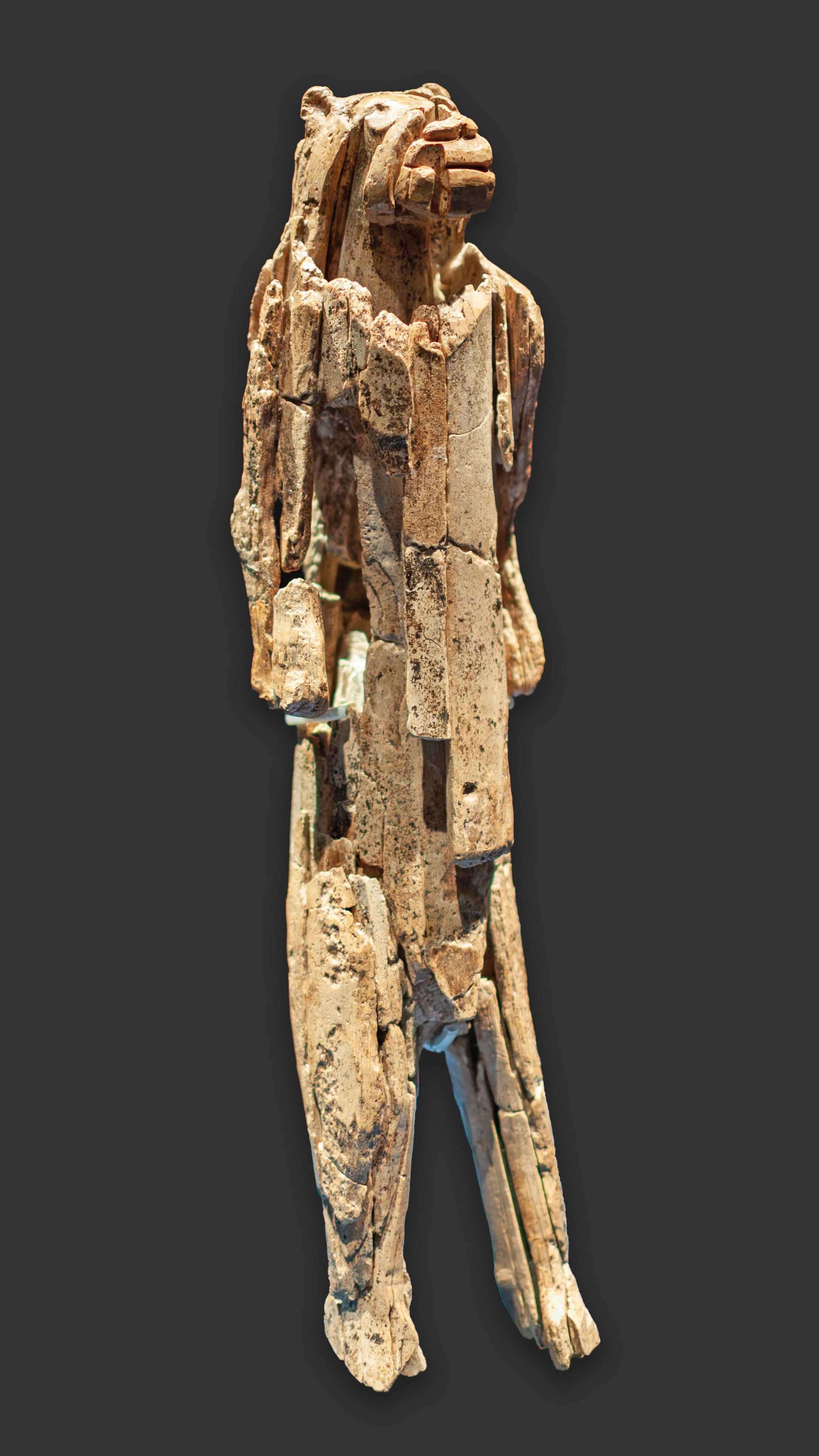
The figure stands upright on human legs, but its head is a lion's. It was carved from mammoth ivory sometime between 35,000 and 41,000 years ago.
At a glance
- Culture
- Aurignacian
- Date
- Between 35,000 and 41,000 years ago
- Material
- Mammoth ivory
- Height
- 31.1 cm
- Discovery
- Hohlenstein-Stadel cave, Germany, 1939
- Collection
- Museum Ulm
Look closer
The lion's head
The head is not human. The muzzle is a lion's — specifically a cave lion, Panthera spelaea, an animal that lived in Ice Age Europe and has been extinct for more than ten thousand years. The ears are set high and to the sides, shaped as a lion's ears are shaped. Whoever carved this knew what a cave lion looked like, in enough detail to render its head recognisably, and chose to place that head on a body that stands upright.
The upright stance
The body is human in posture. The figure stands on two legs, not four. Its arms hang at its sides. The proportions are not those of a lion walking upright — they are those of a person, with a lion's head substituted where a human head would be. The carving is not depicting a lion behaving strangely. It is depicting a being that does not exist: a composite.
Seven parallel cuts on the left arm
Seven grooves run across the left arm, parallel to one another, carved deliberately into the surface. They are not structural damage or wear. They were cut with intention, using a flint blade. What they signify is not recorded. They may be decorative, symbolic, or a form of marking whose meaning has not survived. They are there, and they were put there on purpose.
The story
The Lion-Man was discovered on 25 August 1939 in the Hohlenstein-Stadel, a cave in what is now Germany. It was carved from mammoth ivory — the tusk of a woolly mammoth — using a flint stone knife. The material is hard, and the carving is detailed. The work required sustained effort and skill.
The figure is 31.1 centimetres tall. It combines a human body with the head of a cave lion. The body stands upright on two legs. The head is unmistakably that of a lion: the muzzle, the placement of the ears, the shape of the skull all correspond to Panthera spelaea, the cave lion that lived in Europe during the Ice Age and is now extinct. The person who made this had seen cave lions and knew their anatomy well enough to carve a recognisable likeness.
The figurine was found in fragments and has been reconstructed more than once as new pieces were recovered. It now stands in the Museum Ulm. Carbon dating of the layer in which it was found places its age between 35,000 and 41,000 years old. That associates it with the Aurignacian culture.
Seven parallel grooves are carved across the left arm. They run transversely — across the arm rather than along it — and they are evenly spaced. They were made with a flint blade after the figure itself was shaped. Their meaning is not known. They may have been decorative, or they may have carried significance that has not been preserved in any other form.
The carving is not a portrait of something seen. Cave lions existed, and humans existed, but no creature with a lion's head and a human's upright body existed. The figure is a combination, made deliberately. Someone conceived of a form that did not occur in nature and then worked mammoth ivory until that form existed as an object.
What the figure meant to the people who made it and saw it is not recorded. It may have been ritual, symbolic, narrative, or something else entirely. The archaeological record from this period does not include written language or detailed contextual evidence about the purpose of such objects. What survives is the object itself: a carved body that is not a copy of anything that lived.
Why it mattered then
The Aurignacian people who made this figure lived in a landscape of glaciers and megafauna. Cave lions were real animals in their environment — large, dangerous predators. The decision to combine a lion's head with an upright human body was not random. It required a conception of something that did not exist, and then the labour to make it exist in three dimensions. Carving mammoth ivory with flint tools is slow work. The tusk is dense and hard. The figure is detailed enough that the species of lion is identifiable. Whoever made it invested significant time and skill. That investment suggests the object mattered. Whether it was used in ritual, storytelling, or another context is not known, but it was made with care and kept. The figure depicts neither an animal nor a human alone. It is a hybrid, and that makes it evidence of a particular kind of thought: the ability to imagine a form that does not exist and to give it physical presence.
Why it matters now
The Lion-Man survives because mammoth ivory is durable and because it was left in conditions that preserved it. It is now evidence of something that cannot be observed directly: the cognitive capacity of people living tens of thousands of years ago. The figure demonstrates that those people could conceive of beings that did not exist in nature, and that they chose to make those conceptions into objects. That capacity — to imagine something that is not real and then to depict it — is part of what is meant by symbolic thought. The figure is not a record of something seen. It is a record of something conceived. It shows that the people who made it were thinking in ways that involved abstraction, combination, and invention. The object is also a reminder of how much has not survived. Wooden carvings from this period would have decayed. Paintings on bark or hide would have perished. Songs, stories, and spoken explanations left no trace. What remains is what was made from materials that last: stone, ivory, bone. The Lion-Man is evidence of a much larger world of thought and culture, most of which is now invisible.
The surprising detail
The Lion-Man was found in pieces in 1939, and a reconstruction was made from the fragments that were recovered then. Decades later, further excavation of the cave sediment recovered more than two hundred additional fragments. A later reconstruction incorporated these pieces and revealed details that had not been visible before, including the full shape of the head and the seven parallel cuts on the left arm. The figure that is now displayed in Museum Ulm includes fragments that were not part of the earlier version. What was understood about the object changed when more of it was found.
What is disputed
The meaning of the seven parallel grooves on the left arm is not known. They were carved deliberately, but no evidence survives to explain their purpose. Similarly, what the figure represented or how it was used is not recorded. Interpretations range from ritual object to mythological being to narrative figure, but these remain conjectures. The archaeological context provides a date and a culture, but not an explanation.
Remember this
A figure combining human and lion, carved in ivory between 35,000 and 41,000 years ago — evidence that someone made an object of something that did not exist.
Test yourself
Why does the fact that the Lion-Man is a combination of human and lion, rather than a depiction of either one alone, matter for what the object tells us about the people who made it?
Because it shows that the maker was not simply recording something observed. Humans existed, and cave lions existed, but a being with a lion's head and a human's upright body did not. To make the Lion-Man, someone had to conceive of a form that did not occur in nature, hold that conception clearly enough to guide their hands through hours of carving, and produce an object that others could recognise as intentional. That is evidence of symbolic thought — the ability to imagine, combine, and depict things that are not real. A carving of a lion alone would show skill and observation. A carving of a lion-human shows something more: that the maker's mind was working with ideas, not just images, and that those ideas could be made physical and shared.
Go deeper
Image: Dagmar Hollmann, CC BY-SA 4.0. Licence: CC BY-SA 4.0. Source.