I · THE OBJECT · BRITISH MUSEUM
The Warren Cup
▶ Listen · narrated
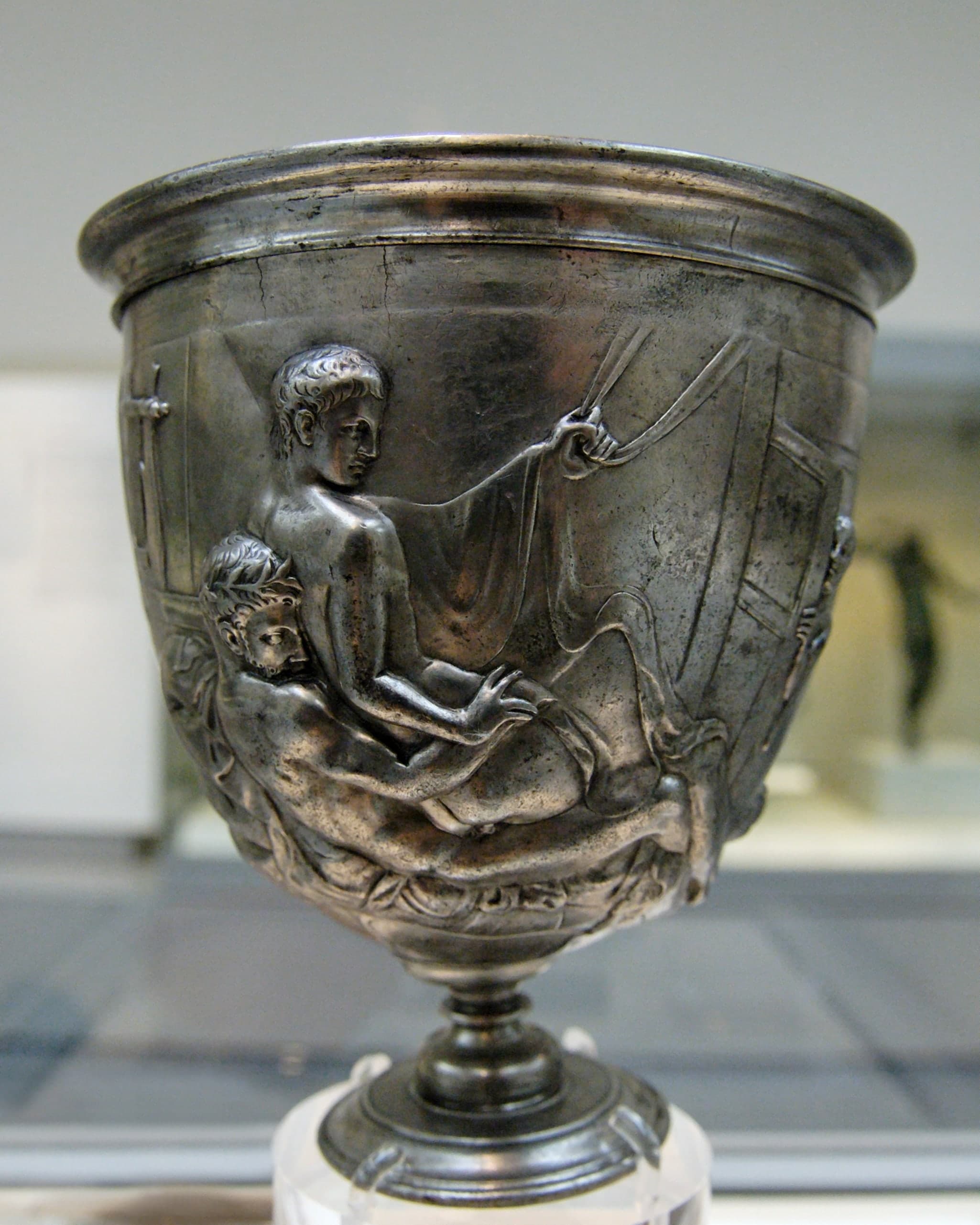
This silver cup shows two sexual acts in relief, made without euphemism in the first century. Its modern silence is more revealing than its ancient frankness.
At a glance
- Material
- Silver
- Height
- 11 cm
- Width
- 9.9 cm
- Technique
- Repoussé — hammered from the reverse to raise the design
- Collection
- British Museum
Look closer
Two handles, now lost
The cup originally had two vertical handles rising from the rim. They are gone, leaving attachment points visible on either side. Their loss changes the object's balance and the way a drinker would have held it, but the imagery remains intact across the body of the vessel.
Repoussé work
The scenes were made by hammering the silver from the inside, pushing the metal outward to create raised relief on the exterior surface. This technique — repoussé — requires working blind for much of the process, feeling the form as it develops on the side you cannot see. The detail achieved here, in musculature and drapery folds, suggests a practiced hand.
Two scenes, facing outward
Each side of the cup shows a male couple in a sexual act. The figures are not symbolic or abstracted: they are rendered with the same attention to anatomy and spatial arrangement that Roman silverwork gave to mythological or domestic subjects. The imagery is explicit, and it is also ordinary in its craftsmanship — made with the same tools and techniques as any figured silver cup of the period.
The story
The cup is usually dated to the time of the Julio-Claudian dynasty, the line of emperors that begins with Augustus and runs through the first century. It is a drinking vessel, silver, worked in repoussé relief. The two scenes show male couples engaged in sexual acts. The figures are detailed, the poses legible, the settings domestic — a bed, drapery, a lyre hanging on the wall in one scene.
The imagery is not allegorical. Roman silver often carried mythological subjects, where a god's behaviour might be read as symbolic or at a narrative remove. Here the scenes are human, contemporary, and specific. They show what they show.
The cup is named after Edward Perry Warren, an American collector who owned it in the early twentieth century. Warren also owned a marble version of Rodin's The Kiss, now in Tate Modern, and a painting by Lucas Cranach the Elder, now in the Courtauld Institute of Art, both also in London. His collection reflected particular interests, and the cup was among them.
For decades, no major museum would acquire it. The imagery made it unsellable in the institutional market, and it passed through private hands. When the British Museum purchased it, the price was £1.8 million. The museum stated this was its most expensive single purchase at that time. The price made news; the cup's arrival in a public collection made more.
The object itself does not explain why it was made or for whom, but it does tell us that such imagery could be rendered in a luxury material, with skill, and survive to be found. What it does not tell us is how common such objects were, or what range of Roman attitudes toward same-sex acts they might represent. The cup is evidence of one thing made, not of a consensus recorded.
Why it mattered then
Roman attitudes toward same-sex acts were not uniform, and a single object cannot stand in for a whole culture's norms. What the cup does record is that such imagery could be commissioned in silver, made with technical skill, and used as a drinking vessel — which suggests it was not unspeakable or entirely private. Silverwork of this quality was expensive. It was made for households with resources, and it circulated in social settings where drinking vessels were seen and handled. The repoussé technique, the domestic details in the scenes, and the survival of the object all indicate that this was not a hidden or furtive commission. It was made to be used. The imagery is explicit, but it is also composed with the same formal attention Roman art gave to other subjects. The figures are proportionate, the drapery falls naturally, and the spatial arrangement is coherent. The cup does not present the acts as transgressive in its visual language; it presents them as it would present any other figured scene. That ordinariness is itself evidence, though of what exactly remains debated. Roman law, Roman literature, and Roman art do not agree on a single view of same-sex acts, and the cup does not resolve that complexity. It adds to it.
Why it matters now
The cup's twentieth-century history is as instructive as its making in antiquity. Museums refused it for decades, not because it was damaged or doubtful in authenticity, but because of what it showed. The imagery that Roman silversmiths rendered without apparent hesitation became, in later centuries, a reason for institutional silence. When the British Museum finally acquired it, the decision was noted in the press not only for the price but for the fact of acquisition itself. The cup had been known to scholars, published in specialist literature, and privately owned, but it had not been publicly displayed in a major collection. Its arrival in Bloomsbury marked a shift in what museums were willing to show, and to whom. The object now prompts questions about how we read ancient evidence. It is easy to project modern categories — identity, orientation, transgression — onto a Roman cup, but those categories did not exist in the same form in the first century. Roman culture had its own structures around sex, gender, status, and power, and they do not map neatly onto ours. The cup shows acts, not identities. It records behaviour, not a social movement. Reading it carefully means holding those distinctions in mind. It also raises questions about what gets preserved, displayed, and taught. Objects that trouble later audiences often end up in storage, described in euphemism, or left out of public narratives. The cup spent generations in that category. Its presence in the museum now is a statement about what institutions are willing to show, but also a reminder of how long that willingness took to arrive.
The surprising detail
The cup was purchased by the British Museum for £1.8 million, which the museum stated was its most expensive single purchase at that time. The price reflected not only the rarity of Roman figured silverwork in good condition, but also the decades of institutional refusal that had kept it out of public collections. The same imagery that made it unsellable for so long became, in 1999, a reason to acquire it — a shift that says as much about the late twentieth century as the cup says about the first.
How it got here
The cup is named after Edward Perry Warren, an American collector who owned it in the early twentieth century. After Warren, it passed through private hands for decades. No major museum acquired it during that period. The British Museum purchased it in 1999 for £1.8 million, which the museum stated was its most expensive single purchase at that time. The place of manufacture and original ownership are not recorded.
Remember this
Explicit imagery, ordinary technique. The cup's modern silence lasted longer than its ancient frankness.
Test yourself
Why is it harder to interpret this cup than it might first appear, even though the imagery is explicit?
Because explicitness in what is shown does not equal clarity in what it meant. The cup records acts, but it does not record the social structures around those acts — who could do what with whom, under what circumstances, and with what consequences. Roman attitudes toward same-sex behaviour varied by status, role, and context in ways that a single object cannot explain. The imagery is clear, but the framework for understanding it is not preserved on the cup itself. We are left with an image made legible by Roman visual conventions, but rendered ambiguous by the loss of the social script that surrounded it. The cup is evidence, but not explanation.
Go deeper
Image: Unknown artist Unknown artist, CC BY 2.5. Licence: CC BY 2.5. Source.