I · THE OBJECT · BRITISH MUSEUM
Javanese Bodhisattva Sculpture
▶ Listen · narrated
Buddhist sculpture travelled to Java in ideas, not objects. What arrived was a vocabulary of gestures and symbols; what emerged was something new.
At a glance
- Date
- 9th century
- Culture
- Central Javanese
- Material
- Stone
- Context
- Era of Borobudur temple construction
Look closer
The posture and its meaning
A bodhisattva is a being who has achieved enlightenment but postpones final liberation to help others. The iconography — the hand gestures, the ornaments, the seated or standing pose — comes from Buddhist tradition, a visual language that travelled with the texts and the monks. What changes in Java is the rendering: the proportions, the stillness of the face, the treatment of fabric and jewellery. The gesture itself would have been legible to anyone trained in that tradition, but the style is distinctly Javanese.
The stone and the carving
Central Javanese sculpture of this period was carved from volcanic stone, abundant in the region. The material allowed fine detail but also imposed limits: it fractures along certain planes, and weathers in particular ways. The carving technique — how the stone was worked, whether with iron tools or abrasives, and in what sequence — shaped what was possible. The surfaces that survive show a high degree of finish, but whether that finish was achieved by grinding, polishing, or both is not always recorded.
What is not shown
Bodhisattva figures in Buddhist sculpture are often heavily adorned: necklaces, armlets, elaborate headdresses, draped cloth. Some Javanese examples follow that template closely; others simplify. Without seeing this particular sculpture, it is impossible to say where it falls on that spectrum, but the range itself is worth noting. Simplification is not always a sign of provincial work or limited skill — it can be a deliberate choice, a different aesthetic emphasis.
The story
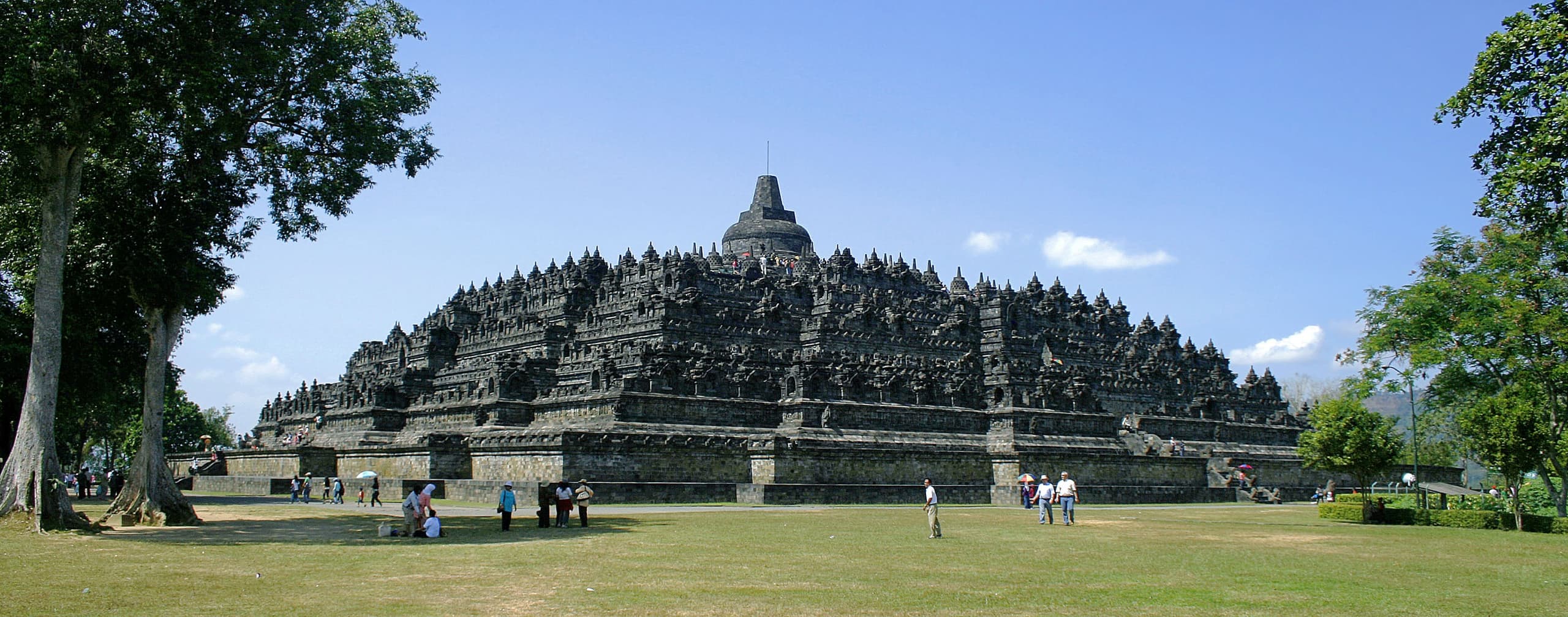
In the ninth century, Central Java was building temples on a scale it had not attempted before. Borobudur, constructed during the reign of the Sailendra Dynasty, is a monument of stacked stone platforms — six square, three circular — topped by a central dome and surrounded by smaller stupas, each one perforated and containing a seated Buddha. The temple is covered in relief panels, more than two thousand of them, depicting Buddhist narratives and teachings. It is a pilgrimage site, designed to guide a visitor upward through levels of spiritual understanding.
The sculpture that survives from this period shares certain qualities with the temple architecture: a preference for symmetry, a clarity of outline, a kind of frontal composure. The figures are not static, exactly, but they are still. Buddhist sculpture of the same centuries in other regions often shows more movement, more sway in the body, more ornament. Javanese carving tends toward restraint.
That restraint is not the result of distance from the source tradition. Java was in active contact with Buddhism, through texts, through monks, through trade. The differences are choices, not misunderstandings. Javanese sculptors were working within an iconographic system they understood — the hand gestures, the attributes, the symbolic meanings — but they were rendering it in a local idiom. The result is sculpture that reads as Buddhist to anyone familiar with the tradition, but looks Javanese.
The ninth century was the high point of this tradition in Central Java. By the fourteenth century, Hindu kingdoms in the region were in decline, and Java was converting to Islam. Buddhist temple building stopped. Borobudur itself was abandoned, and the forest grew over it. It was not entirely forgotten — people in the region knew it was there — but it was no longer in use as a religious site.
In 1814, Thomas Stamford Raffles, then the British ruler of Java, was told of the temple's location by Indonesians who knew the site. Raffles organised an expedition to clear it, and Borobudur entered the record of European scholarship. That moment — 1814, Raffles, the clearing — is often treated as the discovery, but it is more accurate to call it the moment when the site became known outside Java.
Why it mattered then
Buddhist sculpture in ninth-century Java was not decorative. It was functional in a specific sense: it made doctrine visible. A bodhisattva figure, placed in a temple or a shrine, was a focus for devotion and a reminder of the path. The iconography — the gestures, the posture, the attributes — encoded teachings that a viewer trained in the tradition would recognise. The hand positions, called mudras, signified particular states or actions: teaching, meditation, fearlessness, giving. The ornaments indicated the figure's status as a bodhisattva rather than a Buddha, someone still engaged with the world rather than withdrawn from it. The temples themselves, Borobudur among them, were built by rulers who were proclaiming their patronage of Buddhism and their alignment with a cosmopolitan religious and intellectual tradition that linked Java to other centres of Buddhist learning. The scale of the building projects — the stone, the labour, the time — was a statement of resources and authority. The sculpture was part of that statement, but it was also part of the religious infrastructure, the physical apparatus of teaching and practice.
Why it matters now
Borobudur was restored in the twentieth century, a project completed in 1983 with support from the Indonesian government and UNESCO. The temple is now a UNESCO World Heritage Site and a pilgrimage destination for Buddhists in Indonesia, who celebrate Vesak Day there. It is also a tourist site, visited by people who come for the architecture, the reliefs, the history, or simply the scale of the thing. The sculpture from this period, whether still in situ or removed to museums, is studied as evidence of how Buddhist visual language was adapted as it moved across Asia. The Javanese versions are not copies of earlier models; they are translations, and translations always involve choices about what to keep, what to change, and what to leave out. Those choices tell us something about what mattered to the people making them. For Indonesia, Borobudur and the sculpture associated with it are part of a pre-Islamic heritage that complicates any simple narrative about the country's religious identity. The monument is a source of pride, a symbol of historical sophistication and international connection, and also a site where different claims — religious, national, scholarly, touristic — overlap and sometimes conflict.
The surprising detail
Borobudur was not entirely lost during the centuries it stood abandoned. People in the region knew it was there, buried under volcanic ash and overgrown with jungle. The site had a name, and stories attached to it, though it was no longer used for Buddhist worship. When Raffles was told of it in 1814, he was being directed to something already known locally, not discovering something hidden. The surprise, if there is one, is how completely the European narrative of discovery has overshadowed that continuity of local knowledge.
What is disputed
The exact provenance of individual sculptures from this period is often unclear. Many were removed from temple sites during the colonial period, and the records of where they were found, when, and by whom are incomplete or inconsistent. Without specific documentation for this piece, its original location within a temple complex or its relationship to other sculptures cannot be stated with certainty.
Remember this
Buddhist iconography, rendered in a Javanese idiom — the same gestures, a different stillness.
Test yourself
Why would a Javanese sculptor in the ninth century simplify the ornamentation on a bodhisattva figure, given that the iconographic tradition was well understood?
Simplification is not necessarily a sign of limited access to models or incomplete knowledge of the tradition. It can be a deliberate aesthetic choice, a preference for clarity over elaboration, or an emphasis on stillness and symmetry rather than movement and ornament. Javanese sculptors were working within the same iconographic system — they knew what the gestures and attributes meant — but they were also working within a local tradition that valued different qualities. The choice to simplify, where it occurs, is evidence of that local tradition asserting itself, not of distance from the source. It is a reminder that fidelity to a tradition does not require copying its surface features unchanged.
Go deeper
Image: Gunawan Kartapranata, CC BY-SA 3.0. Licence: CC BY-SA 3.0. Source.