III · THE WORK · ART HISTORY
Munch's The Scream
▶ Listen · narrated
The painting everyone calls The Scream shows a figure trying to block out sound, not make it. Munch was clear: nature screamed, and this is what heard it.
At a glance
- Artist
- Edvard Munch
- Date
- 1893
- Medium
- Tempera and pastel on board
- Dimensions
- 91 × 73.5 centimetres
- Collection
- National Museum of Art, Architecture and Design
Look closer
Hands clamped over the ears, not the mouth
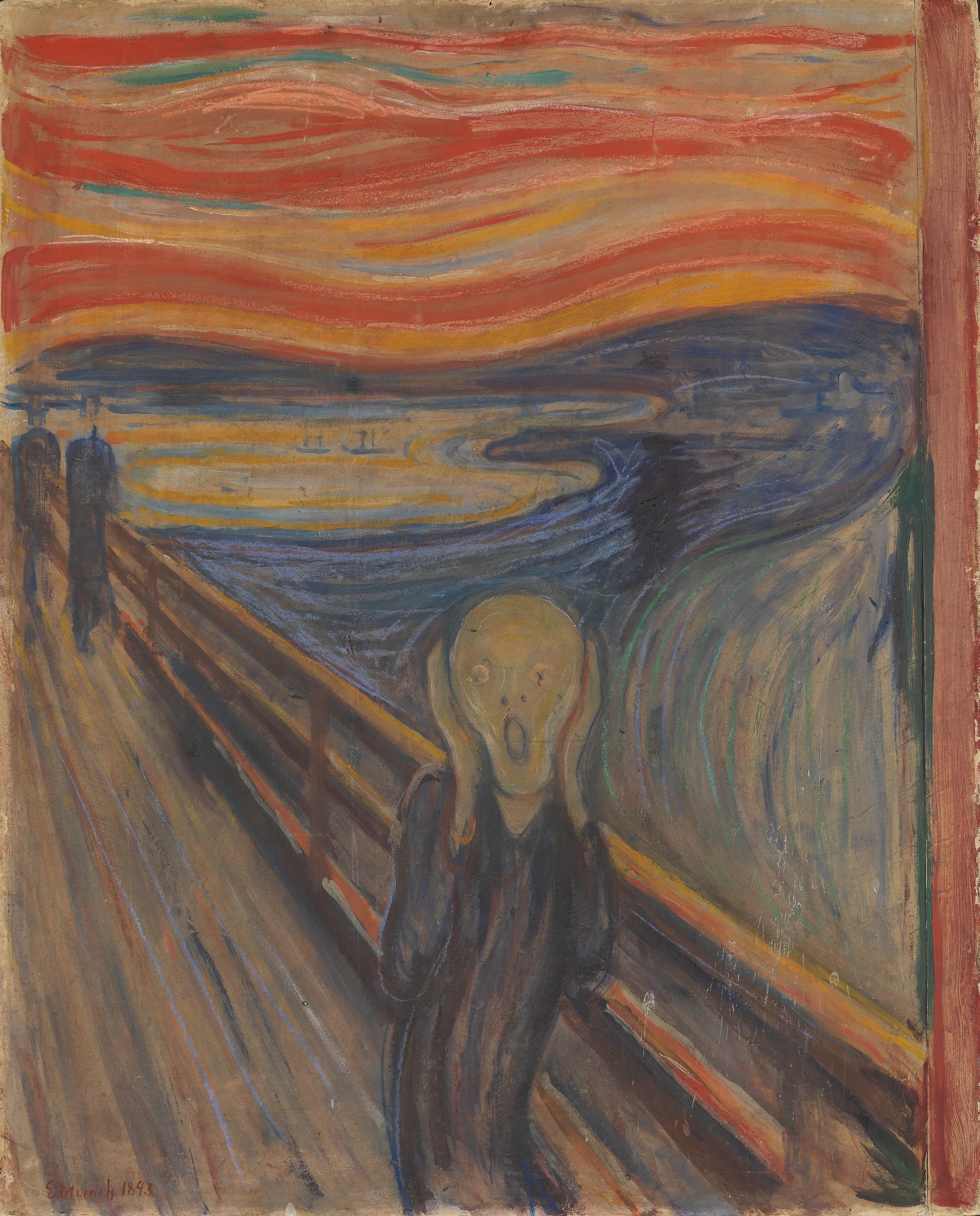
The figure's hands press flat against the sides of its head, covering the ears. The mouth is open, but nothing blocks it. This is the posture of someone shutting sound out, not releasing it. Munch's own account describes walking at sunset and sensing an infinite scream passing through nature — the figure in the painting is the one who heard it. The misreading is so widespread that the image has become a symbol of human anguish crying out, but the gesture recorded is the opposite: a attempt to stop the sound getting in.
Sky bands echoing the figure's curve
The sky is not a gradient. It is built from bands of orange and red and yellow that run in curves across the upper half of the composition, following the same arcing rhythm as the figure's outline. The clouds do not sit still; they stream in lines that bend and pulse. Munch recalled the sunset turning the clouds a blood red, and the painted sky carries that memory not as a colour alone but as a movement — the bands flow as though the air itself is vibrating, as though the scream passing through nature has a shape you can see.
The rigid diagonal of the bridge rail
A dark railing cuts diagonally from the lower left toward the centre, straight and hard-edged. It is the one element in the composition that does not curve. Two figures stand farther along it, upright and still, facing away. The perspective of the boards underfoot rushes toward them in sharp lines. Against the writhing sky and the liquid outline of the foreground figure, the bridge and its occupants hold a geometric order — they are in the same place, at the same moment, and they are not hearing what the figure hears.
The story
Munch made this composition in 1893, working in tempera and pastel on board. The version held by the National Museum of Art, Architecture and Design in Norway measures 91 by 73.5 centimetres. It is one of several versions Munch created: two in paint, two in pastels, and a lithograph stone from which prints were pulled. The Norwegian title is Skrik, meaning scream, and it was first exhibited under the German title Der Schrei der Natur — The Scream of Nature.
The figure stands in the foreground, its body a sinuous outline without hard edges, hands pressed to the sides of its head, mouth open. The posture is universally read as a scream, but Munch's own description reverses it. He recalled walking along a fjord path at sunset when the light turned the clouds a blood red, and he sensed an infinite scream passing through nature. The figure is not the source of the sound. It is the listener, trying to shut it out.
The landscape carries that sound visually. The sky is not still. It is built from bands of colour — orange, red, yellow — that curve and stream across the upper half of the painting in lines that echo the figure's outline. The clouds do not sit; they move, they pulse. The air itself seems to vibrate. Below, the water of the fjord reflects the same colours in darker tones, and the shoreline curves in the same rhythm. The bridge interrupts this flowing, organic movement.
The bridge is geometric. Its railing runs in a sharp diagonal from the lower left, straight and dark. The boards underfoot recede in hard perspective lines. Two figures stand farther along the rail, upright, still, facing away. They are in the same place, at the same moment, and they are not reacting. The contrast is deliberate: the figure in the foreground is alone in what it is experiencing. The scream is passing through the landscape, but the two figures on the bridge are not hearing it.
Scholars have identified the likely location as a path overlooking Oslo, and have offered explanations for the unnaturally orange sky. Suggestions include the atmospheric effects of a volcanic eruption and a psychological reaction by Munch to his sister's admission to a nearby asylum. The painting does not settle which reading is correct. What it records is the sensation: a moment when the boundary between inner experience and outer landscape dissolved, and the world itself seemed to be screaming.
Why it mattered then
Munch created this work in 1893, at a moment when artists across Europe were beginning to assert that a painting did not need to represent the world as it appeared to the eye. It could represent what it felt like instead. The movement that coalesced around this principle came to be called Expressionism, and Munch's work was formative to it. The Scream does not depict a sunset accurately. It depicts the sensation of a sunset that felt like an assault — colour and sound and dread compressed into a single image. The figure's body has no fixed anatomy; it bends and wavers like the sky above it, as though the disturbance in the air has passed into the body itself. This was a new claim: that a painting's subject could be a psychological state, and that distorting the visible world was not a failure of skill but a method of getting closer to the truth of an experience.
Why it matters now
The agonised face has become one of the most widely reproduced images in art, and it is almost always understood as a symbol of existential dread — a figure screaming at the unbearable weight of being human. The image has been simplified, flattened, turned into shorthand for anxiety itself. But the original composition is more specific and more strange. It is not about a person screaming. It is about a person hearing something the rest of the world is not hearing, and being alone in that hearing. The two figures on the bridge are there to make that loneliness visible: they are in the same place, and they are fine. The scream is passing through nature, and the foreground figure is receiving it while they are not. That gap — between what one person experiences and what the world around them registers — is what the painting is about, and it is why the image still holds. It is not a generalised howl. It is a record of a specific kind of isolation: the moment when your inner experience and the outer world come apart, and the people around you are somewhere else.
The surprising detail
Both painted versions have been stolen from public museums. Both have since been recovered. The thefts were not small operations — one involved armed men in a daylight raid — and the fact that the painting has been taken twice speaks to something beyond its monetary value. It is an image that people want to possess, or want to deprive others of seeing. The pastel versions exist separately, and one of them was sold at public auction in 2012. The price paid at that auction was the highest nominal price for an artwork at a public auction at that time. Munch made multiple versions because the image mattered to him, and the world has treated those versions as though they matter in return: stealing them, recovering them, paying large sums for them. The composition has a pull that does not diminish.
What is disputed
Munch's written account describes sensing a scream passing through nature, but scholars have not settled what triggered the experience. Explanations range from atmospheric effects following a volcanic eruption to a psychological response connected to his sister's admission to an asylum nearby. The painting does not resolve this, and the various readings remain speculative. The location along a fjord path overlooking Oslo has been identified by scholars, but the specific cause of the blood-red sky Munch described is not documented.
Remember this
The figure is not screaming — it is hearing a scream pass through the landscape while the others on the bridge are not.
Test yourself
Why does the presence of the two figures on the bridge matter to what the painting is about?
Because they are in the same place at the same moment, and they are not reacting. They stand upright and still, facing away, continuing along the path. The figure in the foreground is hearing something they are not hearing. Without them, the painting would simply show a distressed figure in a distorted landscape, and the distortion could be read as a general statement about the world. With them, the distortion becomes specific: it is not that the world is like this, but that the world is like this for one person and not for others. The two figures make the isolation visible. They turn the painting from a depiction of universal dread into a depiction of a private experience that cannot be shared — the scream is real, it is passing through nature, and the figure is alone in receiving it.
Go deeper
Image: Edvard Munch, Public domain. Licence: Public domain. Source.