III · THE WORK · ART HISTORY
The Tale of Genji Handscroll
▶ Listen · narrated
The oldest surviving pictures of scenes from The Tale of Genji show us something strange: a way of illustrating a story where no face tells you what anyone feels.
At a glance
- Creator
- Fujiwara no Takayoshi
- Date
- 12th century
- Format
- Emakimono — a horizontal illustrated handscroll
- Medium
- Ink and colour on paper
- Period
- Heian period
Look closer
Fukinuki yatai: the roof lifted away
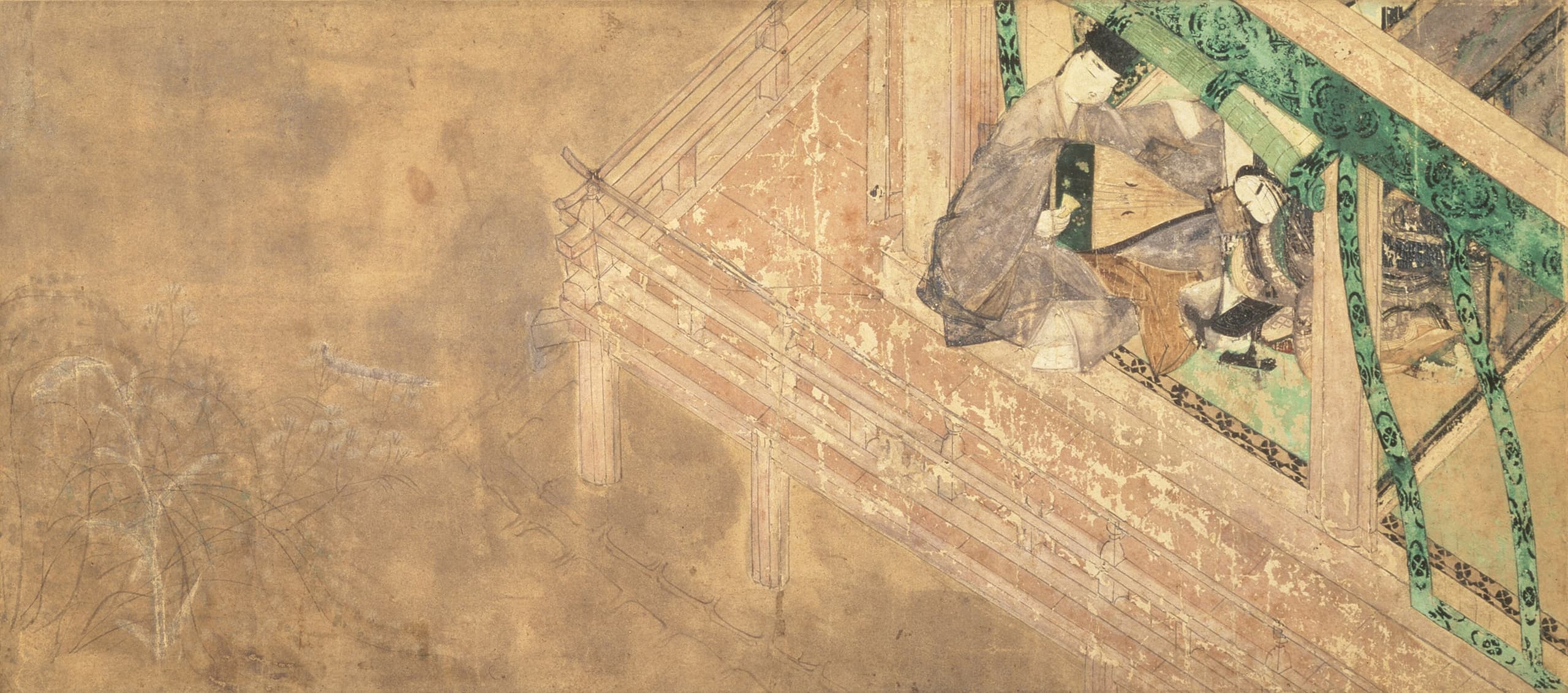
The buildings have no roofs. We look straight down into the rooms as though the ceiling had been removed, a convention called fukinuki yatai — literally, 'roof-blown-off structure'. Walls and screens are shown, but the upper plane is simply absent, giving us a view no person standing in the room could have. The technique lets the scroll show intimate indoor scenes — a woman weeping, a letter being read — without placing a narrator inside the space or breaking the architecture to peer through a window.
Hikime kagibana faces — a line and a hook
The faces are drawn with a minimum of marks: a single horizontal line for the eyes, a small hook for the nose, and a dot or short stroke for the mouth. This convention, called hikime kagibana — 'line-eye, hook-nose' — gives almost no individual expression. You cannot read emotion from the face itself. A figure in despair and a figure at ease have nearly identical features. What changes is posture, the angle of the head, the fall of the hair, the colour and weight of the robes, and the composition of the scene around them.
Diagonal architecture compressing the room
The walls, mats and screens run at sharp diagonals, compressing the space and tilting it toward us. Figures are often pressed into corners or framed by converging lines. The architecture does not recede calmly into depth; it folds the room into a wedge that crowds the people inside it. Combined with blocks of dense colour and the absence of sky, the effect is enclosure — not the expansive world of a landscape but the weight of an interior, a room where something has happened and there is no exit visible.
The story
The Tale of Genji was written in the early eleventh century, a long prose narrative about the life and loves of a prince and the generations that follow him. In the twelfth century, someone — tradition names the artist Fujiwara no Takayoshi — made an illustrated handscroll of scenes from the tale, painted in ink and colour on paper. The scroll is an emakimono, a format that unrolls horizontally, a section at a time, so the story moves from right to left as you open it.
What survives now is a fragment. The original length is not known, and whether it ever illustrated the entire tale is not recorded. The sections that remain are divided between two museums in Japan, the Tokugawa Art Museum and the Gotoh Museum, where they are kept as National Treasures and exhibited only briefly, for conservation reasons. Even in fragments, the scroll shows a highly developed set of conventions for painting narrative.
The most visible convention is the removal of the roof. We look down into rooms from above, seeing the figures, the mats, the curtains and screens, but no ceiling. The walls are present, running at diagonals that tilt the space toward us, but the upper plane is simply gone. This technique, fukinuki yatai, lets the painter show private scenes — a woman alone, a letter arriving, a moment of grief — without inventing a witness inside the room.
The faces are drawn with extreme economy: a line for the eyes, a hook for the nose, a small mark for the mouth. The convention is called hikime kagibana. It gives almost no individual expression. Emotion is not carried by the face but by everything around it — the tilt of the head, the fall of the hair, the weight and colour of the clothing, the angle of the body, and the composition of the scene itself. A figure in despair is shown by posture, by the darkness of the robes, by the way the diagonals of the room press inward, not by a painted expression of sorrow.
The result is a way of illustrating a story where the mechanism of emotion is entirely external to the face. The scroll does not ask you to read a character's feelings from their features. It asks you to read them from structure, colour, and the shape of the space they occupy.
Why it mattered then
The Tale of Genji was central to the culture of the Heian court, and illustrating it in the twelfth century was an act of preserving and interpreting a text that had already become a reference point for how people at court thought about refinement, feeling and memory. The scroll was made for an audience who knew the tale well, who could recognise a scene from the composition and the colour of a robe, and who understood that the way a figure was painted — the curve of the hair, the angle of the shoulders — carried meanings that a more explicit style would have made crude. The conventions of fukinuki yatai and hikime kagibana were not simplifications but a deliberate choice of restraint, a way of painting that matched the indirection and subtlety that the tale itself valued. Making the scroll was a way of saying that this story, and this way of telling it, were worth anchoring in images that would last.
Why it matters now
The scroll shows that there is more than one way to paint emotion, and that the choice of how much to show in a face is a choice, not a limitation. The conventions it uses — the removed roof, the minimal face, the diagonal compression of space — have continued to appear in Japanese visual narrative, in ways that are sometimes direct and sometimes atmospheric. The idea that a story can be told by composition and colour rather than by expression, that a room can carry a mood and a posture can carry a feeling, is not confined to the twelfth century. The scroll is kept under conservation restrictions and exhibited rarely, but the images have been widely reproduced, and the techniques it shows have remained part of how people think about illustrating a story where what matters most is not what is said aloud.
The surprising detail
The painted images in the scroll show conventions that are already fully developed, with no visible sign of experimentation or hesitation. The technique looks settled, as though it had been in use for some time before this scroll was made. But this is the oldest surviving work in this tradition. Whatever came before it — if anything did — has not been preserved. We are looking at a mature style with no surviving earlier examples, which means we cannot trace how it was invented or how long it took to become this consistent. The scroll may record the beginning of a tradition, or it may record a style that was already old when it was painted. The evidence does not tell us which.
What is disputed
The attribution to Fujiwara no Takayoshi is traditional but not documented in a way that settles the matter. The date is given as twelfth century, with some sources suggesting a range around 1120–1140, but the scroll itself does not record when it was made. Whether the original scroll illustrated the entire Tale of Genji, or only selected scenes, is not known. What survives is a fragment, and the scale of what has been lost is not recorded.
Remember this
The scroll removes the roof and reduces the face to a line and a hook, so that emotion is carried not by expression but by composition, colour and the shape of the space.
Test yourself
Why would a painter choose to draw faces with almost no individual features, rather than showing expressions clearly?
Because it shifts the work of conveying emotion away from the face and onto everything else in the scene — the posture, the clothing, the colour, the architecture, the way the space is composed. In a narrative scroll like this, where the audience knows the story and the characters well, the restraint of the face allows the entire composition to carry the feeling. A figure in despair is shown by the weight of dark robes, the tilt of the head, the way the diagonals of the room press inward, not by a painted grimace. The convention makes the image quieter and more indirect, which matches the tone of the tale itself. It also means the viewer has to read the scene as a whole, not just glance at a face. The choice is not about a lack of skill but about where the painter wants the meaning to sit.
Go deeper
Image: Imperial court in Kyoto. The handscroll had been said to be painted by Fujiwara, Takayoshi, though it is now presumed to be painted by several groups of painters in Heian period., Public domain. Licence: Public domain. Source.