I · THE OBJECT · BRITISH MUSEUM
The David Vases
▶ Listen · narrated
These vases matter less for what they are than for what is written on them: a date that anchors an entire category of undated objects.
At a glance
- Date
- 1351, according to their inscriptions
- Origin
- Yuan dynasty
- Museum numbers
- PDF,B.614 and PDF,B.613
- Collection
- British Museum, formerly Percival David Foundation
Look closer
The inscription that matters
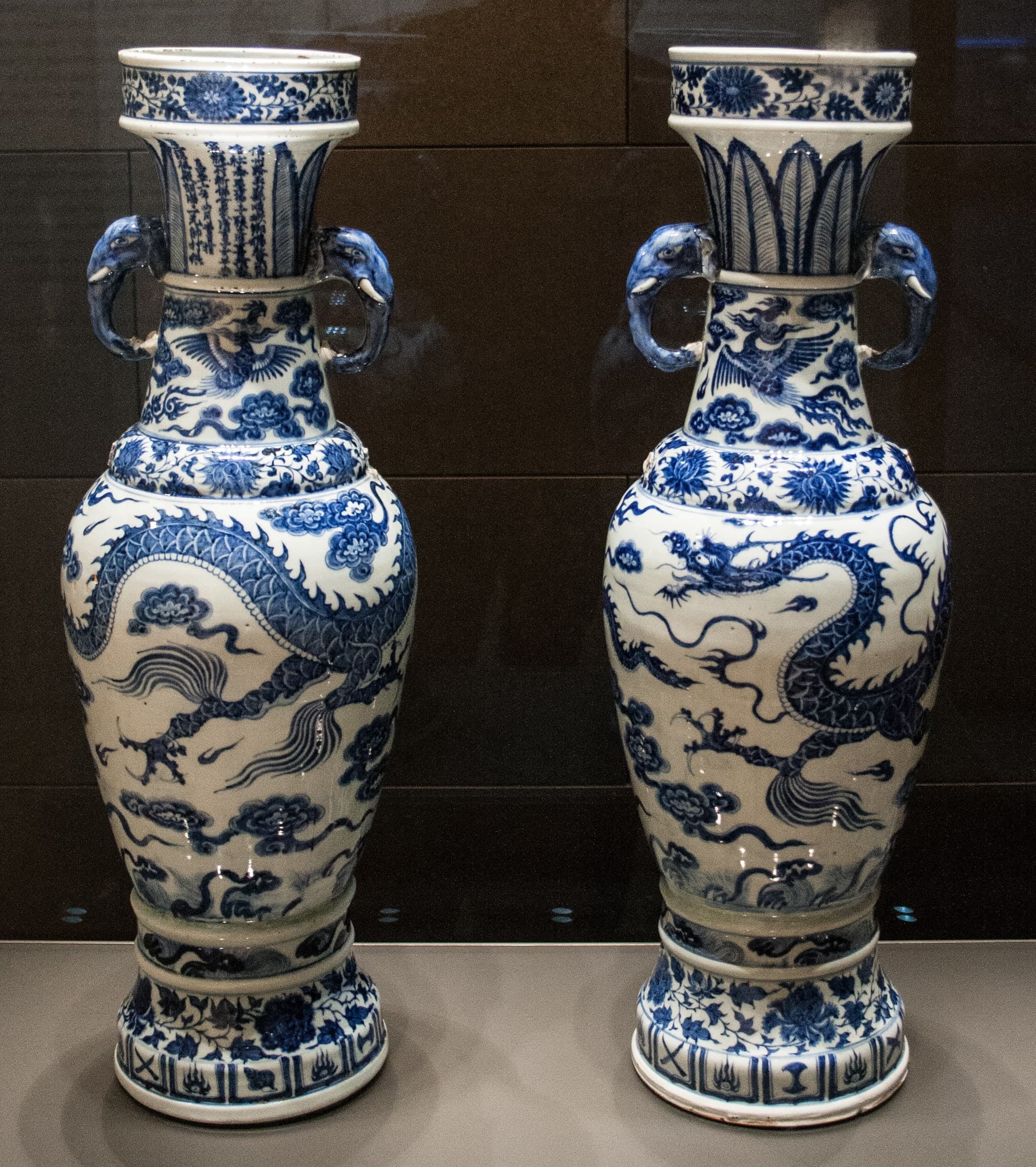
Each vase carries an inscription recording a dedication. The text states that the vases were offered at a temple and gives the date equivalent to 1351. That inscription is why these vases are studied: not because they are unusually fine, but because they are dated. Blue-and-white porcelain survives in quantity, but pieces with dates written on them are rare. When scholars try to date an unmarked vase by style or technique, they compare it to pieces with known dates. These two vases supply one of those fixed points.
Cobalt from elsewhere
The blue decoration is cobalt oxide painted onto the clay body before glazing. Cobalt was not mined in the region where these vases were made. It was imported, and the sources named in scholarship include Iran. The cobalt-bearing ore was ground, mixed with water, and painted onto the unfired vessel. The piece was then glazed and fired at high temperature, which turned the cobalt permanently blue and fused the glaze to the clay. The intensity of the blue and the way it bleeds slightly into the glaze are characteristic of this material and this process.
Temple vases, not domestic ones
The shape and the inscription both indicate a ritual function. These are tall vases with handles, a form associated with temple offerings. The inscription records that they were dedicated at a temple, though the temple itself is not identified in the text as it survives. They were made to be seen in a religious setting, not to hold flowers in a household. That context — public, formal, worthy of an inscription — may be part of why they were dated at all.
The story
These are a pair of porcelain vases, potted in a region of China known for ceramics, decorated in blue, and inscribed with a date corresponding to 1351. They are not remarkable for their beauty or their rarity. What makes them significant is narrow and specific: they carry a date, and that date has been used as a reference point for dating other blue-and-white porcelain that carries no date at all.
Blue-and-white porcelain — white clay with decoration painted in cobalt blue under a transparent glaze — was made in large quantities during the Yuan dynasty and the centuries that followed. Most pieces are undated. Scholars trying to establish when an undated piece was made rely on comparisons: they look at the style of the painting, the shape of the vessel, the intensity and behaviour of the blue, and the composition of the clay and glaze. Those comparisons depend on having a set of dated reference objects. The David Vases supply one such reference.
The inscription on each vase records a dedication. It states that the vases were offered, gives the names of the donor and another individual, and provides a date. The date, converted to the Gregorian calendar, is 1351. The text also mentions a temple, though it does not name the temple or say where it was. The vases were made to be dedicated in a religious setting, not for domestic use.
The blue decoration is cobalt oxide, painted onto the surface of the unfired clay and then covered with a transparent glaze. The whole piece was then fired at high temperature in a kiln. The heat turned the cobalt blue and melted the glaze into a glassy coating bonded to the clay. Cobalt was not available locally in the region where these vases were made. It was imported, and scholarship identifies Iran as one source. The cobalt ore was prepared by grinding and mixing it with water to make a paint that could be applied with a brush.
The vases are named after Percival David, a collector who acquired them from separate sources and brought them together as a pair. They were part of the collection of the Percival David Foundation of Chinese Art and are now held by the British Museum. At the time David acquired them, no earlier dated examples of blue-and-white porcelain were known to Western collections, though it is understood that blue-and-white porcelain was likely made before 1351. The vases provided a dated anchor in a field where most objects carry no date.
The importance of the David Vases is not in their form or their decoration, but in the fact that their date is recorded and readable. That makes them a tool for dating other work.
Why it mattered then
In 1351, blue-and-white porcelain was still a developing technology. The technique of decorating porcelain with cobalt under the glaze had emerged, but the material was not yet common or standardised. Cobalt had to be imported, which meant it was expensive. The decision to use it, and to dedicate the finished vases at a temple with an inscription recording the date and the donor, suggests that these were considered valuable objects worth marking in a formal way. The inscription itself indicates that the vases were made for a public, ritual context. They were not domestic objects. Dedicating objects at temples was an established practice, and recording the dedication in writing was a way of making the gift permanent and visible. The fact that the donor's name and the date were included suggests that the act of giving, and the record of that act, mattered. The vases were made in a region known for ceramic production, using clay and techniques that were well developed by this period. The use of imported cobalt, however, points to trade networks that connected this production centre to sources of raw material far away. The cobalt used in these vases is understood to have come from outside the region, possibly from as far as Iran. That implies an established trade in materials for luxury goods.
Why it matters now
The David Vases matter now because they are dated, and because that date has been used to organise and understand a large body of undated material. Blue-and-white porcelain was made in enormous quantities over several centuries, and most of it carries no mark or date. Establishing a chronology for this material depends on having reference points: objects with known dates that can be compared to objects without them. The David Vases provide one of those points. When a scholar examines an undated piece of blue-and-white porcelain and tries to establish when it was made, the process involves comparison. The shape, the style of decoration, the colour and behaviour of the cobalt, and the composition of the clay and glaze are all compared to dated examples. The David Vases, because they are dated to 1351, allow undated pieces with similar characteristics to be placed in relation to that date: likely earlier, likely contemporary, or likely later. This is a narrow form of importance, but it is a real one. The vases are not studied because they are beautiful or because they represent a peak of technical achievement. They are studied because they are legible in a specific way: they carry a date, and that date can be read and trusted. In a field where most objects are silent about when they were made, a dated object becomes a anchor. The David Vases are that anchor.
The surprising detail
The vases were acquired by Percival David from two different sources and brought together as a pair. It is not recorded where they were between 1351, when they were dedicated at a temple, and the twentieth century, when David acquired them. The temple mentioned in the inscription is not named in the surviving text, and its location is not known. The vases were separated at some point, and their reunion in a single collection was the result of David's recognition that they belonged together. They are now treated as a pair, but the path they took from a temple dedication in 1351 to a collector's hands in the twentieth century is not documented.
How it got here
The vases were acquired by Percival David from separate sources in the twentieth century and formed part of the collection of the Percival David Foundation of Chinese Art. That collection was transferred to the British Museum. The vases are understood to have been dedicated at a temple in 1351, according to their inscriptions, but their location and ownership between that date and their acquisition by David is not recorded.
Remember this
A date written on an object can matter more than the object itself, because it lets you date everything else you compare to it.
Test yourself
Why does a dated object like the David Vases become so important for understanding undated objects, even if the dated object is not especially fine or rare?
Because chronology in art and archaeology is built on comparison, and comparison requires fixed points. Most blue-and-white porcelain carries no date. To establish when an undated piece was made, scholars compare its style, material, and technique to pieces with known dates. A dated object provides a reference: if an undated vase shares characteristics with the David Vases, it can be tentatively placed near 1351. Without dated examples, there is no framework to organise the undated material. The David Vases are not studied because they are exceptional, but because they are legible in a way most porcelain is not. A single dated object can anchor the chronology of thousands of undated ones, which is why an inscription recording a date can matter more than the quality of the work itself.
Go deeper
Image: Unknown author Unknown author, Public domain. Licence: Public domain. Source.