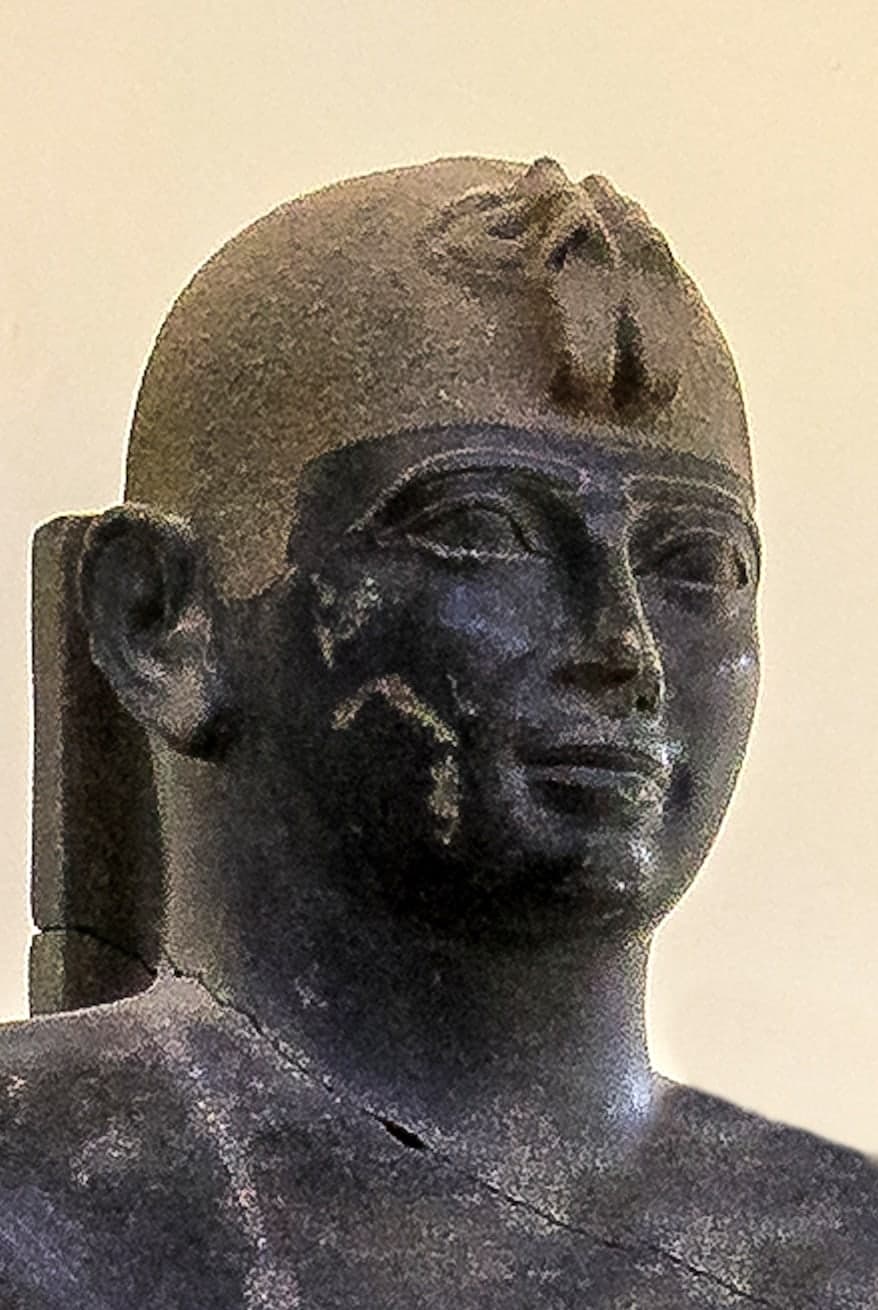
I · THE OBJECT · BRITISH MUSEUM
Shabti of King Taharqa
▶ Listen · narrated
Egypt is usually told as a story flowing north to south. For much of the eighth and seventh centuries BC, power moved the other way.
At a glance
- Ruler
- Taharqa
- Dynasty
- Twenty-fifth Dynasty of Egypt
- Kingdom
- Kingdom of Kush
- Reign
- 690–664 BC
Look closer
A shabti for royal labour
A shabti is a figurine placed in a tomb to perform work on behalf of the dead in the afterlife. The word comes from the Egyptian for 'answerer' — the figure would respond when the deceased was called to labour in the fields of the next world. Wealthier burials included hundreds of them, sometimes organised into crews with overseer figures. Royal shabtis carried the same logic: even a king might be summoned to work, and even a king needed substitutes.
Kushite and Egyptian traditions combined
Taharqa's reign shows Kushite rulers adopting Egyptian royal iconography while maintaining their own identity. The Twenty-fifth Dynasty pharaohs built pyramids, commissioned temple inscriptions in Egyptian, and used the full titulary of Egyptian kingship. At the same time, they maintained the kingdom's administrative centre at Napata, far upstream from the traditional Egyptian capitals. The material culture of the period reflects both traditions without erasing either.
The geography of power
Kush occupied the region south of Egypt along the Nile, in what is now Sudan. Its rulers controlled Egypt for much of the eighth and seventh centuries BC, a period when the political centre of the combined kingdom lay not in Memphis or Thebes but further south. Napata, the Kushite capital, was the seat from which these pharaohs governed. The usual northward flow of authority — Egypt as the dominant power, Nubia as the periphery — was reversed.
The story
Taharqa ruled as both pharaoh of Egypt and qore — king — of the Kingdom of Kush. His reign, from 690 to 664 BC, fell within the Twenty-fifth Dynasty, a period when Egypt was governed by a line of Kushite rulers. These kings are sometimes called the Black Pharaohs, or the Nubian or Kushite Pharaohs, terms that reflect their origin in the kingdom upstream on the Nile.
The Twenty-fifth Dynasty lasted nearly a century, and its rulers governed Egypt from Napata, the Kushite capital in what is now Sudan. This was not a foreign occupation in the sense of a distant conquest: Kush and Egypt had been neighbours, rivals, trading partners and sometimes unified territories for centuries. The relationship was old and tangled. What changed in the eighth century BC was the direction of control.
Taharqa's name appears in several ancient sources, spelled variously depending on the language and script. Neo-Assyrian records call him Tarqû. Hebrew texts name him Tirhakah. Greek writers, including Manetho and Strabo, rendered it as Tarakos or Tearkō. The variety reflects the reach of his reign: he was known across multiple literate cultures of the period.
A shabti like this one was made to serve in the afterlife. The Egyptian funerary tradition held that the dead might be called to labour — ploughing, sowing, irrigating fields in the next world — and a shabti would answer the call in the deceased's place. The word itself means 'answerer'. Wealthier tombs contained large numbers of them, organised into work gangs with overseer figures. Royal tombs were no exception: a king's burial included shabtis just as a commoner's did, because the logic of the afterlife applied to everyone.
The Twenty-fifth Dynasty ended when Assyrian forces pushed into Egypt. Taharqa's reign saw repeated campaigns, and by 664 BC the Kushite hold on Egypt was broken. The dynasty's rulers withdrew south, and Kush continued as an independent kingdom for centuries afterward, but the period of rule over Egypt was finished.
What survives from Taharqa's reign shows a blending of traditions. He commissioned temples, adopted Egyptian royal titles, and was buried under a pyramid. At the same time, the administrative centre remained at Napata, and Kushite identity was not subsumed. The material record suggests a kingdom confident enough to take on Egyptian forms without abandoning its own.
Why it mattered then
The Twenty-fifth Dynasty reoriented Egypt's political geography. For nearly a century, the kingdom's rulers came from the south, and the centre of power lay at Napata rather than Memphis or Thebes. This was not an interlude or a collapse — it was a functioning state, with temple-building, monumental inscriptions, and the full apparatus of pharaonic rule. Taharqa's reign, in particular, saw military campaigns, construction projects, and diplomatic contact with Assyria and the Levantine states. The period mattered because it demonstrated that Egypt's political structure could be governed from outside its traditional heartland, and that Kushite rulers could command the resources and legitimacy required to do so. The dynasty's end came through Assyrian military pressure, not internal collapse, which suggests the system was stable until external force broke it.
Why it matters now
The Twenty-fifth Dynasty complicates the usual story of Egypt as a self-contained civilisation radiating influence outward. For much of the eighth and seventh centuries BC, the flow of power moved in the opposite direction. Kush was not a peripheral culture absorbing Egyptian influence — it was the ruling power, and its kings governed Egypt while maintaining their own capital and identity. This matters because the framing of Nubia as marginal persists in older scholarship and popular accounts, even though the evidence shows a kingdom capable of sustaining pharaonic rule for generations. Taharqa's reign, recorded in Assyrian, Hebrew and Greek sources as well as Egyptian ones, shows a ruler operating across a wide political landscape, not on its edges. Recognising that shifts where we place the centre.
The surprising detail
Taharqa's name appears in Hebrew texts, where he is called Tirhakah, described as king of Kush. The biblical tradition records him in connection with conflicts involving Assyria. The historicity of the specific encounters is debated, but the mention itself shows that Taharqa's military campaigns and diplomatic reach were significant enough to be recorded in the traditions of neighbouring states. He was not a distant figure — he was part of the regional political memory.
What is disputed
The biblical references to Tirhakah in accounts of conflicts with Assyria present chronological difficulties. Some scholars argue the events described could not have occurred during Taharqa's reign as given in Egyptian sources, and suggest either conflation of separate campaigns or errors in the transmission of the text. The nature of Taharqa's involvement in these conflicts, and whether the biblical account reflects a historical encounter or a later tradition, remains unresolved.
Remember this
For nearly a century, Egypt's pharaohs ruled from Napata, a Kushite capital far upstream. Geography is not destiny, and peripheries can become centres.
Test yourself
Why does the existence of a shabti for Taharqa tell us something about how Kushite rulers understood their relationship to Egyptian traditions?
Because a shabti is not a symbol of kingship — it is a practical item for the afterlife, made for anyone who could afford one. By commissioning shabtis, Taharqa and other Twenty-fifth Dynasty rulers were not simply adopting the outward signs of pharaonic power. They were participating in the Egyptian understanding of death and the afterlife, which suggests a deeper cultural engagement than political expediency alone would require. A ruler performing kingship for Egyptian audiences might build a temple or carve a royal inscription. A ruler preparing for the Egyptian afterlife, complete with answering figurines to work the fields, is doing something more: accepting the cosmology, not just the iconography.
Go deeper
Image: Matthias Gehricke, CC BY-SA 4.0. Licence: CC BY-SA 4.0. Source.