I · THE OBJECT · BRITISH MUSEUM
The Vale of York Hoard
▶ Listen · narrated
What you buried said where you had been. This hoard, dug up near Harrogate in 2007, holds silver that travelled from central Asia, Afghanistan, Ireland and Russia to a Yorkshire field.
At a glance
- Discovered
- 6 January 2007, near Harrogate, North Yorkshire
- Contents
- 617 silver coins and 65 other items
- Material
- Silver
- Collection
- British Museum and Yorkshire Museum
Look closer
A container as valuable as the contents
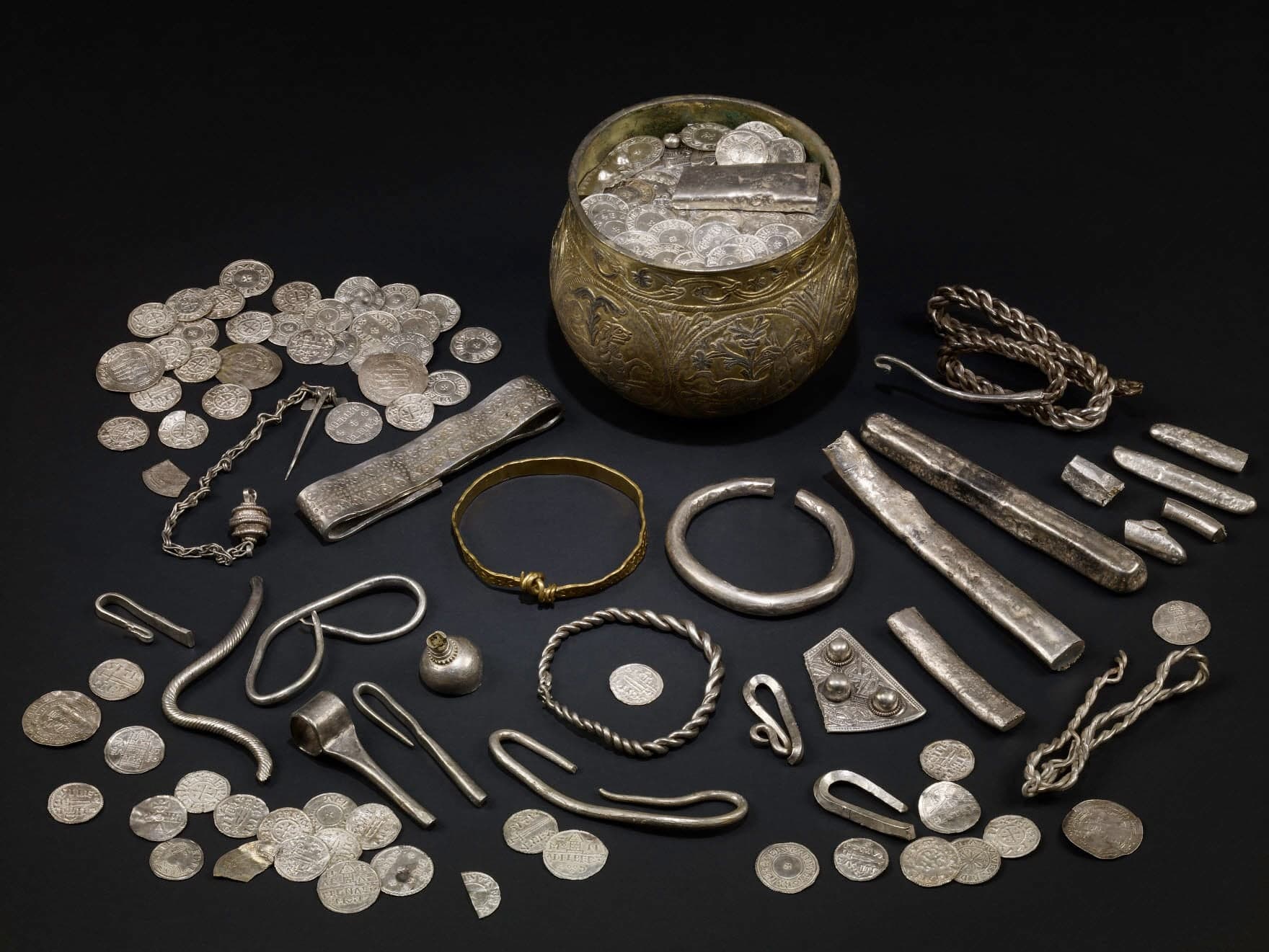
The hoard was buried inside a gilt silver cup, itself an object of value. The cup is Frankish — made somewhere in the Carolingian realm, not in Britain or Scandinavia. It was already old when it was filled with coins and arm-rings and lowered into the ground. Using a decorated vessel as the container was not unusual in Viking hoards, but it does mean the person who buried this was hiding wealth inside wealth, and that the cup itself had travelled before it became a strongbox.
Coins as a map of trade routes
The 617 coins include silver struck in places far from Yorkshire. Some were minted in England, others in the Scandinavian world, and still others came from Islamic regions far to the east. The geographic spread reflects the trading networks Vikings moved through in the tenth century: silver flowed west from Afghanistan and central Asia along river routes through Russia, then across the Baltic and into Britain. A hoard like this is a snapshot of that movement, frozen at the moment someone decided not to spend it.
Arm-rings and ingots: silver as metal, not money
Alongside the coins are arm-rings — bands of twisted or plaited silver worn on the arm — and ingots, which are simply pieces of cast silver. These were not currency in the sense that coins were. They were bullion: valued by weight, not by what was stamped on them. Arm-rings could be worn, but they could also be cut up or melted down when you needed to pay for something. The hoard contains both kinds of silver, which suggests the owner thought in terms of metal as much as in terms of coins.
The story
The hoard was found on 6 January 2007 by metal detectorists working in a field near Harrogate in North Yorkshire. It had been buried undisturbed, and when it was lifted the contents were still packed inside the cup. The find included 617 silver coins, along with arm-rings, ingots, and other pieces of worked and unworked silver — sixty-five items in all, not counting the cup itself.
The coins tell you where silver was moving in the tenth century. Some were minted in England, some in Scandinavian territories, and others came from much farther east: from Islamic regions in what is now Afghanistan and central Asia. There are also coins from Ireland. The mixture is typical of Viking-age hoards found in Britain, but the number of coins and the condition of the find made this one notable when it was uncovered.
The cup that held the hoard is Frankish. It was made in the Carolingian realm — the territory that covered much of what is now France, Germany, and neighbouring regions in the early medieval period. It is gilt silver, decorated, and it was already an old object when it was repurposed as a container. The decision to bury valuable items inside another valuable item is recorded in other hoards, but it is not the majority pattern. Often silver was buried in a pot or a cloth bundle. Here, the container itself was worth keeping.
The arm-rings are another form of portable wealth. These are thick bands of silver, some twisted, some plaited, worn on the arm. They were not just ornaments. They could be cut into pieces when you needed to make a payment, or melted down entirely. The ingots — plain lumps of cast silver — served the same purpose. Both were bullion, valued by weight. The hoard contains examples of both, along with what are called hack-silver pieces: fragments of larger objects, chopped up to make weights that could be traded.
Why someone buried this and never came back for it is not recorded. Hoards are often interpreted as emergency savings — hidden in a moment of danger and never retrieved because the owner died, fled, or forgot the spot. But that is interpretation, not evidence. What is certain is that the ground kept it safe for roughly a thousand years, until a metal detector picked up the signal.
The hoard is now split between the British Museum and the Yorkshire Museum. It was acquired jointly under legislation governing finds of precious metal in England and Wales. That legislation requires finders to report such objects, and museums can then acquire them at a valuation set by an independent committee. The finders and the landowner receive a reward based on that valuation.
Why it mattered then
In the tenth century, silver was the standard of value across a huge area, from the Islamic world in the east to the Atlantic in the west. Vikings did not control all of that territory, but they moved through it, and they moved silver with them. The coins in this hoard came from mints separated by thousands of miles, yet they ended up together in a field in Yorkshire because the trade routes connected them. The mixture of coin types also tells you something about how people used money. A coin minted in central Asia and a coin minted in England were both silver, and both could be spent or melted. The stamp mattered less than the metal. That is why hoards contain coins from so many different places: if you were trading in silver, the origin of the coin was less important than its weight and purity. The arm-rings and ingots show that silver circulated in forms other than coin. You could wear wealth, carry it as a lump of metal, or chop it into pieces. The system was flexible, which made it useful for people who moved between regions with different currencies, or no currency at all. A trader working along the river routes of eastern Europe, or a raider returning from Ireland, needed silver that could be converted quickly. Arm-rings and hack-silver met that need.
Why it matters now
The hoard is evidence of a connected world at a time when the conventional story emphasises separation. The tenth century is often presented as a period of small kingdoms, local power, and limited contact between distant regions. But the contents of this hoard show long-distance trade operating at scale. Silver minted in one part of Asia ended up in another part of Europe, passing through hands and across borders in a system that worked without a single authority managing it. The find also matters for what it shows about the Viking presence in Britain. The hoard was buried in an area that was, at the time, part of the Scandinavian-controlled territory in northern England. The mixture of English, Scandinavian, and Islamic silver reflects the networks that Vikings operated within, and the extent to which they were embedded in trade systems that stretched across continents. For museums, the hoard is an example of how legislation governing archaeological finds functions in practice. The system was designed to ensure that important finds are not lost to private sale, and to reward finders and landowners fairly. The joint acquisition by the British Museum and the Yorkshire Museum kept the hoard accessible, and kept it in the region where it was found. That balance — national significance and local connection — is what the legislation was written to achieve.
The surprising detail
The hoard was found undisturbed, still packed inside the cup. That is unusual. Most hoards that survive a thousand years in the ground are disturbed by ploughing, building, or earlier digging. This one was not. The cup was lifted out intact, with the coins and arm-rings still inside it, which meant archaeologists could study the way it had been packed. The arrangement of the objects — what was placed where, and in what order — can sometimes tell you whether the hoard was assembled quickly or carefully, though in this case the evidence does not settle the question.
How it got here
The hoard was acquired jointly by the British Museum and the Yorkshire Museum under legislation that requires finders of precious metal objects in England and Wales to report them to the local coroner. An independent committee valued the hoard, and the museums paid that sum, which was then divided between the finders and the landowner as a reward. The arrangement kept the hoard in public ownership and accessible to researchers and visitors.
Remember this
A hoard is a snapshot of a network. The silver in this cup came from four continents, and it ended up in a Yorkshire field because tenth-century trade routes connected them.
Test yourself
Why would someone bury a hoard of silver and then never retrieve it?
The honest answer is that we do not know. The usual interpretation is that hoards were buried in emergencies — a raid, a war, a sudden need to flee — and the owner either died, was killed, or could not return to the spot. But that is a pattern we infer from the fact that the hoard was not dug up, not something recorded in the evidence. It is also possible that the owner forgot the location, or that the markers they used to remember the spot were destroyed or moved. Some hoards may have been ritual deposits rather than emergency savings, though there is no strong evidence for that in this case. What we can say is that the ground kept the silver safe for roughly a thousand years, which suggests the hiding place was effective — just not retrievable.
Go deeper
Image: Portable Antiquities Scheme, CC BY 2.0. Licence: CC BY 2.0. Source.