III · THE WORK · ART HISTORY
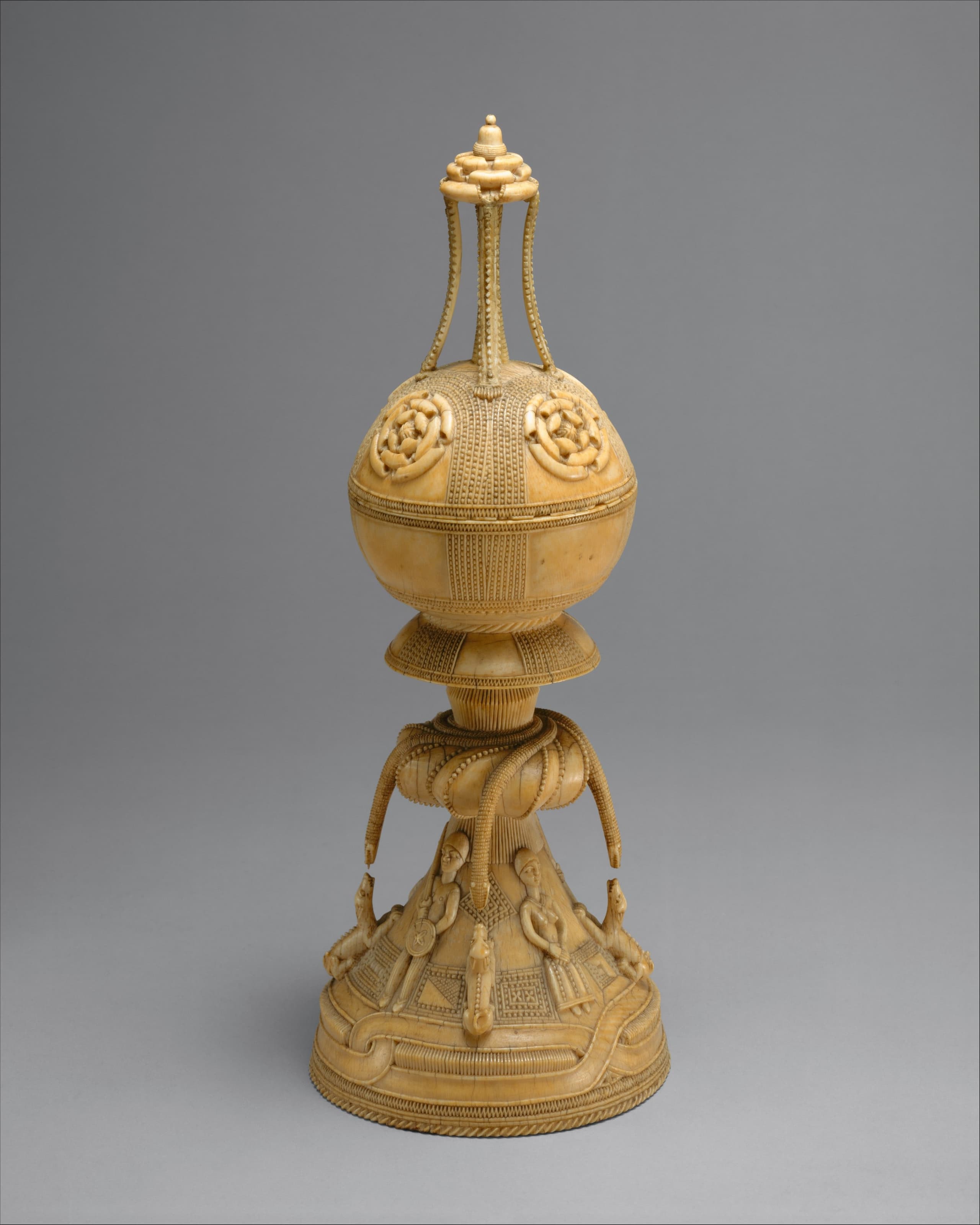
A Sapi-Portuguese Ivory Saltcellar
▶ Listen · narrated
A container for salt, carved from elephant ivory in Sierra Leone for a Portuguese household — neither purely African nor purely European in its design.
At a glance
- Material
- Elephant ivory
- Culture
- Sapi-Portuguese
- Region
- Sierra Leone
- Function
- Saltcellar for European table use
Look closer
Portuguese figures in European dress
The carved figures wear recognisably European clothing — doublets, hose, hats of a style worn in Portugal. The faces and proportions, however, follow conventions used by the carvers in their own work. The result is figures that are European in costume but not in execution, a hybrid that belongs fully to neither tradition.
Interlace patterning from local tradition
Bands of interlaced geometric ornament run around the body of the vessel. This kind of patterning appears in carving on objects made for local use, not only on ivories made for export. The technique — continuous interlocking lines forming repeating shapes — was already part of the carvers' vocabulary when the Portuguese arrived.
The lid finial, often a bird or a ship
Many of these saltcellars have a small carved figure at the top of the lid. Birds appear on some, ships on others. The ship is a Portuguese motif; the bird may be either. The finial is the point where the choice of subject was most flexible, and where the carver's decision about what to place there is most visible.
The story
A saltcellar is a small lidded container for holding salt at the table. In Europe, before refrigeration, salt was both a preservative and a luxury, and the vessel that held it could be an object of display. This one was carved from elephant ivory in Sierra Leone, by carvers whose own tradition did not include saltcellars, for Portuguese buyers who wanted ivory but did not carve it themselves.
The Portuguese reached the coast of Sierra Leone in the second half of the fifteenth century. Within decades, they were commissioning carved ivory objects from local carvers, including saltcellars, spoons, knife handles and hunting horns. The carvers were working in a region where ivory carving was already established, but the forms they were now asked to make were European.
The ivory came from African elephants. Two species live on the continent: the bush elephant, which has larger and heavier tusks, and the forest elephant, which has smaller and straighter ones. African ivory was sought after by the fourteenth century. It often came in larger pieces, held a sought-after cream colour, and was easier to carve. Asian ivory is brittle, more difficult to polish, and tends to yellow with exposure to air. By the fourteenth century, African ivory was moving along trade routes that reached Europe and beyond.
The saltcellars made for the Portuguese are carved in a style that mixes elements. The figures wear European dress, but their faces and proportions follow the conventions of local carving. The geometric interlace patterns that decorate the body of the vessel appear in work made for local use as well. The overall form — a lidded container on a stem, sometimes with a separate base — is European. The technique is African. The iconography belongs to both and to neither cleanly.
We do not know the names of the carvers. We do not know whether they worked to drawings provided by the Portuguese, to verbal instructions, or from examples they were shown. We do not know whether they understood the function of a saltcellar or simply reproduced a form they were asked to make. The objects themselves are the record, and they show decisions being made: what to copy, what to adapt, what to retain from the carver's own practice.
Ivory carving was not new to the region. Ivory tusks and carved ivory objects — masks, emblems, ceremonial items — had been traded and used in religious ceremonies in Africa for hundreds of years before the Portuguese arrived. The carvers were working a familiar material in an unfamiliar form, for a client whose expectations they had to interpret.
Why it mattered then
Salt was valuable in Europe, and the vessel that held it on the table was a sign of wealth. A saltcellar carved from elephant ivory, a material that had to be brought from Africa, was a luxury object twice over. The Portuguese who commissioned these pieces wanted ivory, and they wanted it worked into forms they could use in their own households. The carvers in Sierra Leone had the skill and the material; the Portuguese had the market and the designs. The transaction was not equal — the Portuguese were there as traders and, increasingly, as colonisers — but it required both parties to make something that had not existed before. The saltcellars were made within decades of first contact, at a moment when the terms of exchange were still being negotiated and the consequences of that contact were not yet fixed.
Why it matters now
These saltcellars are evidence of a moment when two artistic traditions met and neither simply absorbed the other. The carvers did not abandon their own techniques; the Portuguese did not impose their style completely. The result is an object that cannot be classified as purely African or purely European, and that is part of what makes it worth looking at. It shows adaptation, interpretation, and the choices people make when they are asked to work across a boundary. It also marks the beginning of a trade relationship that would become extraction, and a contact that would become colonisation. The ivory trade continued for centuries, and the consequences for Africa were catastrophic. These saltcellars were made early, before the full weight of that history had unfolded, but they are part of it.
The surprising detail
African ivory has different material properties from Asian ivory. Asian ivory is brittle, more difficult to polish, and tends to yellow when exposed to air. African ivory often comes in larger pieces, holds a cream colour, and is easier to carve. By the fourteenth century, well before the Portuguese arrived in Sierra Leone, African ivory was already moving along trade networks that reached Europe. The Portuguese did not create the demand for African ivory; they joined a trade that was already established, and then redirected part of it to supply their own commissions.
What is disputed
The exact dates of production for individual saltcellars are not known; we can say only that they were made within decades of Portuguese arrival in the second half of the fifteenth century. Whether the carvers worked from drawings, verbal instructions, or physical examples is not documented. The names of the carvers are not recorded.
Remember this
African technique, European function, and iconography that had to be invented because neither tradition had made this object before.
Test yourself
Why does the mixing of styles in these saltcellars make them harder to classify, and why does that matter?
Because the object does not fit neatly into either African or European art history, and that forces us to ask whose categories we are using and why. If we call it African art, we are ignoring the fact that the form and function are European, and that it was made for export. If we call it European, we are ignoring the carvers, the techniques, and the traditions they brought to the work. The saltcellar is evidence that contact between cultures produces objects that belong to both and to neither, and that our systems for organising art by origin or style are not always adequate to describe what people actually made. The difficulty of classification is not a problem to be solved; it is information about the object and about the limits of the categories we inherit.