I · THE OBJECT · BRITISH MUSEUM
Colossal Bust of Ramesses II
▶ Listen · narrated
A seven-tonne fragment of a pharaoh, dragged from a ruined temple and floated down the Nile — the engineering feat that inspired one of English literature's most famous poems.
At a glance
- Material
- Granite
- Dimensions
- 267 cm high, 203 cm wide
- Discovery location
- Ramesseum
- Current location
- British Museum
Look closer
The Nemes headdress and cobra diadem
The pharaoh wears the Nemes — the striped cloth headcloth that covers the hair and falls in pleats over the shoulders. On top sits a cobra diadem, the uraeus, a symbol of royal authority. The cobra is damaged but still visible. The carving is deep and crisp, designed to be read from below when the statue stood upright in the temple courtyard.
What remains in Egypt
This is the upper portion — head and torso — of a statue that was broken in antiquity. The lower sections remain at the Ramesseum. It was one of a pair that flanked a doorway. The head of the other statue is still at the temple site. What is in the British Museum is a fragment of a fragment: part of one statue from a pair, separated from its own base.
The scale of the engineering
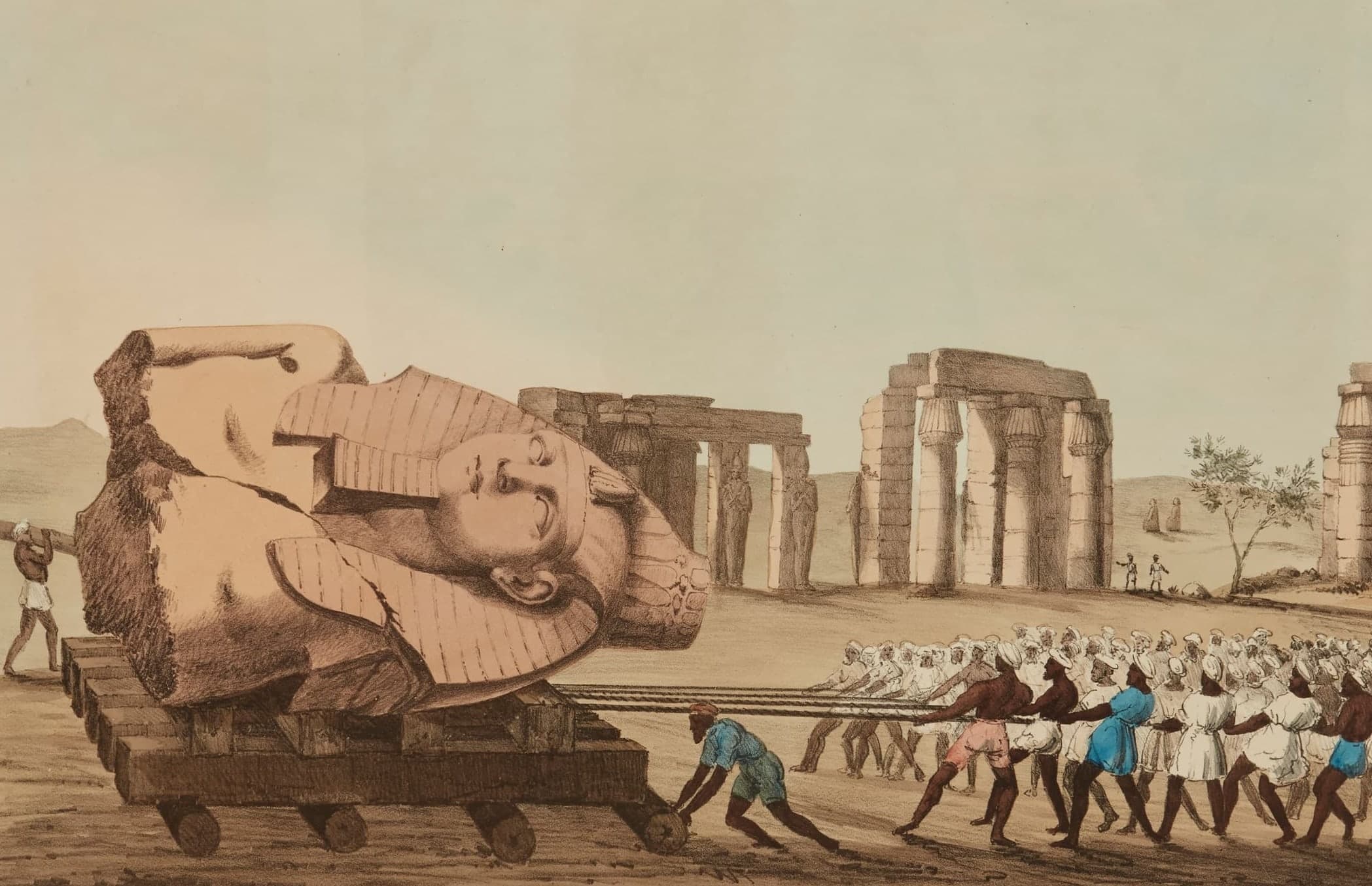
Moving this piece required levers, wooden rollers, and a workforce estimated at over a hundred men. The bust weighs approximately seven tonnes. It had to be dragged across sand, loaded onto a barge, floated down the Nile, then transferred to a ship for the Mediterranean crossing. The operation took weeks. The method is documented but not every detail of the route or the precise timing.
The story
The statue depicts Ramesses II, a Nineteenth Dynasty pharaoh, wearing the Nemes headcloth and cobra diadem. It is carved from granite and stands 267 centimetres high and 203 centimetres wide in its current, incomplete state. It was discovered at the Ramesseum, the mortuary temple complex built for Ramesses II on the west bank at Thebes.
The statue was already broken when Belzoni, working for the British consul, arrived at the site. It had been one of a pair flanking a doorway. The head of the companion statue remains at the Ramesseum. What Belzoni removed was the upper portion — head and torso — of one statue. The lower sections were left behind and remain in Egypt.
Belzoni's account describes the engineering challenge. The bust weighed several tonnes. He used wooden levers to tilt it, then slid wooden rollers underneath. A team of men hauled it across the sand using ropes. The operation required over a hundred workers, and the bust had to be moved without fracturing the granite further. Once it reached the Nile, it was loaded onto a barge and floated downstream to Cairo, then transferred to a ship bound for England.
The removal took place during a period when European powers and private collectors were competing for Egyptian antiquities. The British consul was acting in both diplomatic and commercial capacities, acquiring objects for institutional collections and for sale. Belzoni was employed as the field operative — the man who did the physical work of extraction.
The bust arrived in London and was acquired by the British Museum. It became known as the Younger Memnon, a name that reflects a misidentification common in the period. Greek and Roman travellers had called the colossal statues at Thebes 'Memnon', after a figure from Greek mythology. The name stuck, even after scholars understood that the statues depicted Ramesses II. The 'Younger' distinguished this bust from another colossal head, also in the British Museum.
Shelley wrote 'Ozymandias' as the bust was being shipped to England. The poem imagines a traveller describing a ruined statue in the desert — 'two vast and trunkless legs of stone' and a shattered face. The statue in the poem is not this one, but the timing suggests Belzoni's exploit was in Shelley's mind. The poem is about the collapse of power and the survival of art, and it was written at the moment a fragment of that art was being hauled out of the sand and shipped to a museum in the capital of another empire.
Why it mattered then
The statue was carved to assert permanence. Mortuary temples were built to sustain the cult of the dead king — offerings, rituals, the recitation of names. The statues at the Ramesseum were part of that apparatus. They stood at the entrance, visible from a distance, carved from hard stone that was meant to outlast mud brick and wood and flesh. Ramesses II ruled for decades and built extensively. The scale of the statues was a deliberate statement. They were designed to be seen by priests, by officials, by anyone approaching the temple. The granite was brought from quarries far to the south, a logistical effort that itself demonstrated control and resources. The statue was not decoration. It was part of the architecture of memory and power.
Why it matters now
The bust is now one of the most recognised objects in the British Museum, and it carries two histories. One is the history of New Kingdom Egypt — the carving, the temple, the cult of the king. The other is the history of its removal and display. The removal is contested. The bust was taken during a period when Ottoman authorities issued permits to European agents, and when the legal and ethical framework for such removals was different from what it is now. Egypt has requested the return of the bust, along with other objects removed during the same period. The British Museum's position is that the acquisition was legal under the laws in force at the time, and that the museum holds the objects in trust for a global public. The argument continues. The bust also endures because of 'Ozymandias'. The poem has outlasted most of the diplomatic correspondence and auction records of the period. It is taught in schools, quoted in speeches, used as shorthand for the collapse of imperial ambition. The statue in the poem is imaginary, but this granite head in Bloomsbury is one of the objects that made the poem possible. The irony is that the statue has not been forgotten. It was removed from the desert and placed in a building where millions of people see it. Whether that counts as survival or as a second kind of ruin depends on who is answering.
The surprising detail
Shelley never saw the bust. He wrote 'Ozymandias' before it went on public display, while it was being shipped to England. He may have read Belzoni's account or heard about the removal through London literary circles, but the poem was composed from description and imagination, not from standing in front of the object. The statue in the poem — shattered, half-buried, inscribed with a boast — is not an accurate description of the Younger Memnon, which has no surviving inscription on the fragment in London. The poem created an image more famous than the object that inspired it.
What is disputed
The exact date of the statue's carving is not recorded in the available sources, only that it depicts Ramesses II and comes from the Ramesseum. The circumstances of its original breakage are also unknown — whether it fell in an earthquake, was toppled deliberately, or collapsed over time. The account of the removal gives the method but not every detail of timing or route.
How it got here
The bust was removed from the Ramesseum by Belzoni, working for the British consul. It was acquired by the British Museum. The removal took place under a permit issued by Ottoman authorities, which governed Egypt at the time. Egypt has since requested the return of the bust, arguing that it was taken during a period of foreign occupation and belongs in its country of origin. The British Museum's position is that the acquisition was lawful under the framework in force at the time, and that the object is held in trust for a global public. The disagreement remains unresolved.
Remember this
A fragment of a statue, moved by levers and rollers, became the prompt for a poem about the collapse of empires — and now both the stone and the poem are part of the argument about who owns the past.
Test yourself
Why might the scale of the statue have mattered more in its original setting than it does in a museum gallery?
In the temple courtyard at the Ramesseum, the statue was seen from below, in bright sunlight, as part of an architectural ensemble that included other colossal figures, pylons, and open space. The scale was designed to work at a distance and to assert the king's presence in a landscape. In a museum gallery, the bust is lit evenly, viewed at close range, and surrounded by other objects competing for attention. The physical dimensions are the same, but the experience of scale — the sense of being dwarfed, of looking up — is diminished. The statue was made to dominate a specific place, and removing it changed what the size means.
Go deeper
Image: Agostino Aglio, Public domain. Licence: Public domain. Source.