I · THE OBJECT · BRITISH MUSEUM
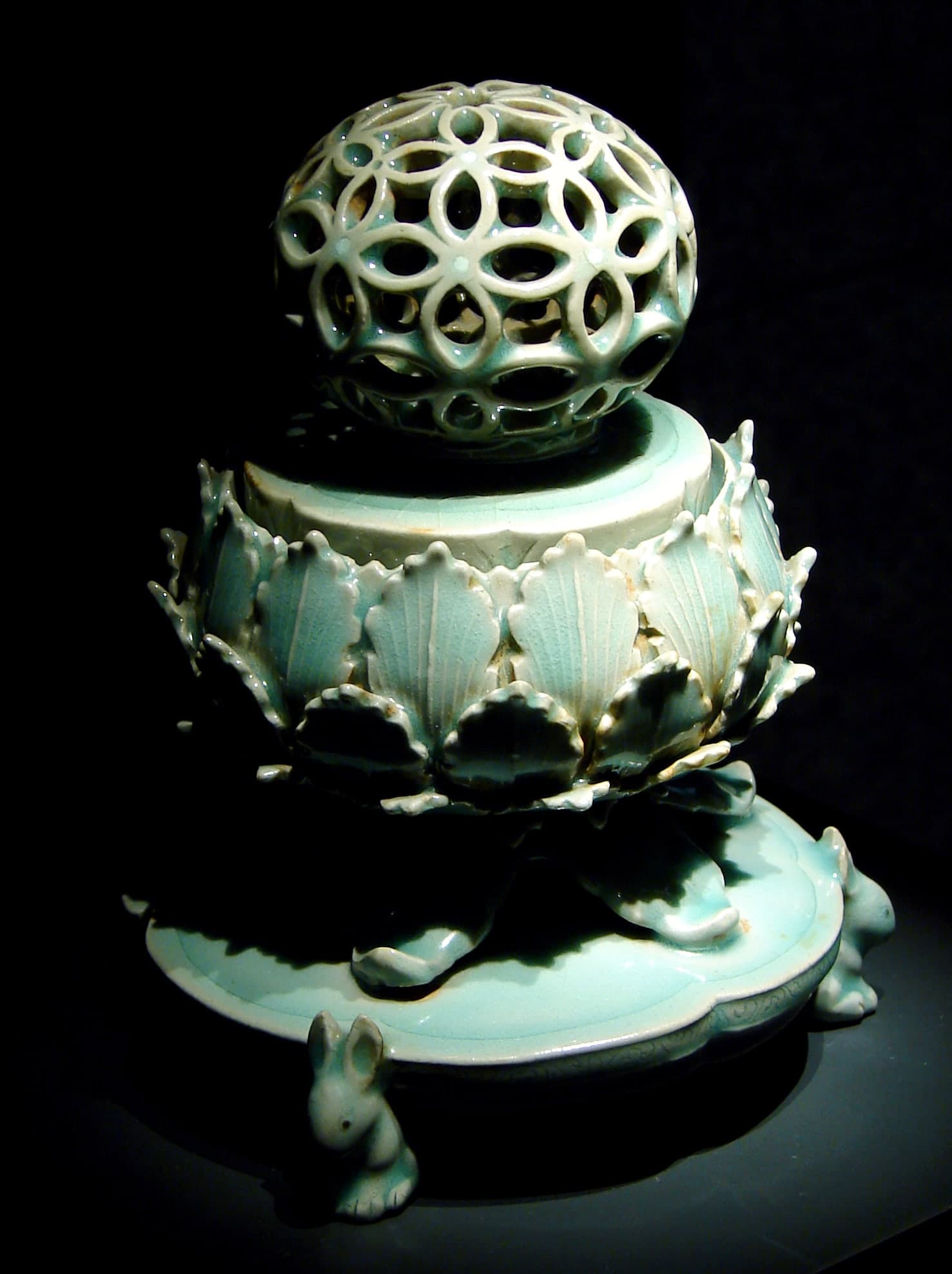
Korean Goryeo Celadon
▶ Listen · narrated
Korean potters cut patterns into clay, filled them with contrasting slip, and sealed everything under a translucent glaze. The method was theirs alone.
At a glance
- Culture
- Goryeo Korea
- Period
- Medieval
- Material
- Stoneware with celadon glaze
- Technique
- Sanggam inlay: incised pattern filled with slip
Look closer
The inlay sits flush with the surface
Sanggam decoration is not painted on. The potter incises a pattern into the leather-hard clay — lines, dots, or broader areas — then presses white or black slip into the grooves. Once the slip dries, the surface is scraped level so the inlay sits flush with the body. The glaze goes over everything. What you see through the translucent blue-green is contrast: pale clay against dark, or dark against pale, locked into the structure of the pot rather than resting on top of it.
The glaze colour comes from iron in a reducing kiln
The blue-green of celadon comes from a small amount of iron oxide in the glaze, fired in a kiln starved of oxygen — a reducing atmosphere. With enough oxygen, iron turns red or brown. Without it, the same iron produces the cool tones called celadon: grey-green, blue-green, or pale jade depending on the iron content and the temperature. The exact colour varies from kiln to kiln and firing to firing.
The clay itself is usually grey
Beneath the glaze, the body of a celadon vessel is typically a grey stoneware, fired dense and hard. The glaze is translucent rather than opaque, so the colour you see is a combination: the grey body showing through the pale green glass. Where the glaze pools thicker — in a carved groove or around the foot — it reads darker and bluer. Where it runs thin on a sharp edge, the grey shows more clearly.
The story
Celadon is a type of high-fired stoneware covered with a glaze that fires to shades of blue-green or grey-green. The colour comes from iron in the glaze, and the atmosphere inside the kiln. Potters in China had been making celadon for centuries before Korean workshops took up the technique, but Korean potters developed a form of surface decoration that was theirs alone.
That technique is called sanggam. The potter incises or stamps a design into the clay surface while it is still leather-hard — dry enough to hold detail but not yet brittle. The pattern might be geometric, floral, or figurative: cranes, clouds, willow branches, chrysanthemums. Once the design is cut, the potter fills the grooves with liquid clay of a contrasting colour, called slip. White slip for dark areas, black slip for light ones. When the slip dries, the surface is scraped smooth so that the inlay sits level with the body. Then the glaze goes on, and the whole piece is fired.
What emerges is decoration that lies beneath a glassy surface rather than on top of it. The inlaid pattern does not wear off, because it is part of the structure. The translucent glaze lets you see the contrast — white clay against grey, black against grey — but the surface itself is continuous and smooth.
Korean potters working during the medieval period made celadon in a wide range of forms: bowls, bottles, vases, incense burners, cosmetic boxes, water droppers for grinding ink. Some were plain, relying on the glaze alone. Others carried carved or moulded decoration under the glaze. Sanggam inlay appears to have developed as a distinct method within this broader tradition, and it became closely associated with Korean celadon production.
Chinese connoisseurs wrote admiringly of Korean celadon. The sources record that it was considered superior, though these references are brief and the texts do not survive in full, so the details of what was valued and why are not entirely clear. What is recorded is that Korean celadon had a reputation beyond the peninsula.
The sanggam technique itself was not successfully replicated elsewhere during the period. Potters in China made celadon, and they incised decoration into it, but the method of inlaying contrasting slip and levelling it flush before glazing does not appear in the ceramic traditions of neighbouring regions during the medieval period. Whether this was because the technique was kept within Korean workshops, or because it required specific clay bodies or firing conditions that were difficult to reproduce, is not documented.
Why it mattered then
Celadon was a luxury product, and the wares were used in both secular and religious contexts. Korean celadon has been excavated from temple sites, aristocratic tombs, and kilns that supplied the court. The inlaid decoration allowed for detailed, durable imagery — cranes for longevity, peonies for prosperity, willow for grace — that would not fade or flake. The praise from Chinese writers suggests that Korean celadon circulated as a prestige good. China was itself producing refined ceramics, so the fact that Korean wares were noted and valued indicates that they were understood as distinctive, not as provincial copies. For the court and the Buddhist institutions that commissioned celadon, the ware carried both aesthetic and symbolic weight.
Why it matters now
Sanggam inlay remains a recognised technique in Korean ceramic practice, taught and used by contemporary studio potters. The method itself — incising, filling, levelling, glazing — has not changed in its essentials, though the imagery and forms have. Korean celadon also stands as evidence of a technical tradition that was geographically specific. In a period when ceramic technology moved along trade routes and potters travelled or were taken to other regions, sanggam inlay stayed localised. That makes it useful for understanding how knowledge was or was not transmitted, and what conditions allowed a workshop tradition to remain distinct.
The surprising detail
Many talented Korean potters were captured and brought to Japan during invasions of Korea, where they contributed to advancing pottery production. Arita ware, which became a significant tradition, was founded by Yi Sam-pyeong, a Korean potter. Another representative ware, Satsuma, was also founded by Korean potters: Dang-gil Shim and Pyeong-ui Park. Descendants of some of these potters have maintained records of their Korean origin across multiple generations.
What is disputed
The exact period when sanggam inlay was developed is not precisely dated, and the reasons why the technique remained specific to Korean workshops are not documented in surviving sources. The references to Korean celadon by Chinese writers are brief and the full texts are lost, so the basis of their judgement is not entirely clear.
Remember this
A technique invented in Korea — inlaying contrasting clay into the surface before glazing — and not replicated elsewhere during the period.
Test yourself
Why does sanggam inlay not wear off the way painted decoration can?
Because the inlay is not applied to the surface. It is set into the clay body itself. The potter cuts grooves, fills them with slip of a different colour, then scrapes the surface level so the inlay and the body are flush. The glaze goes over both. What you see is contrast within the structure of the pot, not a layer on top of it. Painted decoration sits on the surface and can flake or fade; inlay is locked into the clay and lasts as long as the vessel does.
Go deeper
Image: Steve46814, CC BY-SA 3.0. Licence: CC BY-SA 3.0. Source.