III · THE WORK · ART HISTORY
The Nazca Lines
▶ Listen · narrated
The Nazca culture cleared figures into the Peruvian desert between 200 BC and 500 AD. Three centuries of debate have not settled what they were for.
At a glance
- Culture
- Nazca culture
- Date
- 200 BC to 500 AD
- Location
- El Ingenio District, Sechura Desert, Peru
- Type
- Geoglyphs — figures made by altering the ground surface
- Scale
- Combined length over 1,300 kilometres
Look closer
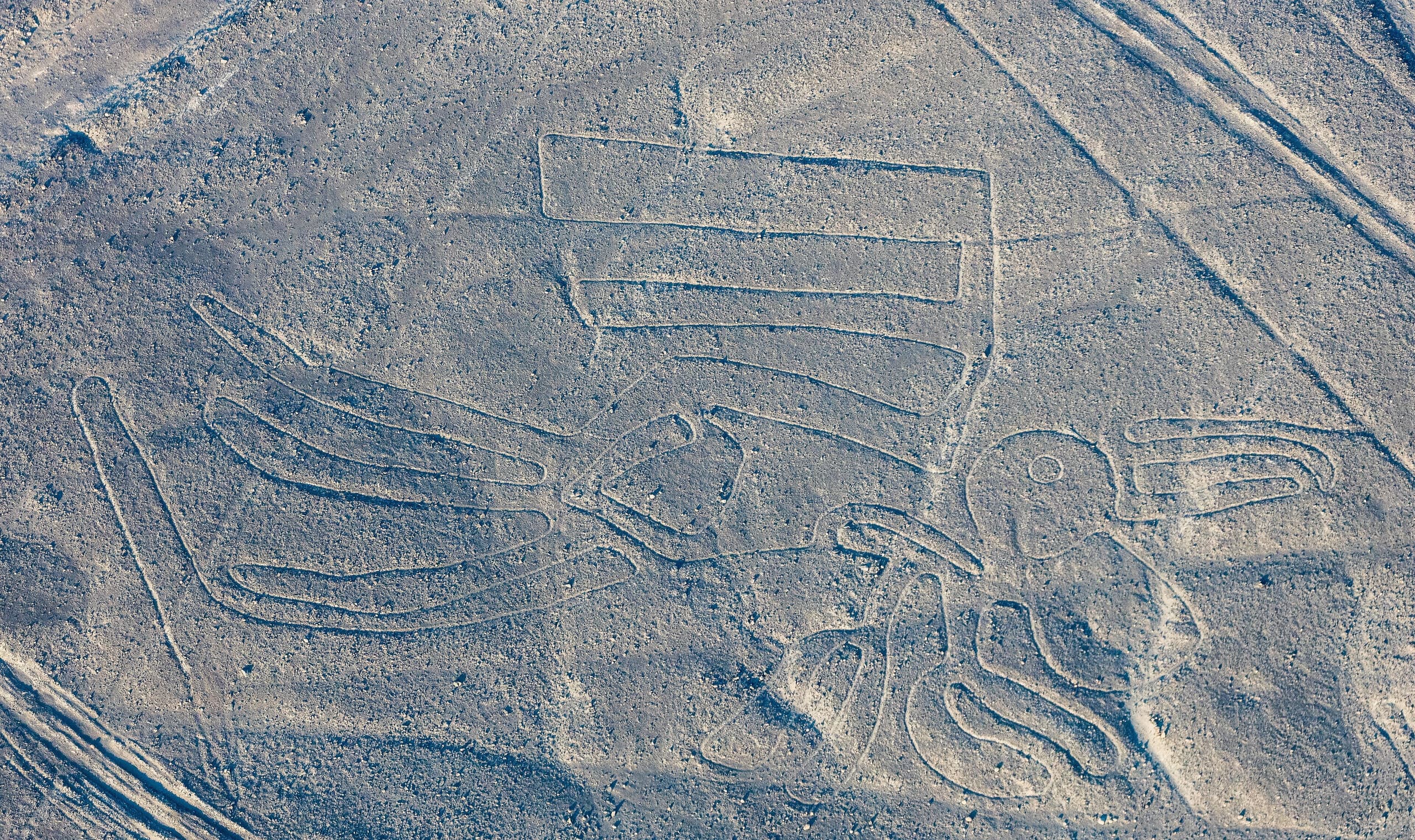
A single continuous line forming the whole figure
The animal and plant shapes are usually made from one unbroken line. The maker walked a path, clearing as they went, and the line doubled back on itself, looped, turned at angles, but did not lift. A hummingbird, a monkey, a spider — each one a single thread of pale ground against dark stone. The line varies in width, sometimes as narrow as thirty centimetres, sometimes as wide as nearly two metres, but it does not stop and restart. The figure exists because someone walked it.
Straight lines running for kilometres
Most of the lines are not figures at all. They are straight, and they run across the desert for great distances. Hundreds of them. They cross one another, layer over one another, and their combined length is more than the animal shapes by orders of magnitude. The figurative designs — the seventy-odd birds and plants and geometric shapes — are the famous part, but they are a small fraction of what was cleared. The bulk of the work went into lines that simply go, straight, often for kilometres, and then stop.
The colour contrast between pavement and subsoil
The desert floor here is covered in reddish-brown pebbles coated with ferric oxide — iron oxide, the compound that makes rust. Beneath them lies a yellow-grey subsoil. The lines are made by removing the top layer of pebbles, ten to fifteen centimetres deep, and exposing what is underneath. The contrast is not dramatic — pale against dark, not white against black — but it is enough. In the dry, windless, stable climate of the plateau, the cleared ground has stayed cleared. The designs have been preserved naturally, not by maintenance, for between fifteen hundred and two thousand years.
The story
The Nazca lines are geoglyphs — figures made by altering the surface of the ground — created by the Nazca culture in the Sechura Desert of southern Peru between 200 BC and 500 AD. The technique was to clear away the dark surface stones and reveal the paler dirt beneath. The result was a network of lines, geometric shapes, and animal figures spread across an area of about fifty square kilometres.
The figures vary in complexity. Hundreds are simple straight lines or geometric shapes. More than seventy are animals and plants: a hummingbird, a spider, a fish, a condor, a heron, a monkey, a lizard, a dog, a cat, a human. There are also trees and flowers. The animal shapes are usually made from a single continuous line — the maker cleared a path that looped and turned back on itself without lifting. The width of the lines varies, from as narrow as thirty centimetres to as wide as nearly two metres. Some of the figures are around three hundred and seventy metres long.
The lines are visible from the ground, particularly from the surrounding foothills, but many of the shapes are most legible from the air, at a height of around five hundred metres. This has generated decades of speculation, some of it lurid. The claim that the lines were made by or for extraterrestrials rests on the assumption that the Nazca culture could not have intended something they could not see in full. That assumption is not supported. The shapes can be seen from nearby high ground, and there is no evidence that the Nazca culture lacked the capacity to plan and execute a large design from ground level. The fact that a figure is most coherent from above does not mean it was made for an aerial observer. It means the design was executed at a scale that exceeds the height of a person.
What the lines were for is unresolved. Scholars generally ascribe religious significance to them, but the specific function is debated. One hypothesis, supported by the alignment of some lines and figures, is that they were part of water-related rituals. The Nazca region is one of the driest on Earth, and water management was central to survival. Some researchers have noted that certain lines point toward water sources or align with the positions of constellations associated with rain in Andean cosmology. Others have proposed that the lines were processional paths, walked as part of ceremonies. The two ideas are not mutually exclusive.
The lines have mostly been preserved by the climate. The plateau is dry, windless, and stable. Rare changes in weather can temporarily alter the designs, but the general pattern has held. In recent years, however, the lines have been deteriorating. Squatters have moved onto the land, and the increase in foot traffic and construction has damaged some figures. The site was designated a UNESCO World Heritage Site in 1994.
In the twenty-first century, the use of drones has led to the discovery of several hundred new figures. Archaeologists believe more remain to be found. The scale of the undertaking — more than thirteen hundred kilometres of cleared line — suggests that the creation of the geoglyphs was not a single project but a sustained practice over centuries. The Nazca culture made these figures, walked them, perhaps, and left them for the desert to keep.
Why it mattered then
The Nazca culture made the lines over a period of seven hundred years, from 200 BC to 500 AD. The act of clearing the ground was not quick. The combined length of all the lines is more than thirteen hundred kilometres. That represents sustained effort, across generations, in one of the driest environments on Earth. Water was the organising problem. The Nazca region receives almost no rain, and survival depended on managing the runoff from the Andes. Some of the lines align with water sources or point toward the mountains where the runoff originates. Some figures align with constellations that, in Andean cosmology, were associated with rain and the agricultural calendar. If the lines were part of water-related rituals, then their scale makes sense. They were not decoration. They were infrastructure of a kind — not physical infrastructure, but ritual infrastructure, made to secure the conditions for survival. The fact that the figures were made from a single continuous line may also have mattered. Walking a path, clearing as you go, is a different act from marking a boundary or digging a channel. It is processional. It takes time. If the lines were walked as part of ceremonies, then the experience of making them and the experience of using them would have overlapped. The line was both the record of the act and the space in which the act was repeated.
Why it matters now
The Nazca lines matter now because they are a record of sustained collective effort whose purpose we do not fully understand. That is not a failure of knowledge. It is a reminder that much of what people do, and have done, is not self-explanatory from the objects they leave behind. The lines also matter because they have been conscripted into arguments they were not made for. The extraterrestrial hypothesis, though unsupported by evidence, has had wide cultural circulation. That says something about how we treat the unfamiliar. When we encounter something that seems difficult to explain, the move toward the fantastic can feel like curiosity, but it often works the other way. It replaces the problem of understanding a particular culture with the problem of explaining a visitation, and the second problem is easier to have opinions about. The water hypotheses are harder to hold in mind because they require understanding the Nazca environment and cosmology, and because they do not resolve into a single answer. But they take the lines seriously as the work of people solving the problems they actually had. That is a more difficult kind of attention, and a more respectful one. The lines are also deteriorating. Squatters, foot traffic, and vehicle tracks have damaged some figures. The fact that the geoglyphs survived fifteen hundred years of weather and are now being erased by a few decades of human proximity is a compressed version of a pattern visible across many sites. What lasts is often fragile in ways that only become clear when it stops lasting.
The surprising detail
The combined length of all the Nazca lines is more than thirteen hundred kilometres. That is roughly the distance from London to Rome. It was cleared ten to fifteen centimetres deep, by hand, by removing reddish-brown pebbles to expose the yellow-grey subsoil beneath. The work was done over seven hundred years, but even distributed across that span, the scale is difficult to picture. The animal figures — the hummingbird, the monkey, the spider — are the famous part, but they represent a small fraction of the total. Most of what was cleared are straight lines, running for kilometres, crossing one another, layering. The Nazca culture committed more effort to the lines that simply go than to the shapes we remember.
What is disputed
What the Nazca lines were for is genuinely unresolved. Scholars generally agree they had religious significance, but the specific function is debated. The water hypothesis — that some lines and figures were part of rituals related to water and agriculture — is supported by alignments with water sources and constellations, but it is not universally accepted. The processional hypothesis — that the lines were paths walked during ceremonies — is compatible with the water hypothesis but adds a different emphasis. Neither has displaced the other. The extraterrestrial hypothesis, though culturally prominent, is not supported by evidence and is not taken seriously in archaeological scholarship.
Remember this
The Nazca lines are figures cleared into desert pavement between 200 BC and 500 AD. What they were for is still debated.
Test yourself
The extraterrestrial hypothesis assumes the Nazca culture would not have made something they could not see in full from the ground. Why does that assumption not hold, even if we set aside whether the hypothesis is plausible?
Because the figures are visible from the ground, particularly from the surrounding foothills and other high places. They are most legible from the air, at around five hundred metres, but that does not mean they were invisible to the people who made them. The assumption conflates 'best seen from above' with 'only seen from above', and it also assumes that a culture would not plan and execute a large design unless they could stand back and see it whole. That assumption is not supported. Many large structures and images in many cultures were made without the makers having a vantage point from which to see them complete. The fact that a design exceeds the height of a person does not mean it was made for someone taller. It means the design was executed at a scale that required planning rather than direct observation. The Nazca culture had the capacity to do that. The extraterrestrial hypothesis solves a problem that does not exist.
Go deeper
Image: Diego Delso. Licence: CC BY-SA 4.0. Source.