I · THE OBJECT · BRITISH MUSEUM
The Franks Casket
▶ Listen · narrated
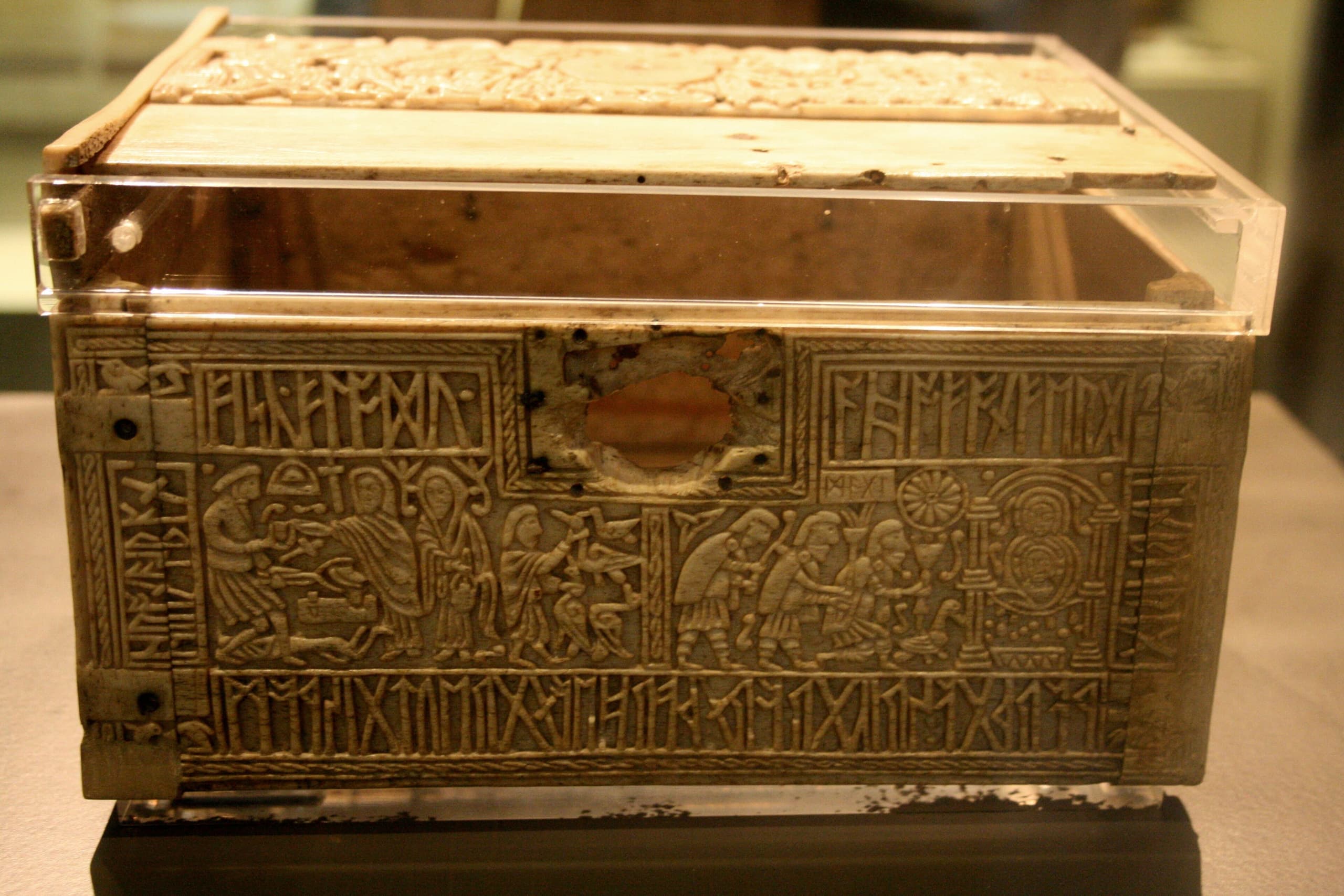
This box holds scenes from four different traditions on its panels, and the runic texts do something stranger still: they change language and script without warning, and some run backwards.
At a glance
- Date
- 8th century
- Material
- Whalebone
- Dimensions
- 10.9 × 19 cm
- Origin
- Thought to be Northumbrian
- Collection
- British Museum; Bargello National Museum
Look closer
Scenes from four traditions side by side
The panels show a Christian scene — the Adoration of the Magi — alongside images drawn from Roman history and mythology, including the emperor Titus and the founders Romulus and Remus. A fourth panel depicts a legend from Germanic tradition: Weyland the Smith. Scholars have suggested other scenes may represent further legends, including one involving Sigurd, another about Weyland's brother Egil, and possibly episodes involving Achilles or the legendary founders of England, Hengist and Horsa. The identifications are not all certain, and the scholarship on what the images represent is considerable.
Runic inscriptions that switch script and language
The inscriptions are cut in runes and mostly written in Old English, but they shift into Latin and the Roman alphabet, then back into runes while continuing to write Latin. Some texts are carved upside down or back to front. This has been described as a deliberate display of linguistic and alphabetic skill — the carver was showing what could be done with writing systems, not simply labelling the images.
Carved in low relief with a knife
The scenes are cut in flat two-dimensional low relief across the whalebone surface. The technique produces dense narrative images without much depth, and the carving was done with a knife rather than a chisel. The bone itself is from a whale, not baleen — the material sometimes called whalebone in other contexts.
The story
The casket is a small box carved from whale bone in the 8th century, thought to have been made in Northumbria. Its surfaces are covered with images and inscriptions, and both have generated scholarly debate about what they represent and why they were chosen.
The images draw on Roman, Christian and Germanic traditions without apparent hierarchy. One panel shows the Adoration of the Magi, the Christian nativity scene. Another depicts the Roman emperor Titus. A third shows Romulus and Remus, the legendary founders of Rome, and a fourth represents Weyland the Smith, a figure from Germanic legend. Scholars have proposed that other scenes may depict further stories — an episode from the Sigurd legend, an otherwise unrecorded event from the life of Weyland's brother Egil, a Homeric legend involving Achilles, and possibly an allusion to Hengist and Horsa, legendary founders of England. Not all these identifications are agreed upon, and interpreting the images remains an active area of study.
The inscriptions are as varied as the images. Most are written in Old English using Anglo-Saxon runes, but the texts shift into Latin and the Roman alphabet, then return to runes while still writing Latin. Some inscriptions run upside down or back to front. This has been read as a deliberate demonstration of skill — the carver was not simply labelling the scenes but performing with the writing systems themselves, showing fluency across languages, alphabets and directions.
The box was probably a reliquary — a container for sacred objects — though its original contents are not recorded. It is named after Augustus Wollaston Franks, who owned it and gave it to the British Museum. One panel is now held separately at the Bargello National Museum.
The casket is considered important for the insight it offers into early Anglo-Saxon art and culture, particularly because it brings together such a range of sources and traditions in a single object. The combination of Christian, Roman and Germanic material, and the linguistic virtuosity of the inscriptions, suggest a maker and a context in which those worlds were not separate but part of a shared repertoire.
Why it mattered then
The casket was made in a period when the culture that produced it was drawing on multiple traditions at once. The inscriptions suggest a context in which literacy in multiple scripts and languages was valued and displayed. If the box was a reliquary, as its form suggests, then the range of imagery makes a particular kind of sense. Reliquaries were containers for sacred objects, and their decoration often communicated the authority and significance of what they held. The combination of scenes from different traditions may have been a way of asserting that those traditions could all be claimed as inheritance. The maker was literate in runes and the Roman alphabet, in Old English and Latin, and in the visual languages of different storytelling traditions — and the casket itself is evidence of that multilingual, multi-script competence.
Why it matters now
The casket is a reminder that cultural identity has rarely been simple or singular. This object shows a maker who could move between Christian, Roman and Germanic material without treating any of it as foreign, and who could write in two languages and two alphabets with equal fluency. The inscriptions are particularly striking because they refuse to stay in one system. The shifts between runes and Roman letters, between Old English and Latin, and the texts that run backwards or upside down, all suggest that writing was not just a tool for recording information but a medium for display and play. That attitude — treating literacy as something to perform with, not just use — is recognisable in later periods, but seeing it in an 8th-century object makes the continuity visible. The casket also matters because both identifying the scenes and reading the inscriptions remain open questions. Scholarship on the object is considerable, and interpretations are still debated. That means the casket continues to generate new readings, not because the evidence has changed but because the questions asked of it have.
The surprising detail
The inscriptions do not simply label the scenes. Some of them are riddles. The text on one panel, for instance, does not name the creature whose bone the box is made from — it describes it obliquely, as something that beached on a shore. The reader is expected to work out what is being referred to. This is consistent with a broader Anglo-Saxon tradition of riddling, in which objects and creatures were described without being named directly. The casket itself, in other words, participates in a genre: it is not just decorated with texts, but with puzzles.
What is disputed
The identification of some of the carved scenes is uncertain. Scholars have proposed that certain panels may depict episodes from the Sigurd legend, an event from the life of Weyland's brother Egil, a Homeric scene involving Achilles, or an allusion to Hengist and Horsa. Not all these readings are agreed upon, and the scholarship on the casket's imagery continues. The original contents of the box are also not recorded, though its form suggests it was a reliquary.
How it got here
The casket is named after Augustus Wollaston Franks, who gave it to the British Museum. One panel is now held separately at the Bargello National Museum. The circumstances of its discovery and the history of its ownership before Franks are not detailed in the available material.
Remember this
Four traditions carved onto one small box, and inscriptions that switch script, language and direction — a single object holding multiple worlds at once.
Test yourself
The casket's inscriptions shift between Old English and Latin, and between runes and the Roman alphabet. Why might a maker in 8th-century Northumbria have treated that kind of switching as something worth displaying?
Because fluency in multiple scripts and languages was a form of cultural capital in a context where those systems were all in active use. Latin was the language of the church and learning, Old English was the vernacular, runes were an older native script, and the Roman alphabet was the script of Latin texts. Being able to move between them signalled education and access to different traditions. The casket's inscriptions perform that fluency — they do not just use the scripts, they show off the ability to switch between them, including by writing Latin in runes or running text backwards. That kind of display makes sense in a culture where literacy itself was not universal, and where multilingual, multi-script competence marked someone as learned.
Go deeper
Image: CC BY-SA 3.0. Licence: CC BY-SA 3.0. Source.