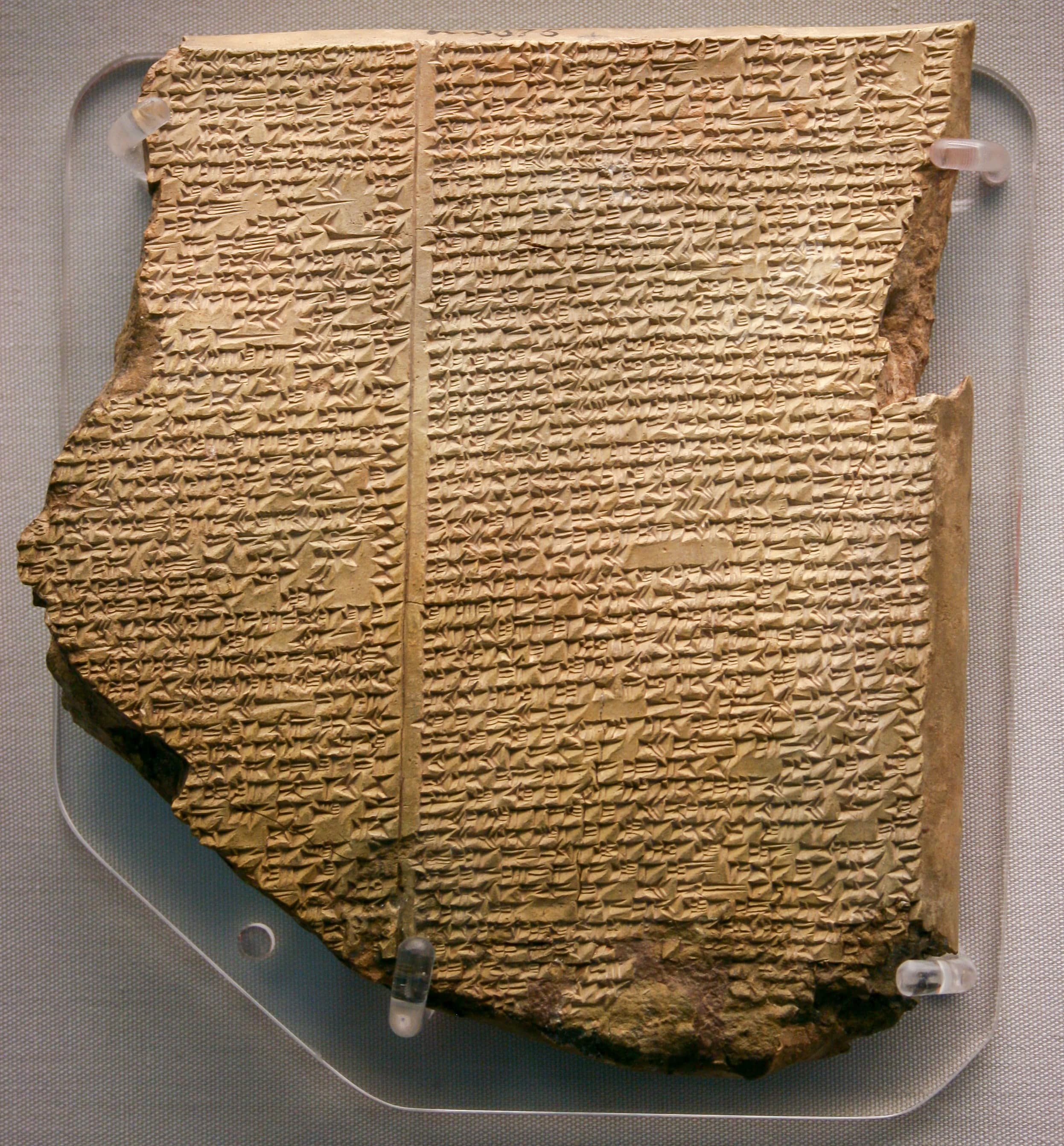
I · THE OBJECT · BRITISH MUSEUM
The Flood Tablet
▶ Listen · narrated
When this tablet was read aloud in 1872, it proved that a story thought to originate in Genesis had been written down centuries earlier in Mesopotamia.
At a glance
- Culture
- Neo-Assyrian
- Collection
- British Museum
- Content
- Deluge myth
- Script
- Cuneiform
Look closer
Tablet XI of a longer epic
This is not a standalone text. It forms part of the Gilgamesh Epic, a longer narrative about a king searching for immortality. The flood story appears on what editors call Tablet XI — the eleventh section in a standard arrangement of the epic. The flood account interrupts the main narrative: Gilgamesh meets a man who survived a great deluge, and that man tells his story. Scholars believe this flood episode was inserted into the epic by an editor who drew on material from another work, the Epic of Atra-Hasis, which also contains a flood narrative.
One of three Mesopotamian flood myths
The Gilgamesh flood myth sits alongside two other Mesopotamian flood accounts: one included in a text called the Eridu Genesis, and an episode from the Epic of Atra-Hasis. These are separate compositions, not versions of the same text. A brief reference to a flood also appears in older Sumerian poems about Gilgamesh, from which the later Babylonian versions drew inspiration and subject matter. The relationship among these texts — which borrowed from which, and when — remains a matter of scholarly reconstruction.
Read aloud in 1872
George Smith, an assistant at the British Museum, was working through cuneiform tablets when he read this one and recognised the flood narrative. He announced the discovery in a public lecture in 1872. The significance was immediate: here was a flood story written in Mesopotamia that predated the composition of Genesis. The tablet did not prove that the biblical account was borrowed — the relationship between the texts is more complicated than simple copying — but it demonstrated that the flood story had a literary history outside Scripture.
The story
The tablet is a clay slab inscribed with cuneiform — the wedge-shaped script pressed into wet clay with a reed stylus. It was part of a library, and the text it carries is a section of the Gilgamesh Epic, a long narrative poem about a king who seeks eternal life and fails to find it.
The flood story appears late in the epic. Gilgamesh, exhausted by his quest, meets a man named Utnapishtim, who lives at the edge of the world. Utnapishtim tells him how he survived a great flood sent by the gods. He was warned in advance, built a boat, loaded it with his family and animals, and rode out the deluge. When the waters receded, he sent out birds to test whether land had reappeared. The gods, regretting their destruction, granted him immortality.
The parallels to the Genesis flood narrative are close: a divine warning, a boat, a family saved, animals loaded aboard, birds sent out to find dry land. When George Smith read the tablet in 1872, those parallels were unmistakable. He was working as an assistant in the British Museum, sorting and translating cuneiform tablets that had been brought back from excavations in Mesopotamia. Smith had taught himself cuneiform as a young man, and the museum had hired him to work through the backlog of unread tablets.
When he reached the flood passage, he recognised what he was reading and announced the discovery in a lecture that December. The response was immediate. Here was a flood story written in Mesopotamia, and the tablets it appeared on were older than the composition of the biblical text. The discovery did not prove that Genesis had borrowed the story — the relationship between the texts is more complicated than that — but it did prove that the flood narrative had a literary history outside Scripture.
Scholars now believe the flood episode in the Gilgamesh Epic was added to Tablet XI by an editor who drew on material from another Mesopotamian work, the Epic of Atra-Hasis, which also contains a flood account. The Gilgamesh Epic exists in multiple versions, and the flood story appears in what is called the standard version — a later arrangement of the text. Shorter references to a flood also appear in older Sumerian poems about Gilgamesh, so the story was circulating in Mesopotamian literature before it was incorporated into the longer epic.
The tablet Smith read was part of a library assembled in Mesopotamia. The library contained many tablets, and the Gilgamesh Epic was preserved across multiple clay slabs. Tablet XI is the section that contains the flood narrative.
Why it mattered then
The flood story was part of a larger narrative tradition in Mesopotamia. The Gilgamesh Epic was copied and recopied, and the flood episode was inserted into the standard version of the text by an editor who drew on material from other sources. The epic was not Scripture in the way Genesis became Scripture, but it was a central literary work, and the flood story was one episode within it. The story served a narrative function: it explained why Utnapishtim had been granted immortality, and it provided a foil for Gilgamesh, who seeks the same gift and does not receive it. The flood account also reflected older Mesopotamian traditions about divine destruction and survival, themes that appear in other texts from the region.
Why it matters now
The discovery in 1872 changed how scholars understood the relationship between Mesopotamian literature and the biblical text. It demonstrated that stories thought to originate in Genesis had older parallels in the literature of the ancient Near East. That does not mean Genesis copied from Gilgamesh — the relationship is more complicated, and both may draw on older shared traditions — but it does mean the flood story had a literary history that extended beyond Scripture. The tablet also raised questions that remain unresolved. How did these stories circulate? Were they transmitted orally before being written down? Did the biblical authors know the Mesopotamian versions, or did both traditions draw on a common source now lost? The evidence does not settle these questions, and scholars continue to debate them. What the tablet did prove, beyond dispute, is that the flood narrative was not unique to Genesis. That realisation was unsettling in 1872, and it remains significant now. It places the biblical text inside a broader literary context, one in which stories were shared, adapted, and retold across cultures and centuries.
The surprising detail
George Smith's reaction to reading the tablet has become part of the story. According to accounts from the time, he became so excited when he realised what he was reading that he began to undress — though how much of his clothing he actually removed is disputed in the retellings. The anecdote has been repeated often enough that it is difficult to know how much of it is accurate, but it captures the shock of the discovery: a flood story older than Genesis, read for the first time in centuries, by a self-taught scholar working through a backlog of unread tablets in a museum basement.
What is disputed
The relationship among the Mesopotamian flood texts — the Gilgamesh Epic, the Epic of Atra-Hasis, the Eridu Genesis, and the references in older Sumerian poems — is a matter of scholarly reconstruction. Which text borrowed from which, and when the flood episode was inserted into the Gilgamesh Epic, are questions the evidence does not settle definitively. The standard version of the Gilgamesh Epic, which includes the flood story, is a later arrangement, but how much earlier the flood narrative circulated in other forms is uncertain.
Remember this
A flood story older than Genesis, read aloud in 1872, and proof that Scripture's narratives had a literary history outside the Bible.
Test yourself
The tablet proved that a flood story was written in Mesopotamia before Genesis was composed. Why does that not prove Genesis borrowed the story from the Gilgamesh Epic?
Because the relationship between texts is more complicated than simple copying. Both the Gilgamesh Epic and Genesis may draw on older traditions that are now lost. The flood story appears in multiple Mesopotamian works — the Eridu Genesis, the Epic of Atra-Hasis, and references in older Sumerian poems — so it was circulating in various forms before it was incorporated into the standard version of Gilgamesh. The biblical authors may have known Mesopotamian versions, or both traditions may reflect older shared material. The evidence shows that the flood narrative had a literary history outside Scripture, but it does not settle the question of how the stories are related. Parallel does not prove dependence; it proves a shared tradition, and the direction of influence is harder to establish than the fact of overlap.
Go deeper
Image: Photograph by Mike Peel ( www.mikepeel.net ).. Licence: CC BY-SA 4.0. Source.