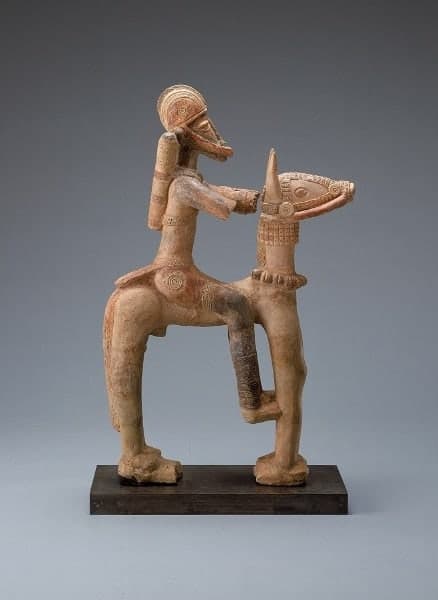
III · THE WORK · ART HISTORY
The Terracottas of Djenné-Djeno
▶ Listen · narrated
These terracottas come from a city that was already ancient when the empires of Mali rose, and whose sculpture tradition we know almost entirely through objects stolen from the ground.
At a glance
- Site
- Djenné-Djeno, Mali
- Occupation
- 250 BC to 1400 AD
- Material
- Fired terracotta
- Status
- UNESCO World Heritage Site
Look closer
The kneeling, self-embracing posture
Many figures from Djenné-Djeno are shown kneeling with their arms wrapped around their own bodies or drawn close to the chest. The pose is compact, symmetrical, contained. Whether it represents prayer, mourning, meditation or something else is not recorded in the objects themselves, and the absence of contemporary written accounts means we have the gesture without its name. What is clear is that the posture was deliberate and repeated across multiple figures, suggesting it carried a meaning within the culture that made them.
Raised scarification lines on the temple
The clay surfaces of some figures carry patterns of raised lines, particularly on the face and temple. These are scarification marks — deliberate cuts made in the skin that heal as raised tissue, forming permanent patterns. The terracotta records them as ridges built up on the surface of the clay, mimicking the three-dimensional quality of the scars themselves. Scarification served as identity, decoration, ritual marking or all three, and the care taken to model these marks in clay suggests they mattered enough to preserve in a permanent medium.
Serpents modelled along the back
Some figures carry serpents coiled around the torso or along the back and shoulders. The snakes are modelled as separate forms applied to the body of the figure, their scales sometimes indicated by incised lines or pressed texture. What serpents meant in this context — whether protective, symbolic of water and fertility in a delta environment, or tied to specific practices — is not explained by the objects. The repetition of the motif across multiple figures suggests a shared iconography, but the texts that would decode it have not survived.
The story
Djenné-Djeno sits in the inland delta of the Niger River in what is now Mali, about three kilometres from the modern town of Djenné. The name translates as ancient Djenné. The site is an occupation mound — a tell, in archaeological terms — built up over centuries of continuous habitation. When it was mapped in 1977, the mound stood up to six metres high and covered thirty-three hectares.
Excavations, mainly by Roderick and Susan McIntosh, established that the site was occupied from 250 BC to 1400 AD. That span of sixteen centuries makes it one of the long-lived urban centres in the region, and the terracotta figures recovered from it represent a sculpture tradition that persisted across much of that period. The figures themselves are varied: kneeling and standing forms, some wrapped in serpents, many carrying scarification marks modelled as raised lines on the clay surface. Some are hollow, built up from coils. Others are solid. The firing was done in open fires or simple kilns, hot enough to harden the clay but not to vitrify it.
What the figures were for is not recorded in writing. Djenné-Djeno had no written language of its own, and the oral traditions that might have explained the iconography were not continuous with later cultures in the region. Scholars have proposed that the figures served ritual purposes, marked ancestral or spiritual figures, or were placed in domestic or public settings as part of practices we can no longer name. The repetition of certain motifs — the kneeling posture, the serpents, the scarification patterns — suggests a coherent symbolic system, but the key to that system was not written down and has not been passed on.
Scholars now believe the site was likely established by the Mande progenitors of the Bozo people, based on linguistic and archaeological evidence. The city was involved in long-distance trade and in the domestication of African rice. It flourished long before traders from the north arrived, disproving earlier scholarly assumptions that complex societies and trade networks in the region developed only after contact from the north. Djenné-Djeno was already urban, already trading, already making sculpture when those assumptions were formed.
The site was abandoned around 1400 AD. Why is not certain. The population may have moved to the nearby site that became modern Djenné, or dispersed for reasons related to trade routes, environmental change, or political shifts in the region. The mound remained, and the terracottas remained in it, until the late twentieth century, when the site became a target for large-scale looting. Figures were dug up and sold into the international art market in such numbers that the archaeological context for most surviving terracottas from Djenné-Djeno has been destroyed. The objects exist, but the record of where they were found, in what layers, and in relation to what structures has been lost. What we know about the site comes almost entirely from the controlled excavations conducted before the looting began.
Why it mattered then
Djenné-Djeno was an urban centre in a region where scholars once believed cities did not develop until external traders arrived. Its existence, and its early occupation date of 250 BC, demonstrated that urbanism, trade networks and complex social organisation were indigenous developments, not imports. The city was involved in long-distance trade and in the domestication of African rice, both of which required coordination, surplus production and specialised labour. The terracotta tradition itself represents a sustained investment in symbolic or ritual production over many centuries, suggesting that the society had the stability and resources to support non-subsistence activities. The figures, with their repeated motifs and careful modelling, point to a shared visual language and possibly to specialist makers. What Djenné-Djeno mattered as, in its own time, was a functioning city in a region where cities were thought not to have existed until much later.
Why it matters now
Djenné-Djeno matters now as evidence against a long-standing narrative that positioned the region as a recipient of civilisation rather than a generator of it. The site proved that urbanism, trade and symbolic production were not dependent on contact from the north, and that the timeline for these developments was much earlier than previously assumed. The terracottas themselves are now scattered in museums and private collections, most of them looted in the late twentieth century. The scale of that looting makes Djenné-Djeno a case study in the destruction of archaeological context: the objects survive, but the information about where they came from and what they were found with has been lost. The site is a UNESCO World Heritage Site, but the designation came too late to prevent the removal of most of its portable material. What remains is a mound, a small number of documented excavations, and a large number of undocumented objects whose original context can no longer be reconstructed.
The surprising detail
The terracottas of Djenné-Djeno are among the most heavily looted African archaeological material of the late twentieth century. The site was systematically dug by looters, and the figures were sold into the international art market in such quantities that the archaeological record for most surviving objects has been destroyed. Museums and collectors now hold terracottas whose exact findspot, stratigraphic layer and associated material are unknown, because they were removed without documentation. The looting was so extensive that scholars estimate the majority of terracottas from the site now in existence were taken illegally. What we know about Djenné-Djeno comes almost entirely from the controlled excavations conducted before the looting began. The objects are visible; the context is gone.
What is disputed
The function of the terracotta figures is not documented in contemporary sources, and the oral traditions that might have explained them were not continuous with later cultures in the region. Proposals that they served ritual purposes, represented ancestors or spirits, or were placed in domestic or public contexts are scholarly interpretations, not recorded facts. The attribution of the site to the Mande progenitors of the Bozo people is based on linguistic and archaeological evidence and represents current scholarly consensus, but the ethnic and linguistic identity of the inhabitants across the full sixteen centuries of occupation is not certain. The reason for the site's abandonment around 1400 AD is likewise not documented and remains a matter of hypothesis.
Remember this
A sixteen-century urban tradition recorded in clay, now known mostly through objects whose archaeological context has been destroyed by looting.
Test yourself
Why does the looting of Djenné-Djeno matter more than simply the loss of objects to the country they came from?
Because looting destroys archaeological context, and context is what turns an object into evidence. A terracotta figure removed from the ground without documentation loses the record of where it was found, what layer it came from, what it was buried with, and what structures it was near. That information cannot be reconstructed later. It is gone permanently. The object still exists and can be studied for its form, material and technique, but the answers to questions like what the figures were used for, where they were placed, whether they were made locally or traded in, and how their production changed over time all depend on context. When the context is destroyed, those questions become much harder or impossible to answer. The looting of Djenné-Djeno did not just move objects from one country to another. It erased the information that would have allowed scholars to understand what the objects meant in the society that made them.
Go deeper
Image: Franko Khoury, Public domain. Licence: Public domain. Source.