III · THE WORK · ART HISTORY
Berthe Morisot's The Cradle
▶ Listen · narrated
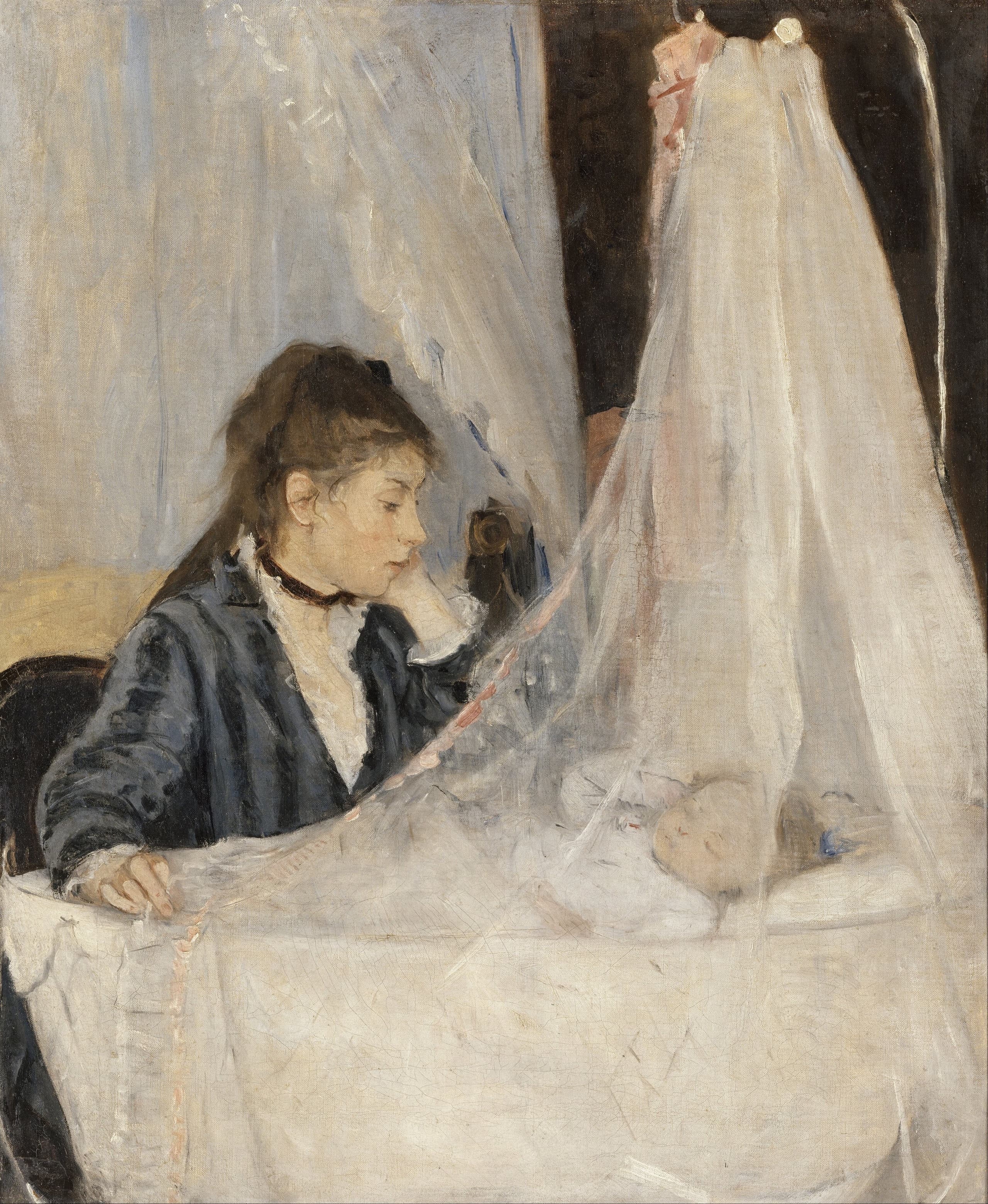
The subject is maternal devotion, but the veil is painted thick enough to be a screen, and the expression on the mother's face will not resolve into tenderness alone.
At a glance
- Artist
- Berthe Morisot
- Date
- 1872
- Medium
- Oil on canvas
- Dimensions
- 56 × 46.5 cm
- Collection
- Musée d'Orsay, Paris
Look closer
The veil as painted obstacle
The gauze curtain draped over the cradle is not treated as transparent fabric. Morisot has painted it with enough body and opacity that it reads as a physical screen between the two figures. The brushwork is dense and the white is worked thickly, so that the veil occupies space in the composition rather than dissolving into atmosphere. It divides the canvas vertically, placing mother and child in separate zones. The effect is that what ought to be a protective canopy becomes a barrier you notice.
The mother's expression
The woman's face, turned toward the cradle and resting on one hand, does not settle into a single readable emotion. There is attention, certainly, and stillness, but the set of the mouth and the shadowed eyes resist the easy interpretation the subject invites. Paintings of mothers watching sleeping children conventionally show absorption or contentment. This face is more ambiguous. The gaze is steady but the expression is withheld, as though the act of watching contains something more complicated than devotion.
Mirrored hands
The mother's left hand, supporting her head, echoes the position of the infant's hand inside the cradle. Both are curved, both rest near the face, both are painted with the same loose, summary brushwork. The repetition creates a formal link between the two figures despite the veil that separates them. It is a quiet piece of composition that suggests connection without sentimentality, a visual rhyme that works whether or not you read it as intentional.
The story
Morisot painted this in 1872. The woman is her sister, who had been a painter herself before marriage. The infant is her sister's daughter. The setting is domestic, the subject conventional: a mother watching over a sleeping child, the cradle draped with protective gauze.
But the painting does not behave conventionally. The veil, which ought to recede as a piece of functional fabric, is painted with such solidity that it becomes the most assertive element in the composition. Morisot has worked the white paint thickly, with visible brushstrokes, so that the gauze reads as an opaque screen rather than a transparent drape. It runs vertically through the centre of the canvas, dividing the space into two zones. The child is behind it, softened and partly obscured. The mother is in front of it, separated.
The effect is that the painting is as much about distance as it is about proximity. The veil is a barrier you cannot ignore. It does not frame tenderness; it interrupts it.
The mother's expression reinforces this ambiguity. Her face is turned toward the cradle, her head resting on her left hand in a pose that suggests both attention and fatigue. But the expression itself will not resolve. The eyes are shadowed, the mouth is set, and the overall effect is one of withheld emotion. There is watchfulness, but not the absorption or soft contentment that paintings of this subject typically show. The face is painted with enough restraint that it allows multiple readings: devotion, yes, but also weariness, or distance, or something more complicated than a single word will cover.
Morisot was associated with Impressionism, the movement listed in the painting's catalogue record. She exhibited alongside other painters working in a similar mode, painters who had been refused by the official Salon or chose not to submit to it.
The painting is now in the Musée d'Orsay in Paris. It was previously held in the Louvre's Department of Paintings and at the Galerie nationale du Jeu de Paume before being transferred to the Orsay. Its inventory number is RF 2849.
Why it mattered then
The painting was made at a moment when the subject matter it depicts was becoming a site of argument. Domestic scenes of women and children were an established genre, but they were also being used by painters to make claims about modern life and modern vision that went beyond the subject itself. Morisot was working within a set of conventions about maternal devotion and private interiors, but she was also painting in a way that complicated those conventions. The veil is not treated as a decorative detail; it is painted as a structural element that divides the composition. The mother's expression is not legible as simple tenderness. The brushwork is loose and summary, refusing the smooth finish that the Salon expected. The painting is both a genre painting and a painting that will not behave as the genre requires.
Why it matters now
The painting remains compelling because it refuses to simplify its subject. Maternal feeling is still depicted in art and media as a set of recognisable poses and expressions, and paintings like this one, which show the subject without resolving it into a single emotion, still read as unusual. The veil is a formally brilliant device: it is both a real object in the scene and a painted barrier that makes you aware of the act of looking. The ambiguity in the mother's face is not a failure of skill but a choice to leave something open. The painting does not tell you what the woman is feeling, and that refusal is what makes it durable. It describes a relationship without flattening it into sentiment.
The surprising detail
Morisot's sister had trained as a painter alongside her. Both studied under the same teachers, both exhibited at the Salon, both were serious practitioners. The sister stopped painting after her marriage. The woman in this painting, watching her child, had been a painter herself a few years earlier. The painting does not state this, but it is one of the things the image does not say.
Remember this
The veil is painted so solidly that it becomes a barrier, and the mother's expression will not resolve into tenderness alone.
Test yourself
Why does painting the gauze veil with thick, opaque brushwork change what the painting is about, even though the subject remains a mother watching her child?
Because it converts a conventional protective canopy into a visual obstacle that divides the composition. A transparent veil would reinforce the idea of maternal closeness; an opaque one interrupts it. By painting the gauze with enough body and density that it reads as a screen, Morisot makes separation as much a subject of the painting as connection. The veil stops being a functional detail and becomes a structural element that you cannot look past. That shift means the painting is no longer simply about a mother watching her child; it is about the space and the barriers between them, and about the act of looking through something that will not let you see clearly. The ambiguity in the mother's expression then reads differently: not as a failure to show devotion, but as an acknowledgment that the relationship contains more than one feeling at once.
Go deeper
Image: Berthe Morisot, Public domain. Licence: Public domain. Source.