III · THE WORK · ART HISTORY
The Reliefs of Borobudur
▶ Listen · narrated
Borobudur is not a building you enter. It is a route you walk, reading stone panels as you climb, until the pictures end and only latticed stone remains.
At a glance
- Date
- 9th century
- Type
- Buddhist temple and pilgrimage monument
- Material
- Grey andesite stone
- Discovery
- Brought to wider attention in 1814
- Structure
- Nine stacked platforms: six square, three circular
Look closer
The narrative register at eye height for a walking pilgrim
The reliefs are arranged in horizontal bands that run continuously around each terrace. A pilgrim follows them by walking clockwise, the direction prescribed for Buddhist circumambulation, reading the panels in sequence from left to right. The carvings sit at a height that places them directly in the sightline of someone moving on foot. The path and the story advance together: you cannot read ahead or skip a section without climbing to a different level. The architecture enforces the narrative order.
Ships of the Sailendra period, carved in detail
Among the reliefs are depictions of oceangoing vessels, complete with outriggers, sails and rigging. These are not symbolic boats but working ships, rendered with enough precision that scholars have used them to reconstruct the design of Javanese trading craft. The carvings record a maritime culture: the Sailendra dynasty that built Borobudur controlled trade routes, and the stone carries that knowledge in technical detail.
Perforated stupas on the bare upper terraces
The three circular terraces at the summit are open to the sky and contain no narrative reliefs. Instead, dozens of bell-shaped stone stupas sit in concentric rings. Each is pierced with diamond-shaped or square openings, and through the lattice you can see a seated Buddha figure inside. The perforations mean the statues are visible but not fully exposed. The pilgrim who has climbed through a kilometre of detailed storytelling arrives at a place where the carvings have been replaced by repetition, enclosure and empty air.
The story
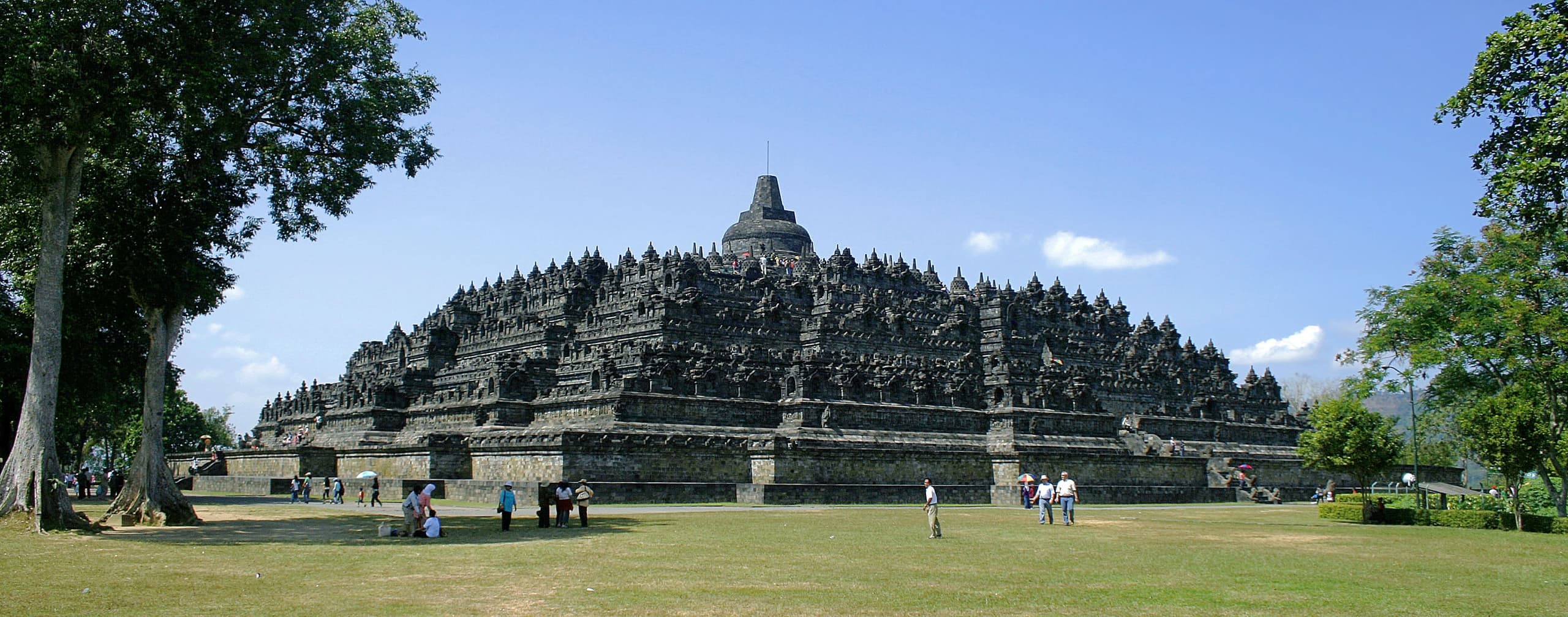
Borobudur is built as nine platforms stacked in a stepped pyramid, each terrace smaller than the one below. The lowest six are square; the upper three are circular. A central dome crowns the summit. The whole structure is faced in grey andesite, a volcanic stone, and the monument was constructed in the 9th century during the reign of the Sailendra dynasty in Central Java.
The design is not that of a temple with an interior. There is no chamber to enter, no enclosed sanctuary. Instead, the building is a path. A pilgrim begins at the base and walks clockwise around each terrace in turn, following a prescribed route that spirals upward. The walls and balustrades of the lower terraces are covered with relief panels — more than 2,600 in total — that tell stories in sequence. You read them as you walk, panel by panel, terrace by terrace, the narrative unfolding in a continuous band that wraps around the monument.
The subject matter of the reliefs varies by level. Some depict scenes from the life of the Buddha; others illustrate Mahayana Buddhist texts. The carvings are detailed and specific: figures in conversation, ships at sea, animals, trees, architectural settings. The style is narrative rather than symbolic. A viewer moving along the terrace sees cause and effect play out in stone, one episode following another.
Then, at the summit, the reliefs stop. The three circular terraces are bare of narrative. In place of the detailed panels, the upper levels hold rows of stupas — bell-shaped stone structures, each containing a Buddha statue. The stupas are perforated: you can see the figure inside through a lattice of openings, but you cannot reach it. The monument that began with a kilometre of specific storytelling ends in repetition and enclosure. The pilgrim who has climbed through detailed narrative arrives at a level where the decoration is lattice, sky and stone.
The architecture makes a deliberate argument. The path moves from the crowded, story-filled lower terraces to the sparse, open upper ones. The shift from narrative relief to empty space is not an accident of preservation or a change in plan. It is the structure of the monument. Borobudur was built to be walked as a progression from the detailed and worldly to the abstract and open, and the form of the building is the form of that progression.
The monument was abandoned at some point after the 14th century, following the decline of Buddhist kingdoms in Java and a shift toward Islam. It was not destroyed, but it was no longer maintained. Volcanic ash and jungle growth covered much of the structure. In 1814, during the British administration of Java, the site was brought to wider attention and clearing work began. Major restoration took place in the 20th century, with a large project completed in 1983 under Indonesian government and UNESCO coordination. The monument is now visited both as a pilgrimage site and as a historical structure.
Why it mattered then
Borobudur was constructed under the Sailendra dynasty, a power that controlled trade routes and sponsored Buddhist institutions. Building a monument of this scale required not only resources but also the technical knowledge to quarry, transport and carve andesite on a massive scale, and the political stability to see the project through. The result was both a pilgrimage site and a demonstration of dynastic authority. The monument's design reflects Mahayana Buddhist thought, in which the path to enlightenment is understood as a progression through stages. The lower terraces, dense with narrative, correspond to the world of form and story. The upper terraces, bare and repetitive, correspond to formlessness. A pilgrim walking the monument enacts that progression physically, moving from detailed representation to abstraction. The architecture does not merely house a ritual; it is the ritual. The act of circumambulation — walking clockwise around each level in turn — is itself the practice the monument was built to support. The reliefs also functioned as teaching texts. Many of the panels illustrate Buddhist scriptures, rendering complex theological ideas in visual narrative. For a pilgrim who could not read written texts, the stone carvings provided access to the stories and doctrines that structured religious life. The monument was a library in stone, and the path through it was a course of instruction.
Why it matters now
Borobudur remains an active pilgrimage site. Buddhists in Indonesia observe Vesak, the celebration of the Buddha's birth, enlightenment and death, at the monument, and the structure still functions as it was designed to: as a path walked in ritual sequence. The monument is not a relic of a vanished practice but a place where the practice continues. It is also a record of a maritime culture. The Sailendra dynasty's control of trade routes is visible in the relief carvings, which include detailed depictions of ships. These are not symbolic vessels but working craft, rendered with enough precision that historians have used them to study Javanese shipbuilding. The stone preserves knowledge that would otherwise be lost, and it does so in technical detail. The restoration history of Borobudur raises questions that apply to many large archaeological sites: how much intervention is required to keep a structure standing, and at what point does restoration become reconstruction? The 1983 project involved dismantling and reassembling large sections of the monument, replacing damaged stones and reinforcing the foundation. The work was necessary to prevent collapse, but it also means that much of what a visitor sees today is 20th-century stonework, cut and placed according to 9th-century logic. The monument is both ancient and modern, and the distinction between preservation and rebuilding is not always clear. Borobudur also stands as evidence of a Buddhist culture in a region that is now predominantly Muslim. The monument was not destroyed during Java's conversion to Islam; it was abandoned and then buried by natural processes. Its survival is partly a matter of geography and partly a matter of neglect. It was left alone long enough to be forgotten, and that neglect allowed it to endure.
The surprising detail
The monument was not excavated from beneath the earth in the way that, say, a buried city might be. It was covered by volcanic ash and overgrown with jungle, but the structure itself remained largely intact and visible as a hill. When clearing began in 1814, what emerged was not a ruin requiring reconstruction but a building that had been slowly encased in vegetation. The stone had weathered, and some statues and reliefs had been damaged or removed over the centuries, but the basic form of the monument — nine terraces, a central dome, a spiral path — was still there. Borobudur had survived not by being hidden but by being ignored, and the jungle had acted as a kind of unintentional preservative, holding the stones in place even as it obscured them.
What is disputed
The exact date of construction within the 9th century is not recorded in the available sources, nor are the specific rulers or architects responsible named. The reasons for the monument's abandonment after the 14th century are inferred from broader historical patterns — the decline of Hindu-Buddhist kingdoms and the spread of Islam in Java — rather than documented in records specific to Borobudur itself. The interpretation of the monument's design as a representation of the path to enlightenment is widely accepted but is a scholarly reading of the structure, not a description left by its builders.
Remember this
Borobudur is a path, not a building. The monument is the route through it, and the architecture is the argument that route makes.
Test yourself
Why does the shift from detailed narrative reliefs on the lower terraces to bare, perforated stupas on the upper terraces matter to the function of the monument?
Because the monument was designed to be walked as a physical enactment of spiritual progression. In Mahayana Buddhist thought, the path to enlightenment moves through stages, from engagement with the world of form and story toward formlessness and emptiness. The lower terraces, dense with narrative, represent the realm of earthly existence and detailed doctrine. The upper terraces, stripped of narrative and filled with repetitive, enclosed forms, represent a stage closer to enlightenment, where specific stories give way to abstraction. A pilgrim walking the monument does not simply observe this progression; the act of climbing from one level to the next is itself the practice. The architecture does not illustrate a teaching — it is the teaching, and the body moving through space is the method of instruction.
Go deeper
Image: Gunawan Kartapranata, CC BY-SA 3.0. Licence: CC BY-SA 3.0. Source.