III · THE WORK · ART HISTORY
Andrei Rublev's Trinity
▶ Listen · narrated
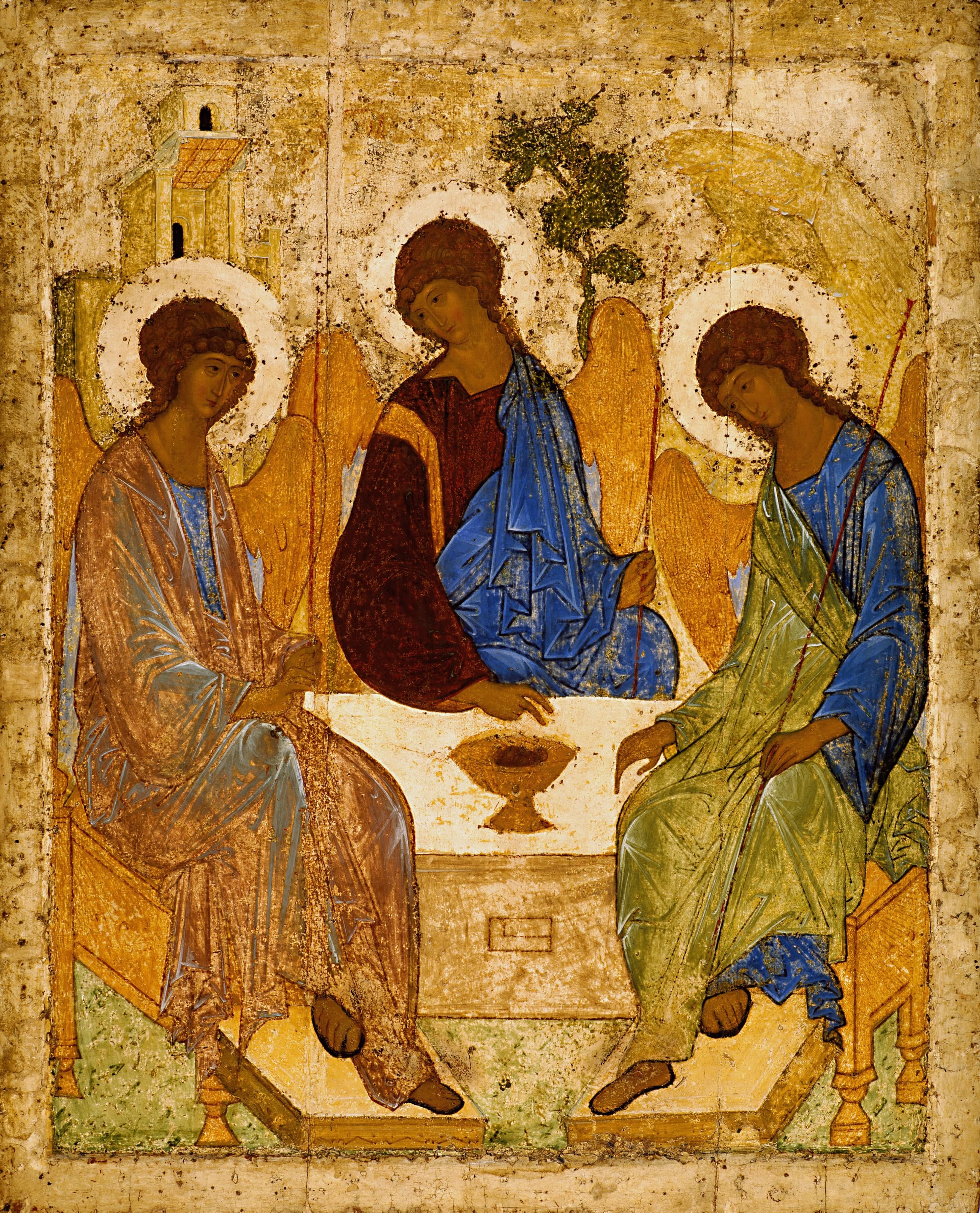
An icon painted in tempera on wood, showing three figures in a composition so carefully balanced that the empty space in front of them becomes part of the design.
At a glance
- Artist
- Andrei Rublev
- Date
- 1412 or 1420
- Material
- Egg tempera on wood
- Dimensions
- 141.5 × 114 cm
- Current location
- Old Katholikon of the Trinity Lavra
Look closer
The circle described by the three figures
The heads and shoulders of the three angels trace an invisible circle. Their staffs are parallel verticals, but their bodies lean inward, and the curve of their wings, the tilt of their heads, and the fall of their robes all follow the same arc. The circle is not drawn — it emerges from the arrangement of the figures themselves, a geometric fact that becomes visible only when you look at the composition as a whole rather than at any single angel.
The chalice on the table
A chalice sits at the centre of the table, and the two outer angels — left and right — bow their heads toward it in symmetry. Their postures mirror one another: the same incline, the same gesture. The chalice is small, but it sits at the exact centre of the composition, and the surrounding forms — the angels' bodies, the curve of the circle, the open space in front — all direct the eye toward it.
The open fourth side
Three angels sit around a table, but the fourth side is empty. There is no fourth figure, no fourth chair, no object blocking the view. The composition is symmetrical left to right, but the foreground is open, and the viewer stands in the space where a fourth presence might be. The circle closes only if you count the viewer's position as part of the geometry.
The story
The subject is the three angels who visited Abraham at the Oak of Mamre, an episode recorded in Genesis. Abraham saw three men approaching, offered them hospitality, and prepared a meal. The text does not explain who the visitors were, and Christian tradition has read the three figures as a manifestation of the Holy Trinity — three persons, one God.
Rublev painted three angels seated around a table. They are identical in form — same wings, same robes, same staffs — but each is distinguished by colour and posture. The central angel wears deep red and blue. The left angel inclines toward the centre. The right angel mirrors that inclination. Their heads are bowed toward a chalice on the table, which sits at the geometric centre of the composition.
The arrangement is circular. The three figures describe an arc with their bodies, and the curve is completed by the space in front of the table, where no fourth figure sits. The composition is symmetrical left to right, but the foreground is open. The viewer stands in that space, and the geometry of the icon pulls the eye inward, toward the chalice, and then outward again, to the empty fourth side.
The painting is in egg tempera on wood, a medium that dries quickly and cannot be blended once applied. Colours are built up in thin layers, and the surface remains matte. The gold background is flat, without depth or shadow. The faces are modelled in pale tones, with dark contour lines defining the features. The robes fall in stylised folds, and the wings are rendered as overlapping feathers in bands of colour.
The icon was painted for the Trinity Lavra of St. Sergius, a monastery near Moscow. The date is uncertain. The verified records give two possibilities: 1412 or 1420. Scholars have proposed other years, but the evidence is thin, and no consensus has settled the question. The icon was commissioned in honour of Saint Sergius of Radonezh, the monastery's founder, though the circumstances of the commission are not recorded.
What is known with more confidence is that Rublev painted it. Even that attribution rests on limited evidence — scholars consider this icon and frescoes in a cathedral in Vladimir to be the only two works that can be attributed to him with reasonable certainty. The icon itself carries no signature, and the historical record is sparse. But the attribution has held, and the icon is treated as Rublev's work.
The composition is read as an image of the Trinity, though the mechanism by which three identical angels represent three persons of one God is left implicit. The icon does not label the figures, and the symmetry resists hierarchy. The three are equal in form, and the circle they describe is continuous.
Why it mattered then
The icon was painted for a monastery dedicated to the Trinity, and the Trinity was understood at the time as an embodiment of spiritual unity. The monastery itself was a centre of religious and political life in medieval Russia, and Saint Sergius, in whose honour the icon was commissioned, was a figure of considerable authority. The icon was not a private devotional object but a public image, meant to be seen by the monastic community and by visitors to the monastery. The circular composition and the open fourth side are not decorative choices — they are theological ones. The Trinity was a difficult doctrine to represent visually, and earlier icons had shown the three angels with Abraham and Sarah, surrounded by the details of the Genesis narrative. Rublev removed the narrative. There is no Abraham, no Sarah, no oak tree, no servants preparing the meal. The table is bare except for the chalice. The setting is abstracted to gold. What remains is the three figures and the geometry that binds them. The open space in front of the table invites the viewer into the composition, and that invitation is itself a statement about the nature of the Trinity — not a closed system, not a remote mystery, but a presence that includes the observer. The icon does not explain this in words. It arranges the figures so that the geometry itself becomes the argument.
Why it matters now
The icon has been moved three times in recent years, each time under circumstances that have drawn public attention. It was kept at the Tretyakov Gallery from 1929 until 2022, when it was moved back to the Trinity Lavra of St. Sergius. In 2023 it was transferred to the Cathedral of Christ the Saviour in Moscow. In 2024 it was moved again, to the Old Katholikon of the Trinity Lavra. Curators have warned that moving the icon risks damaging it, as the tempera on wood requires precise temperature and humidity. The warnings have not stopped the moves. The question of where the icon should be kept is also a question of what it is for. Is it a work of art to be preserved under controlled conditions in a museum, or is it a religious object that belongs in a church, where it can be venerated? The icon was painted for a monastery, and it has returned to one, but the path between those two facts has been contested. The composition itself remains legible. The circle, the chalice, the open fourth side — these are visible in reproduction, and the icon has been studied and copied widely. But the surface of the tempera, the matte gold, the layered pigments — these are material facts that change when the object is moved, and they are not recoverable once damaged. The icon is both an image and an object, and the tension between those two identities is not resolved.
The surprising detail
Scholars consider this icon and frescoes in a cathedral in Vladimir to be the only two works that can be attributed to Rublev with reasonable certainty. Even for an icon this widely studied and reproduced, the authorship rests on limited evidence. The icon carries no signature, and the historical record does not name Rublev in connection with it in any surviving document from his lifetime. The attribution has held because the work is consistent with what is known of Rublev's style and because later tradition associates it with him, but the certainty is not documentary — it is inferential. For an object this central to the study of medieval Russian art, the thinness of the evidence is striking.
What is disputed
The date of the icon is uncertain. The verified records give 1412 or 1420, and scholars have proposed other years, including 1408–1425, 1422–1423, and 1420–1427. No documentary evidence settles the question. The attribution to Rublev is also inferential rather than documentary — no surviving text from his lifetime names him as the painter of this icon.
Remember this
Three angels arranged in a circle, with the fourth side left open for the viewer — theology made visible through geometry.
Test yourself
Why does removing Abraham, Sarah and the narrative details from the Genesis story make the icon more, rather than less, specific in what it represents?
Because the narrative details would identify the scene as a particular moment in time — three visitors arriving at Abraham's tent. By removing them, Rublev removes the historical frame and leaves only the three figures and the geometry that binds them. The composition no longer illustrates an episode; it represents a doctrine. The Trinity is not a story that happened once but a structure that is always present, and the circular arrangement, the symmetry, and the open fourth side make that structure visible. The fewer objects in the image, the more clearly the relationships between the figures emerge as the subject. The icon becomes less illustrative and more theological — not a picture of what the angels did, but an image of what the Trinity is.
Go deeper
Image: Andrei Rublev, Public domain. Licence: Public domain. Source.