I · THE OBJECT · BRITISH MUSEUM
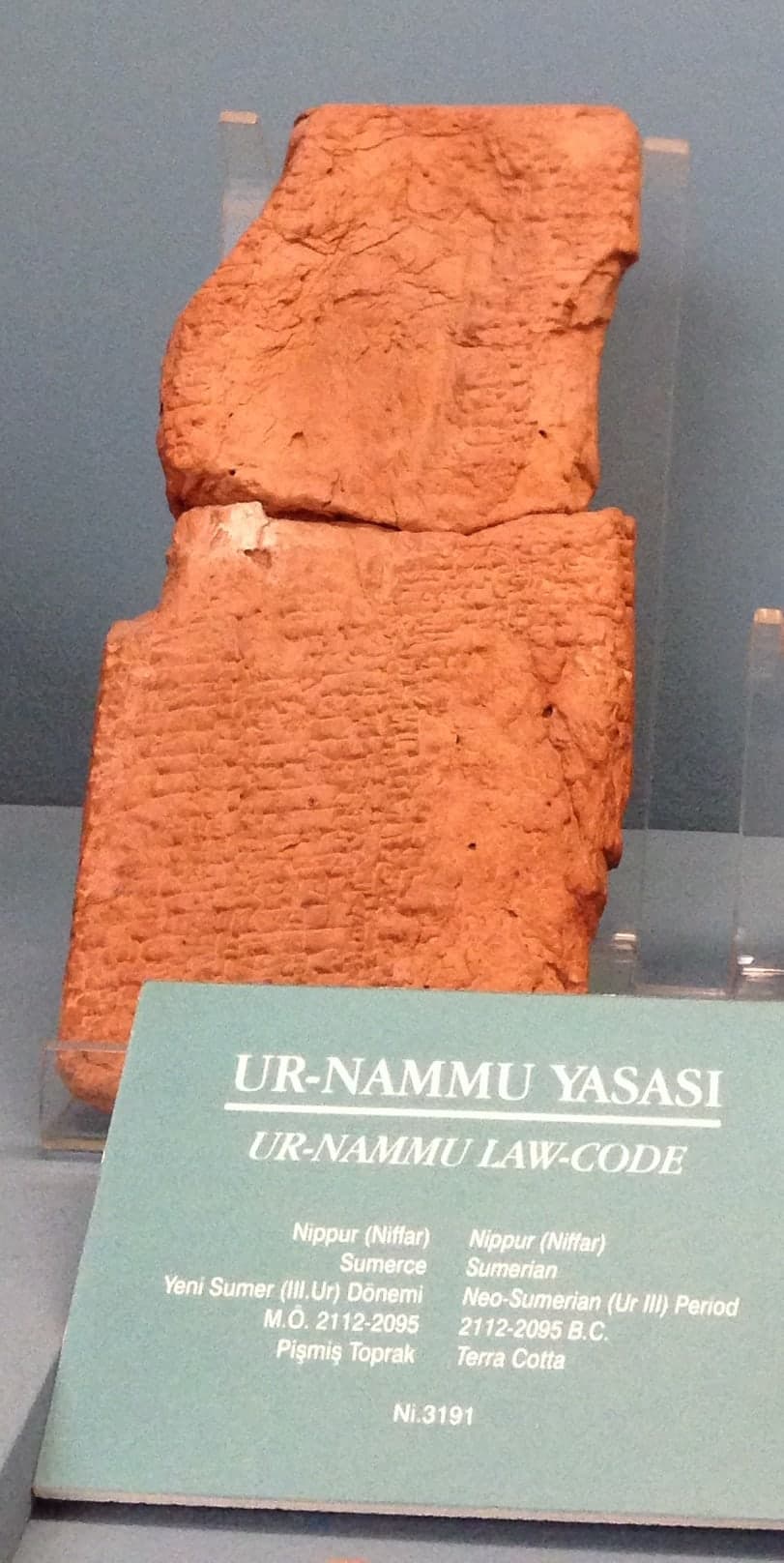
The Ur-Nammu Law Code Tablet
▶ Listen · narrated
Law becomes different when you write it down. These clay tablets hold some of the earliest surviving attempts to do exactly that.
At a glance
- Material
- Clay
- Culture
- Sumerian
- Findspot
- Ur
- Current location
- Istanbul Archaeology Museums
Look closer
The conditional structure
The clauses are written as paired statements: if a specific situation occurs, then a specific consequence follows. This 'if-then' pattern — the same logical form programmers now call a conditional — turns a judgment into something that can be stated in advance, consulted, and applied by someone other than the person who first made the decision. It separates the rule from the ruler.
Clay as medium
Wet clay takes an impression and then hardens into a permanent record. A scribe could press the text with a reed stylus, let it dry, and the tablet became a durable object that could be stored, moved, or copied. The material itself made law portable in a way that memory or oral proclamation could not be. If you wanted the same rules applied in two cities, you could send a tablet or commission a copy.
What the text includes
The surviving portions contain legal rules but also statements about royal authority and social priorities. One passage records the elimination of enmity, violence, and cries for justice. Others address the treatment of widows, orphans, and the poor. The tablets mix procedural law with declarations of what the state claims to have achieved or intends to protect.
The story
Law existed before writing, but it existed as memory, custom, and the judgment of whoever held authority at the moment a dispute arose. Writing changed that. When you press a rule into clay, you create an object that can be referred to later, that says the same thing tomorrow as it did today, and that can be carried to a place where the person who wrote it is not present.
These tablets from Ur are written in Sumerian and contain legal clauses structured as conditionals: if a man does X, then Y follows. That structure is significant. It describes a situation and prescribes a response in a form that does not require the original lawgiver to be in the room. Someone else — a judge, an official, a scribe — can read the rule and apply it. The law begins to separate from the person who made it.
The text is not purely procedural. Alongside the conditional clauses are statements of royal power and intent. One line records the elimination of enmity, violence, and cries for justice — a claim about what the state has accomplished. Other passages address the treatment of widows, orphans, and the poor, groups named as deserving protection or support. Whether these statements describe what actually happened or what the ruler wanted to be remembered for is a question the tablets do not answer. What they do show is that law, even in written form, was not only a set of rules but also a declaration of authority and values.
The tablets were found at Ur, a city in southern Mesopotamia. They are now held in the Istanbul Archaeology Museums. The surviving pieces are fragmentary, so the full scope of the code is not known. What remains shows a system in which specific situations — disputes, injuries, transactions — were anticipated and paired with specific outcomes. The logic is transactional: if this, then that. It is a way of managing complexity by breaking it into cases.
Writing law down does not make it fair, and it does not make it enforced. But it does make it checkable. A written rule can be consulted, disputed, or copied. It can be compared to what actually happens. That gap — between what the clay says and what people do — becomes visible in a way it was not before.
Why it mattered then
In a society where authority was personal — vested in a king, a priest, a local official — written law created a new kind of object: a text that claimed to apply regardless of who was reading it. That claim was not always honoured, but the existence of the claim mattered. It meant that someone could, in principle, point to the tablet and say: this is what was decided. For a ruler, written law was also a tool of projection. It allowed decisions made in one place to be enforced, or at least stated, somewhere else. It turned the king's voice into something that could travel without him. The declarations about eliminating violence and protecting widows were not just policy; they were also propaganda, a way of saying what kind of ruler this was and what kind of state this was meant to be. For scribes, the law code was work. It had to be copied, stored, and maintained. Scribes were the ones who made the system run, and their training included learning the forms and phrases that legal texts required. The 'if-then' structure was not natural language; it was a specialised format that had to be learned and reproduced. Law, in this sense, was already a technical practice.
Why it matters now
The conditional structure these tablets use — if X, then Y — is still the basic form of written law. Statutes, contracts, and regulations are built from it. The form works because it separates the rule from the situation, making it possible to state in advance what will happen if a condition is met. That separation is what makes law scalable. The tablets also show something about how information technology changes power. Writing did not make rulers unnecessary, but it did make their presence less essential to the application of their decisions. A written rule could be consulted by someone who had never met the person who made it. That shift — from authority embodied in a person to authority encoded in a text — is one of the things that made large, complex states possible. The gap between what is written and what happens remains. We still write laws that are not enforced, or enforced selectively, or interpreted in ways that contradict their stated purpose. The existence of a written rule does not guarantee its application. But it does create a standard against which application can be measured, and that measurability is one of the things writing makes possible.
The surprising detail
The tablets are fragmentary, and the full text has never been recovered in one piece. What survives comes from multiple copies, found in different locations, none of them complete. Scholars have reconstructed the code by comparing fragments, but there is no single authoritative version. The law code, in other words, is itself a reconstruction — an editorial product assembled from partial evidence. That makes it harder to know what the original scope was, or whether there even was a single original. It is possible that what we call a code was really a collection of texts that overlapped but were never meant to be identical.
What is disputed
The attribution to Ur-Nammu, a ruler of Ur, is based on references within the text, but some scholars have argued that the code may have been compiled or completed under his successor. The fragmentary state of the tablets makes it difficult to determine the original extent of the text or whether all surviving fragments belonged to a single version. The relationship between the surviving copies is also unclear: they may represent different editions or local adaptations rather than exact duplicates of a single master text.
Remember this
Writing law down turned it from a judgment into a document, from a voice into an object that could be copied, stored, and checked.
Test yourself
Why does the 'if-then' structure of these legal clauses make law more scalable than oral proclamation?
Because it separates the rule from the ruler. An oral proclamation requires the lawgiver to be present, or for someone to remember and faithfully repeat what was said. An 'if-then' clause written on a tablet states the condition and the consequence in a form that can be consulted later, by someone else, in a different place. It does not require memory or interpretation of tone or context — the rule is there in the text. That makes it possible to apply the same rule in multiple locations, or at multiple times, without the person who made the rule needing to be involved each time. It is a form of delegation encoded in syntax.
Go deeper
Image: Istanbul Archaeology Museums, CC0. Licence: CC0. Source.