III · THE WORK · ART HISTORY
The Dancing Girl of Mohenjo-daro
▶ Listen · narrated
She has been called a dancer since the day she was excavated, but the Indus Valley script is still undecoded and the pose could mean something else entirely.
At a glance
- Culture
- Indus Valley Civilisation
- Date
- Around 2500 BC
- Material
- Bronze, cast using the lost-wax method
- Height
- Approximately 10 centimetres
Look closer
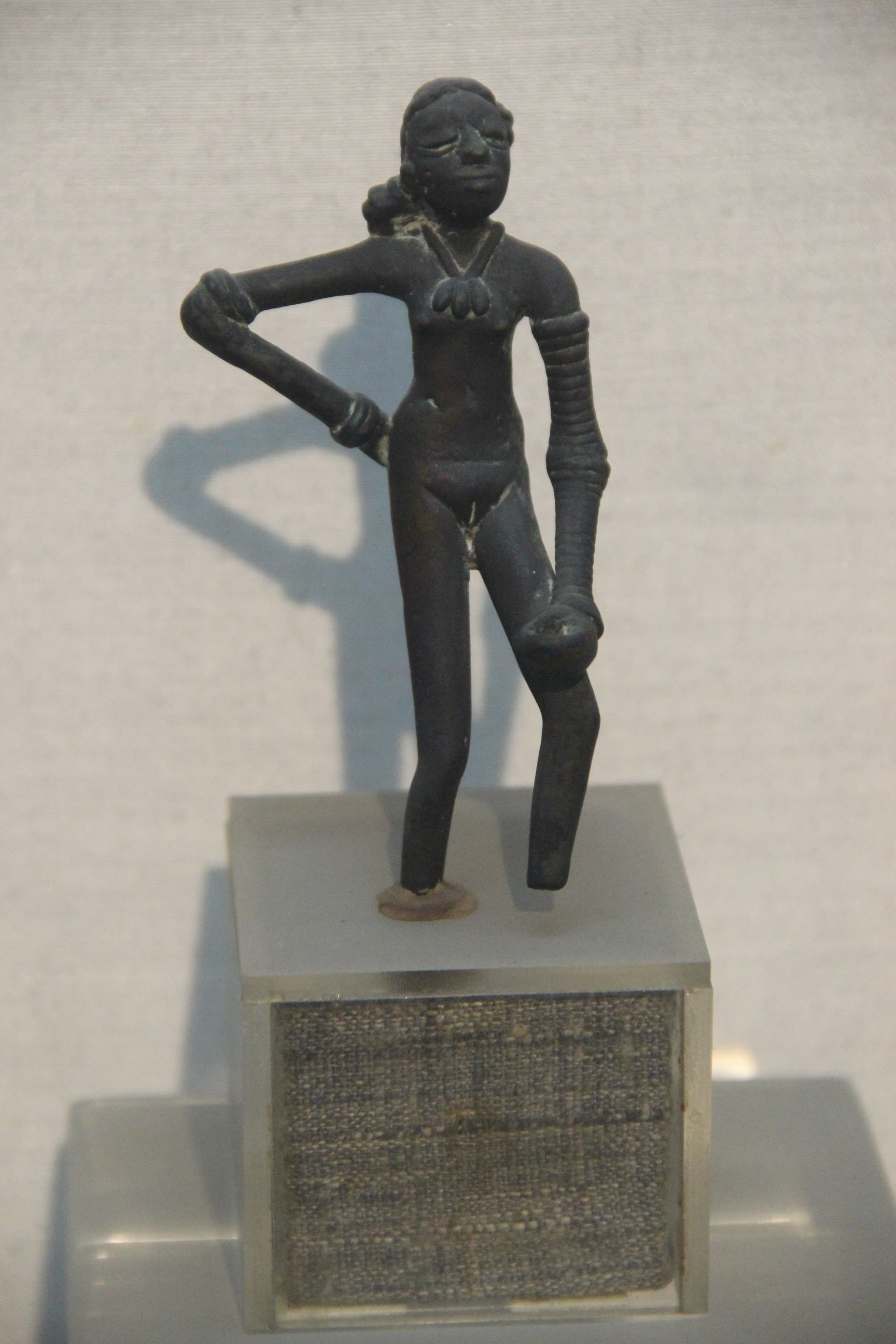
Bangles stacked the length of the left arm
The left arm carries what appears to be a dense stack of bangles running from wrist nearly to shoulder. They are rendered as a series of ridges in the bronze. The right arm is bare by comparison. Whether this asymmetry had a ceremonial meaning, marked a status, or was simply ornament, we cannot say — the Indus script that might have explained it remains undeciphered.
The relaxed, hip-shot stance
The figure stands with weight on one leg, the opposite hip pushed out, one hand on that hip. It is this posture — casual, confident, with the torso slightly turned — that suggested dance to the archaeologists who found her. But a hand on the hip can signal many things: rest, performance, authority, informality. Without text or context, the pose is open to interpretation.
Lost-wax casting seams and surface pitting
The surface shows the marks of the lost-wax process: seams where the mould sections met, small pits and irregularities in the metal. Lost-wax casting — in which a wax model is encased in clay, then melted out and replaced with molten bronze — allows fine detail but leaves these traces. The technique itself is evidence of sophisticated metalworking knowledge in the Indus Valley around 2500 BC.
The story
The figure is a bronze statuette, roughly ten centimetres tall, cast around 2500 BC in the Indus Valley Civilisation. She stands in a pose that has been called dance since her discovery: weight on one leg, the other knee bent, one hand resting on a jutting hip, the other hanging loose. The left arm is covered in what appear to be bangles from wrist to shoulder; the right is bare. The head is turned slightly, as though looking to one side.
The name Dancing Girl is an interpretation, not a translation. The Indus Valley script has not been deciphered. We have no texts that name her, describe her role, or explain the pose. The label comes from the archaeologists who excavated her, reading the stance as one of movement or performance. It may be correct. It may not. A hand on the hip, a shifted weight, a turned head — these can belong to dance, but also to rest, to waiting, to a dozen other postures we no longer recognise.
She was made using the lost-wax method. A model is carved in wax, encased in clay, then heated until the wax melts and runs out through channels. Molten bronze is poured into the hollow space left behind. When the clay is broken away, the bronze form remains. The process allows sharp detail — individual bangles, the curve of a hand — but it is also destructive. Each casting destroys the mould, and the wax original is gone. What survives is the metal impression.
The figure is small enough to hold in one hand. Bronze was not common in the Indus Valley at this date; stone and terracotta were far more usual. The choice of metal, and the skill required to cast it, suggest that this was not an everyday object. Whether it was a ritual figure, a portrait, a toy, or something else, we do not know.
What we do know is this: someone, four and a half thousand years ago, had access to bronze, to the knowledge of lost-wax casting, and to a tradition of representing the human figure in a relaxed, naturalistic pose. That much the object itself records. The rest is conjecture, however confident it sounds.
Why it mattered then
Bronze was a material that required resources and knowledge. Copper and tin do not occur together naturally; they must be sourced separately, transported, and alloyed in the correct proportions. Lost-wax casting demands both technical skill and an understanding of how wax, clay, and molten metal behave under heat. The existence of this figure tells us that the Indus Valley Civilisation had access to these materials, mastered these techniques, and used them to make small-scale representations of the human body. Whether the figure had a ritual function, marked a social role, or served another purpose we cannot now identify, it was made with care and kept. That it survived suggests it mattered.
Why it matters now
The figure is one of the few three-dimensional representations of a human form to survive from the Indus Valley Civilisation. Most of what remains from that culture is architecture, seals, pottery, and the undeciphered script. The statuette offers something rarer: a sense of how people were seen, or how they saw themselves. The pose is informal, the proportions are naturalistic, the details — bangles, the angle of the head — are specific. It is also a reminder of how much we do not know. The name Dancing Girl is a placeholder, a label applied in the absence of text. The pose might represent dance, or it might not. The figure might depict a person, a role, or an idea. Until the script is read, we are looking at an object whose meaning is partly lost.
The surprising detail
The figure has been called the Dancing Girl since its excavation, but the Indus Valley script remains undeciphered. We have no written record that tells us what the pose signified, whether it was meant to represent dance, or what role the figure played. The name is an interpretation based on the stance — a hand on the hip, a shifted weight — but without text, we cannot verify it. The label has stuck, but it may be wrong.
What is disputed
The name Dancing Girl is an interpretation, not a documented designation. The Indus Valley script has not been deciphered, so we have no written evidence for what the pose represented or what role the figure played. The label reflects how the stance appeared to the archaeologists who excavated her, but it remains unverified.
Remember this
A bronze figure from a culture whose script we cannot read, named for a pose we cannot confirm.
Test yourself
Why does the fact that the Indus Valley script is undeciphered matter more for interpreting this figure than it would for, say, a pot or a brick?
Because a pot or a brick has a function you can deduce from its form: one holds liquid, the other builds walls. The Dancing Girl has no such self-evident purpose. Her meaning depends entirely on context — what she represented, why she was made, what the pose signified — and that context would have been recorded, if anywhere, in the script we cannot read. Without it, we are left with the physical object and our own assumptions. The pose looks like dance to us, but that is a modern interpretation. The bangles might mark status, ritual, or fashion; we do not know. The figure is legible as bronze, as lost-wax casting, as a representation of a human form. What it meant to the people who made it is missing.